A Systematic Literature Review on Impacts of Financial Inclusion and Digital Banking on Economic Growth: The Mediating Role of Financial Institutions
An initial literature search across scholarly databases yielded 150 articles at the first stage.
142 documents
An initial literature search across scholarly databases yielded 150 articles at the first stage.
Deep-π* models trend inflation by mapping 122 macroeconomic indicators through neural networks into trend innovations, eliminating latent random-walk shocks and enabling exact Shapley attribution.
By end-2025, the global stablecoin market grew from approximately $25 billion in 2020 to over $300 billion.
The study analyzed data from a questionnaire distributed to 250 employees of commercial banks to evaluate the impact of financial information systems on financial sustainability.
The source material reports a dataset of 540 observations across Jalgaon district.
The document establishes a distinction between voluntary payment digitalisation and forced cashlessness, evaluating welfare trade-offs across financial inclusion, privacy, and system resilience.
China committed over $1.3 trillion in development finance to the Global South between 2000 and 2021.
In March 2024, the Central Bank of Nigeria launched a major regulatory overhaul in the Bureau De Change sector, revoking the licenses of over 4000 BDC operators to curb financial malfeasance.
Empirical analysis of post-war US data demonstrates that government spending shocks financed with short-term debt yield significantly higher output multipliers than those financed with long-term debt, typically exceeding unity under short-term financing.
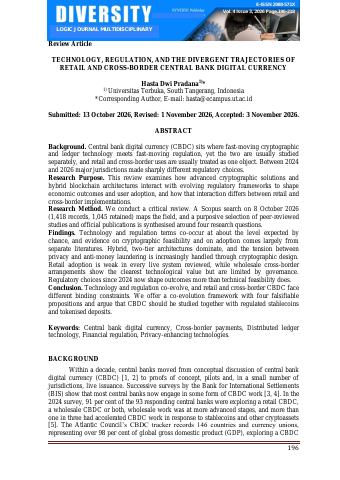
A Scopus bibliometric search conducted on 8 October 2026 retrieved 1,418 records, from which 1,045 were retained for critical analysis.
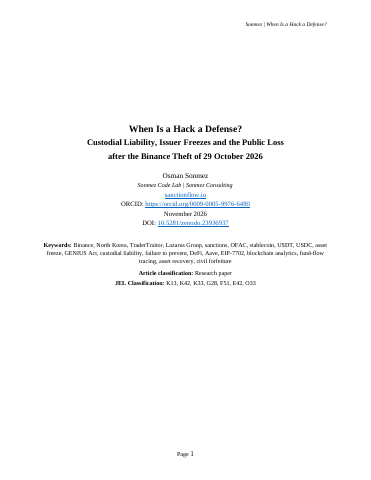
On 29 October 2026, about $6.36 billion was taken from Binance's hot wallets across ten blockchains.
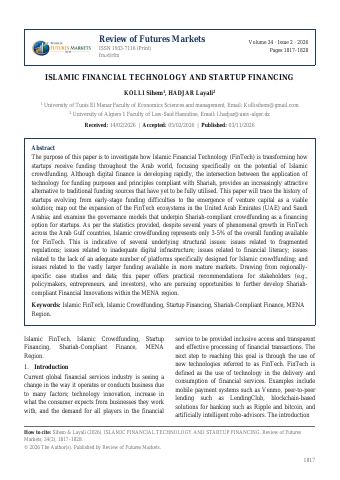
Islamic crowdfunding currently accounts for only 3-5% of total FinTech funding in the Arab Gulf region.
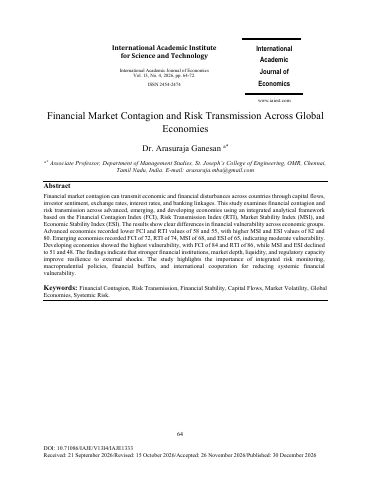
Advanced economies recorded lower vulnerability with a Financial Contagion Index (FCI) of 58 and a Risk Transmission Index (RTI) of 55.
In May 2022, the International Monetary Fund increased the RMB's weight in the Special Drawing Rights basket from 10.92% to 12.28%.
Expanding access to Tether's arbitrage mechanism reduced the absolute size of peg deviations by approximately one half.
Polish banks account for 4 out of the 40 global Digital Champions, defined as the top 10% of banks.
The authors construct an index tracking the European Central Bank's perception of non-bank financial intermediaries using 2,830 speeches delivered between July 1998 and June 2024.
In 2019, Federal Bureau of Investigation data recorded USD 1.424 billion in reported stolen currency and USD 36.981 million recovered relative to USD 1.7598 trillion of U.S. currency in circulation.
India's MSMEs generate 31.1% of GDP and 48.58% of exports, yet face an addressable credit gap of roughly ₹30 lakh crore.
Regulators actively enforced rules by blocking sixty-nine unlicensed loan applications in November 2024.
European Union Regulation (UE) 2023/1114 was enacted on 31 May 2023 to establish the MiCA framework for crypto-asset markets.
Transition economies across Eastern Europe, Central Asia, and Latin America face unique structural macroeconomic challenges, including currency substitution and weak monetary policy transmission.
Financial services contributors generated 1,260,883 commits to public GitHub repositories in 2026, representing a 63% increase year-over-year.
The empirical study analyzed Albania's digital banking ecosystem using quantitative data from a survey of 151 respondents and qualitative data from 15 semi-structured interviews.
Ethereum accounted for $12.3 billion of the $19.08 billion global market for tokenized real-world assets excluding stablecoins in early January 2026.
The Elliptic benchmark dataset contains roughly 204 thousand Bitcoin transactions linked by about 234 thousand payment-flow edges across 49 time steps.
Total Ukrainian banking sector net assets grew by 70.1% from UAH 2,352 billion in 2022 to UAH 4,001 billion in 2025.
The studied sample of five Moroccan commercial banks achieved an overall average digital maturity score of 3.48 out of 5.
The Securities Holdings Statistics by Sector (SHSS) dataset provides granular coverage generally above well 90 percent for each euro area country analyzed.
The EBA published its discussion paper on machine learning for IRB models under reference EBA/DP/2021/04 on 11 November 2021.