A Graph Neural Network Platform for Blockchain Anti-Money Laundering: A Literature Review and Proposed System Architecture (OpenAlex (recherche mondiale))
Summary
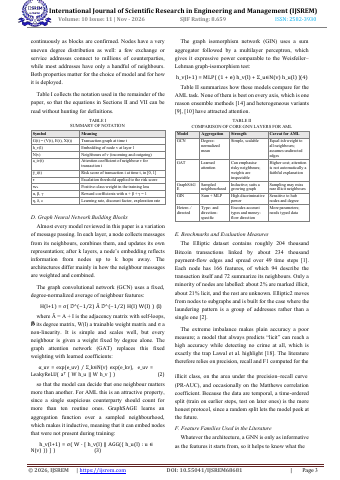
- The Elliptic benchmark dataset contains roughly 204 thousand Bitcoin transactions linked by about 234 thousand payment-flow edges across 49 time steps.p.3
- Extreme class imbalance in the Elliptic dataset leaves about 2% of nodes marked illicit and about 21% marked licit, with the rest unknown.p.3
- Standard GNN layers evaluated for money laundering detection include GCN, GAT, GraphSAGE, and GIN, each presenting distinct architectural tradeoffs.p.3
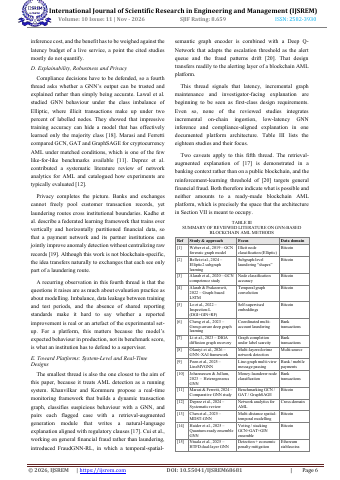
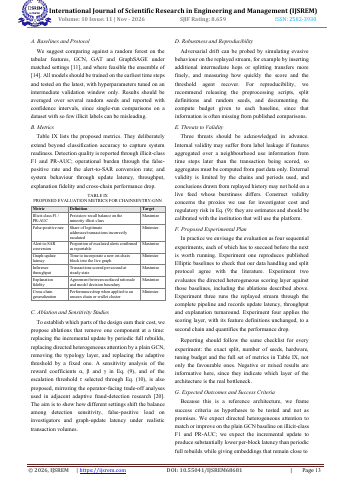
- Illicit transactions constitute under 2 percent of labelled nodes in the Elliptic benchmark, making raw overall accuracy a misleading evaluation metric.p.6
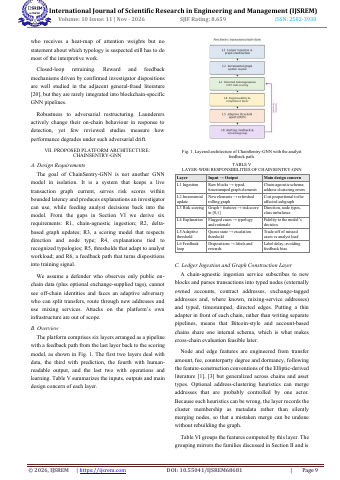
- The proposed ChainSentry-GNN architecture introduces a 6-layer reference design spanning ingestion, incremental updates, risk scoring, explainability, thresholding, and analyst feedback.p.9
Key insights
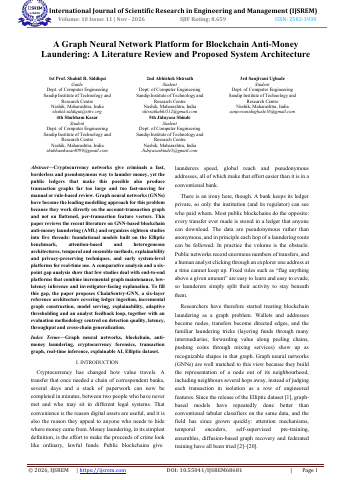
- Cryptocurrency networks allow criminals borderless speed and pseudonymity, generating transaction graphs too large for manual rule-based review.p.1
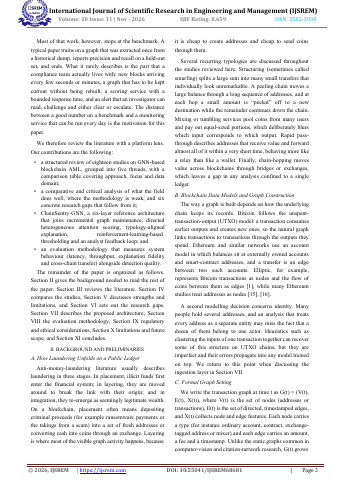
- Most existing GNN research evaluates models on static historical datasets rather than addressing continuous real-time block ingestion requirements.p.2
- Graph neural networks capture laundering patterns like peeling chains and mixing services because these typologies manifest as recognizable structural shapes.p.1
- Traditional fixed-rule monitoring systems are easily evaded by launderers who split transfers to remain under reporting thresholds.p.1
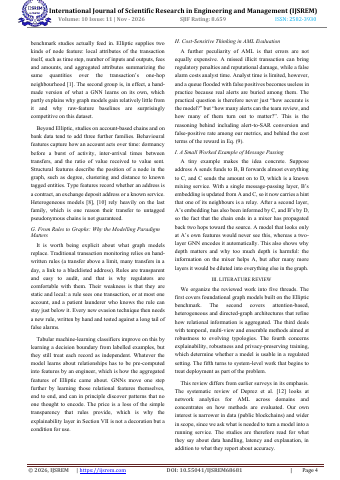
- Models incorporating transaction direction and node heterogeneity achieve superior financial crime detection compared to homogeneous graphs.p.5
- Evaluating AML platforms requires accounting for operational analyst costs, alert-to-SAR conversion rates, and false positive overheads.p.4
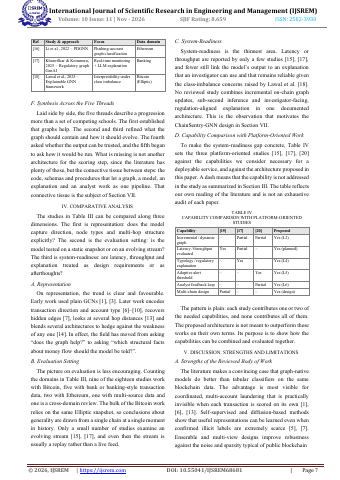
- None of the reviewed literature integrates incremental graph maintenance, sub-second scoring, and investigator-aligned explanations into one unified platform design.p.7
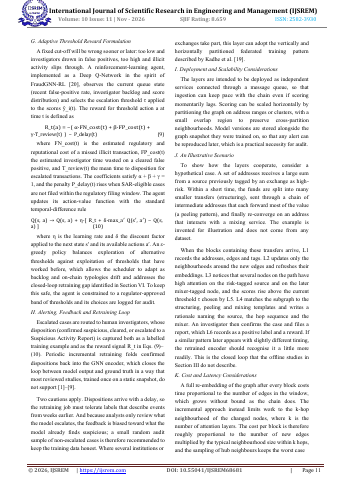
- Deep Q-Network reinforcement learning can dynamically tune risk escalation thresholds based on alert backlog and potential non-filing penalties.p.11
Pages
 p.1
 p.2
 p.3
 p.4
 p.5
 p.6
 p.7
 p.8
 p.9
 p.10
 p.11
 p.12
 p.13
 p.14
 p.15
Topics and entities
Summary and figures generated from the document and checked automatically: every number shown appears on the cited page. Publishers can request removal.