Fintech Investment and Innovation in African Financial Services: Trends and Drivers
The article was submitted on 29 July 2026, accepted on 15 November 2026, and published on 25 December 2026.
142 documents
The article was submitted on 29 July 2026, accepted on 15 November 2026, and published on 25 December 2026.
SMEs represent about 90% of businesses and more than 50% of employment worldwide.
A quantitative study surveyed 200 digital channel users using structural equation modeling (PLS-SEM) to analyze barriers to internet banking adoption.
In 2025, 86.5 per cent of Bulgarians aged 16 to 74 used the internet regularly, while internet banking usage remained significantly lower at 31.1 per cent.
Amazon executed a $200M acquisition of BNPL lender Axio in early 2025 to expand into Indian digital lending.
During FY 2024–25, IPPB operated more than 1.64 lakh banking access points and 649 banking outlets across the country.
In June 2020, UPI recorded more than 1.34 billion transactions amounting to almost US$35 billion.
The study gathers primary data using a structured questionnaire administered to a sample size of 100 respondents from MSMEs.
The study analyzed data from an online survey of 355 university students aged 15–25 with prior digital banking experience in Malaysia.
At year-end 2023, OECD countries held $63.1 trillion of assets earmarked for retirement, almost equal to their annual GDP.
A textual analysis of more than 5,000 U.S. SEC filings from 2020 to 2025 indicates that AI washing may satisfy Rule 10b-5 materiality and scienter requirements when corporate representations diverge from operational reality.
Artificial intelligence adoption in fintech enhances operational speed in credit scoring, insurance risk assessment, and fraud detection, but creates algorithmic opacity known as the black box dilemma.
South Africa was removed from the Financial Action Task Force list of jurisdictions under increased monitoring on 24 October 2025 following statutory reforms.
Data were collected from 200 micro culinary enterprises in Indonesia that actively use QRIS in daily transactions.
According to international surveys by the Bank for International Settlements, about 70% of financial sector companies use AI for cash flow forecasting and risk assessment.
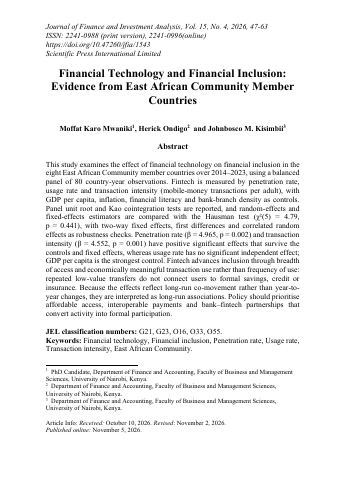
The study investigates the impact of financial technology on financial inclusion across 8 East African Community countries over the period 2014–2023 using a panel of 80 country-year observations.
Asset tokenization serves as a digital financing mechanism converting real asset rights into blockchain-based tokens (page 2).
Cross-Border Interbank Payment System (CIPS) daily usage was reported at about $60 billion compared to about $1,800 billion a day for CHIPS, with about 80 percent of CIPS payments still using Swift messaging.
SWIFT diffusion among nearly 7,000 banks demonstrated that profitability benefits materialized only after several years of adoption.
The World Bank Firm Adoption of Technology Survey analytical dataset for India comprises 1,519 establishments and 987 variables.
Between 1 January 2021 and 1 January 2026, total banking assets in Uzbekistan grew from UZS 366.1 trillion to UZS 925.0 trillion, achieving a compound annual growth rate of 20.4 percent.
The Bangladesh Financial Intelligence Unit received 17,345 STR/SAR reports in FY2023–24, consisting of 11,736 STRs and 5,609 SARs.
The PayQRIS system achieved a System Usability Scale (SUS) score of 83.25, indicating high usability.
Primary data was gathered from 2,168 investors, fintech users, and financial professionals across seven Arab countries to evaluate regional digital transformation.
The research article published in Vol. 2 No. 4 (2026) develops a theoretical risk-return framework to evaluate Islamic microfinance institutions in the post-digital transformation era.
As of January 1, 2025, the total number of users of remote banking service systems in Uzbekistan reached 52,917,166, comprising 51,455,447 individuals and 1,461,719 legal entities and individual entrepreneurs.
The source material reports a dataset of 540 observations across Jalgaon district.
In March 2024, the Central Bank of Nigeria launched a major regulatory overhaul in the Bureau De Change sector, revoking the licenses of over 4000 BDC operators to curb financial malfeasance.
The report analyzes gender gaps in financial knowledge and behaviour across 20 EU Member States using 2022 OECD/INFE survey data.
An initial literature search across scholarly databases yielded 150 articles at the first stage.