Regulatory Reforms in Nigeria's Bureau De Change Sector and Exchange Rate Stability: Assessing the Role of the Central Bank of Nigeria (OpenAlex (recherche mondiale))
Summary
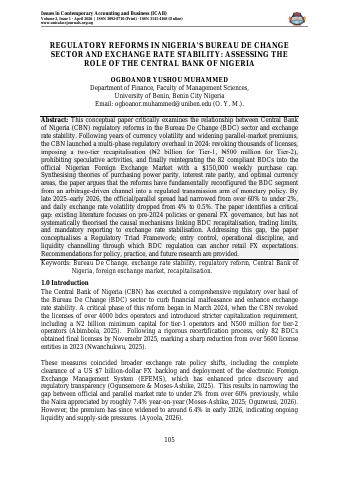
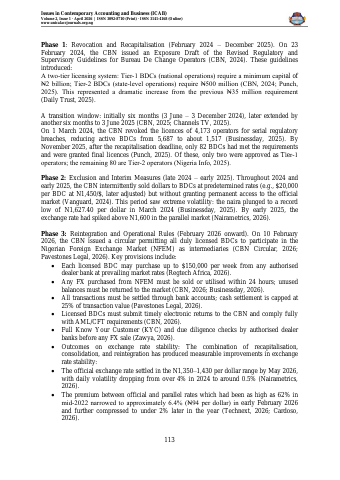
- In March 2024, the Central Bank of Nigeria launched a major regulatory overhaul in the Bureau De Change sector, revoking the licenses of over 4000 BDC operators to curb financial malfeasance.p.1
- The CBN established a two-tier recapitalisation framework requiring ₦2 billion for Tier-1 operators and ₦500 million for Tier-2 operators.p.1
- Following a recertification process, the total number of licensed BDCs dropped from over 5600 entities in 2023 to only 82 by November 2025.p.1
- Reintegrated BDCs were granted access to the official Nigerian Foreign Exchange Market subject to a $150,000 weekly purchase cap.p.1
- The regulatory measures coincided with the clearance of a US $7 billion FX backlog and deployment of the electronic Foreign Exchange Management System.p.1
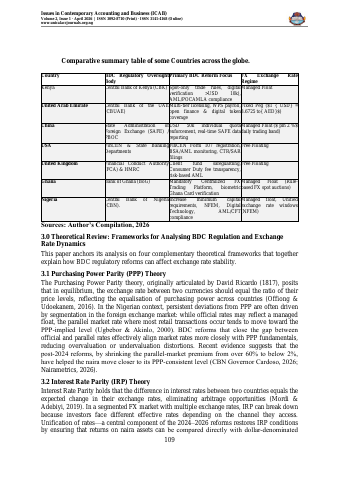
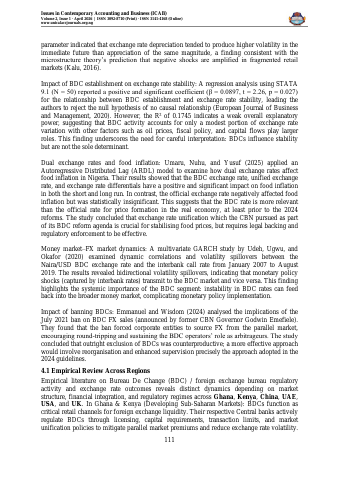
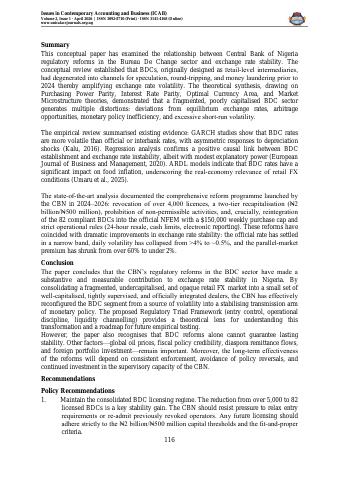
- Following reforms, the spread between official and parallel market rates narrowed from over 60% to under 2%, while daily exchange rate volatility fell from 4% to 0.5%.p.1
Key insights
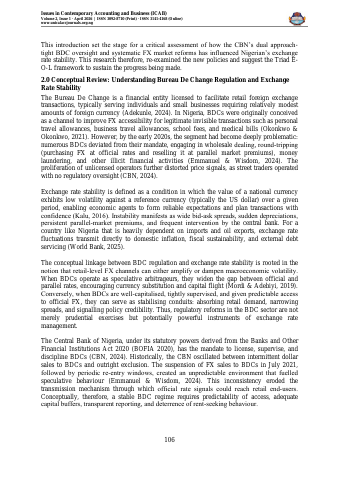
- Historical inconsistency in central bank dollar allocations to BDCs created market unpredictability and encouraged speculative arbitrage.p.2
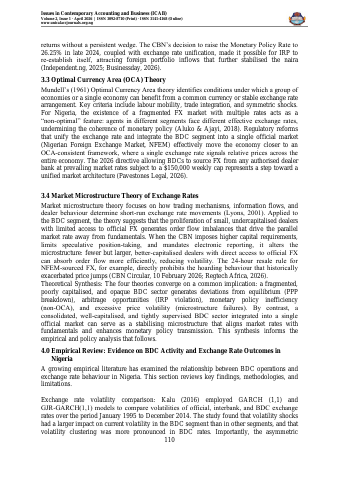
- Raising the Monetary Policy Rate to 26.25% in late 2024 alongside rate unification helped restore Interest Rate Parity conditions and attract portfolio inflows.p.6
- The CBN enforced a 24-hour resale rule requiring BDCs to sell or return official market FX within 24 hours to prevent speculative currency hoarding.p.6
- Out of the 82 BDCs approved by November 2025, only two qualified as Tier-1 national operators while 80 were approved as Tier-2 operators.p.9
- By May 2026, the official exchange rate settled in the ₦1,350–1,430 per dollar range, demonstrating reduced daily volatility.p.9
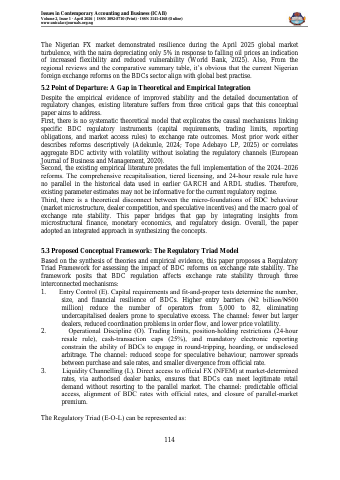
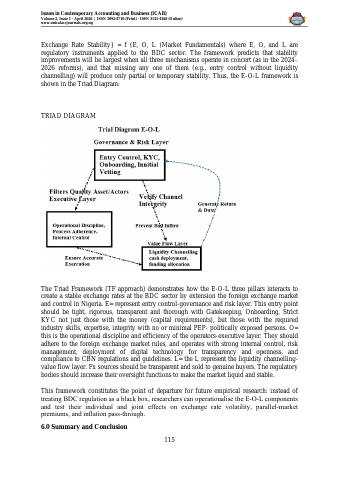
- The proposed Regulatory Triad Framework models BDC impact on stability across three mechanisms: Entry Control, Operational Discipline, and Liquidity Channelling.p.10
Pages
 p.1
 p.2
 p.3
 p.4
 p.5
 p.6
 p.7
 p.8
 p.9
 p.10
 p.11
 p.12
 p.13
 p.14
 p.15
 p.16
 p.17
Topics and entities
Summary and figures generated from the document and checked automatically: every number shown appears on the cited page. Publishers can request removal.