Examining SME Owners' Willingness to Submit Personal and Business Documents as a Proxy for Trust and Creditworthiness: The Psychological Collateral Paradigm (OpenAlex (recherche mondiale))
Summary
- SMEs represent about 90% of businesses and more than 50% of employment worldwide.p.2
- Formal SMEs contribute up to 40% of national income (GDP) in emerging economies and create 7 out of 10 formal jobs.p.2
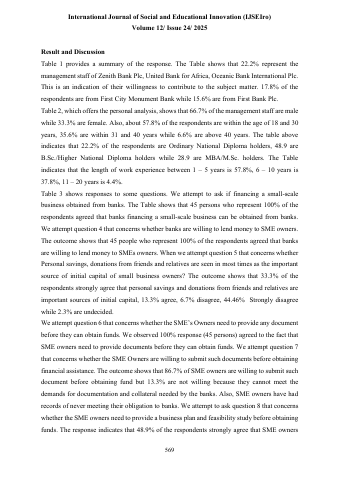
- All 45 bank management staff surveyed (100%) agreed that small-scale business financing can be obtained from banks and that banks are willing to lend to SME owners.p.5
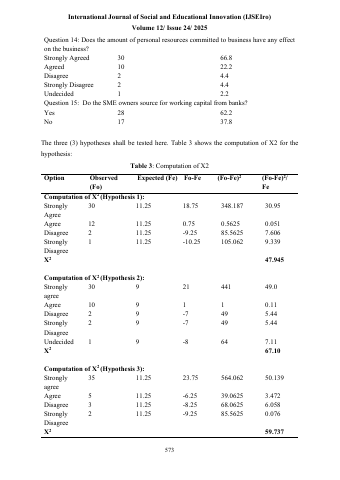
- While 86.7% of SME owners are willing to submit required documentation to banks, 13.3% are unwilling due to an inability to meet documentation and collateral demands.p.5
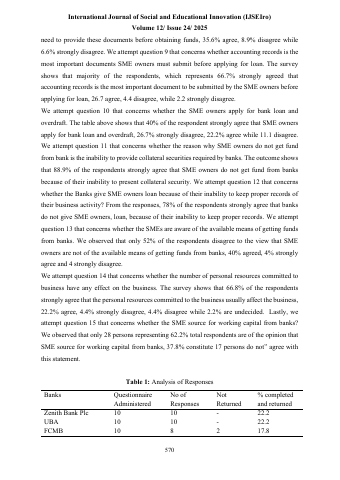
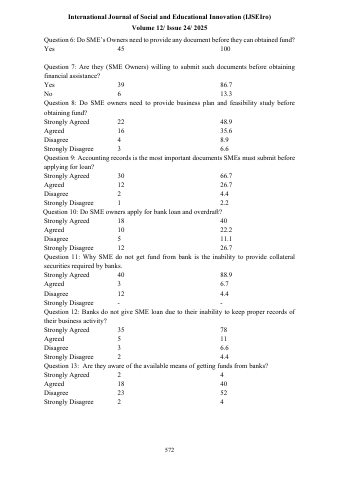
- A majority of 66.7% of bank management respondents strongly agreed that accounting records are the most important document SMEs must submit before applying for a loan.p.6
- Inability to provide collateral securities is strongly agreed by 88.9% of bank respondents as the primary reason SMEs fail to obtain bank funding.p.6
- A total of 78% of bank respondents strongly agreed that banks refrain from lending to SMEs due to the business owners' inability to keep proper records.p.6
Key insights
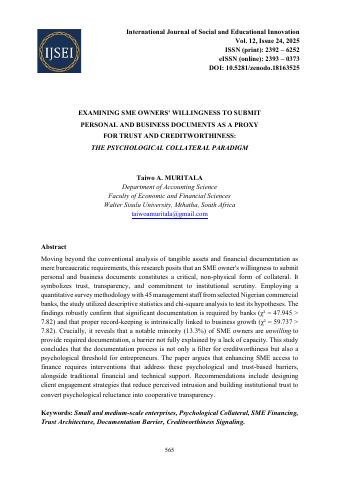
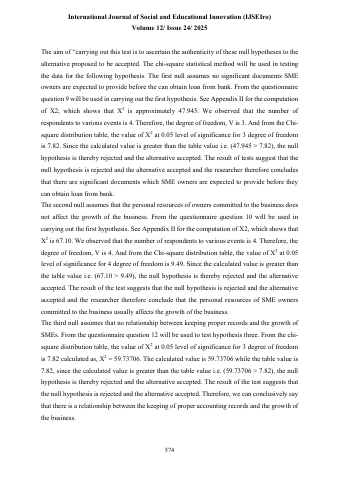
- Empirical analysis confirms that banks require significant documentation from SMEs prior to granting credit (χ² = 47.945 > 7.82).p.1
- Statistical testing demonstrates that proper record-keeping by SMEs is intrinsically linked to business growth (χ² = 59.737 > 7.82).p.1
- The SMIEIS scheme adopted in Nigeria mandated that 10% of bank profit before taxes (PBT) be set aside for SME equity investments.p.3
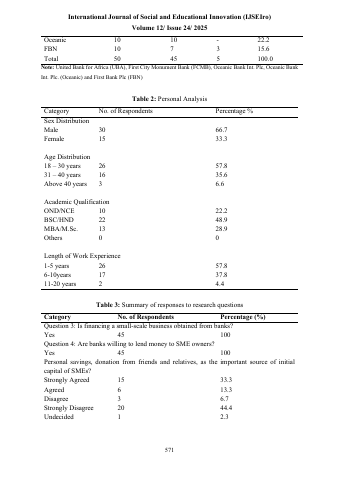
- Demographic survey data shows that 57.8% of participating bank management respondents were between 18 and 30 years of age.p.5
- Exactly 48.9% of respondents strongly agreed that SME owners must provide a business plan and feasibility study prior to securing funds.p.5
- A total of 52% of bank staff respondents disagreed with the premise that SME owners are unaware of available bank funding avenues.p.6
- Survey results show that 62.2% of respondents confirmed SME owners source working capital from commercial banks.p.6
- Chi-square testing confirms that personal resources committed by owners directly affect SME business growth (χ² = 67.10 > 9.49).p.10
Pages
 p.1
 p.2
 p.3
 p.4
 p.5
 p.6
 p.7
 p.8
 p.9
 p.10
 p.11
 p.12
 p.13
 p.14
Topics and entities
Summary and figures generated from the document and checked automatically: every number shown appears on the cited page. Publishers can request removal.