Risk Return Dynamics and Portfolio Performance of Islamic Microfinance Institutions: Evidence from Post-Digital Transformation Era (OpenAlex (recherche mondiale))
Summary
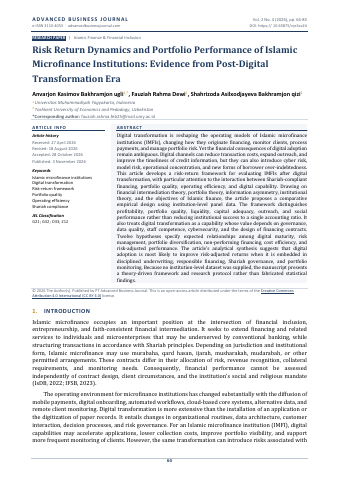
- The research article published in Vol. 2 No. 4 (2026) develops a theoretical risk-return framework to evaluate Islamic microfinance institutions in the post-digital transformation era.p.1
- The study outlines 12 core hypotheses to specify theoretical relationships among digital maturity, risk management, cost efficiency, and risk-adjusted performance.p.1
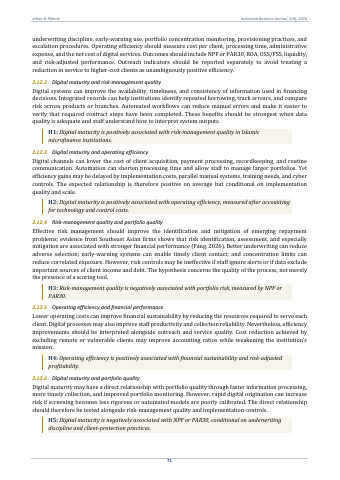
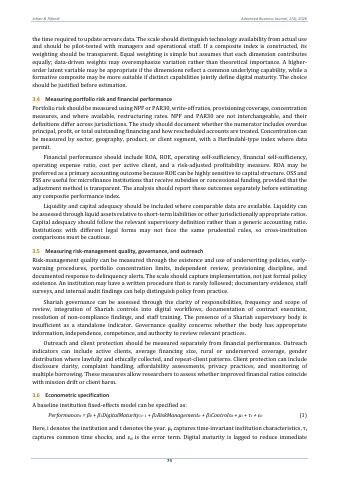
- Hypothesis H3 specifies that risk-management quality is negatively associated with portfolio risk measured by NPF or PAR30.p.8
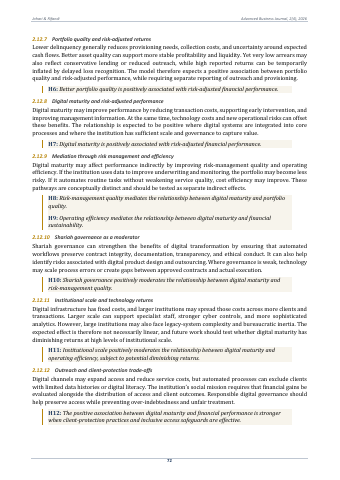
- Hypothesis H6 posits that better portfolio quality is positively associated with risk-adjusted financial performance.p.9
- Hypothesis H11 states that institutional scale positively moderates the relationship between digital maturity and operating efficiency, subject to potential diminishing returns.p.9
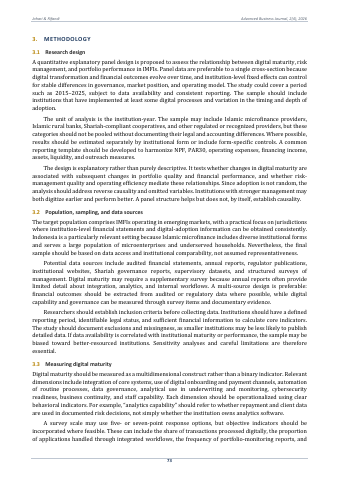
- The methodology proposes an empirical panel data research design covering an institution-year observation period such as 2015–2025.p.10
Key insights
- Digital maturity is positively associated with risk-management quality in Islamic microfinance institutions.p.8
- Digital maturity is positively associated with operating efficiency when measured after accounting for technology and control costs.p.8
- Risk-management quality is negatively associated with portfolio risk as measured by non-performing financing or portfolio-at-risk over 30 days.p.8
- Operating efficiency is positively associated with financial sustainability and risk-adjusted profitability.p.8
- Risk-management quality mediates the relationship between digital maturity and portfolio quality.p.9
- Shariah governance positively moderates the relationship between digital maturity and risk-management quality.p.9
- Institutional scale positively moderates the relationship between digital maturity and operating efficiency, subject to diminishing returns at high scale.p.9
- The positive association between digital maturity and financial performance is stronger when client-protection practices and inclusive access safeguards are effective.p.9
Pages
 p.1
 p.2
 p.3
 p.4
 p.5
 p.6
 p.7
 p.8
 p.9
 p.10
 p.11
 p.12
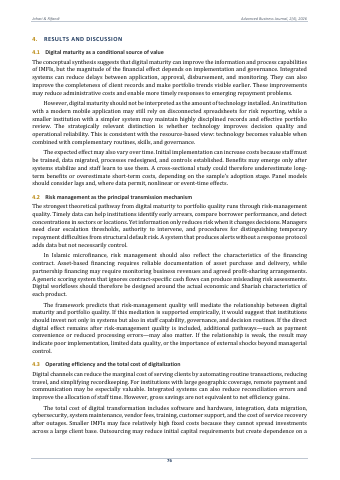 p.13
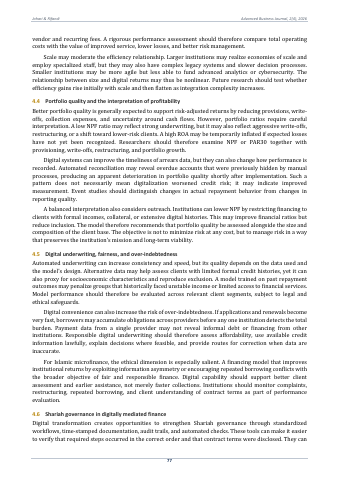 p.14
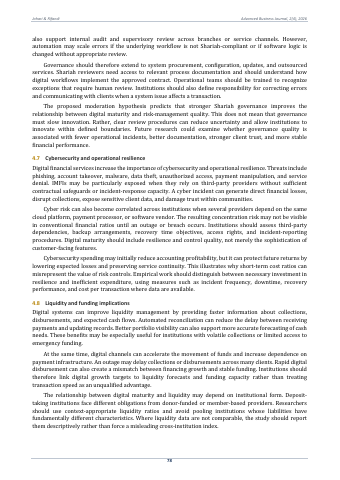 p.15
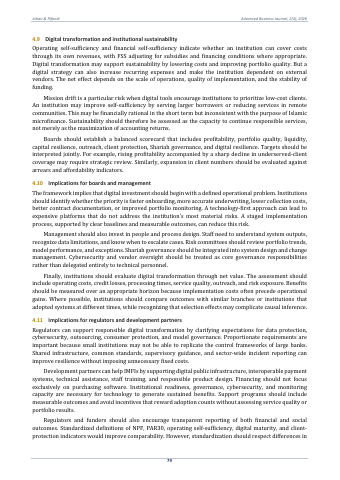 p.16
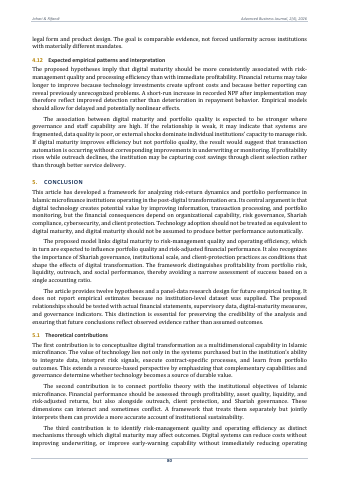 p.17
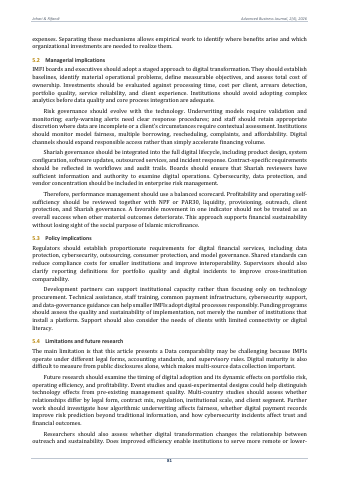 p.18
 p.19
 p.20
Topics and entities
Summary and figures generated from the document and checked automatically: every number shown appears on the cited page. Publishers can request removal.