Unified Payment Interface: Towards Greater Cyber Sovereignty
In June 2020, UPI recorded more than 1.34 billion transactions amounting to almost US$35 billion.
29 documents
In June 2020, UPI recorded more than 1.34 billion transactions amounting to almost US$35 billion.
The study gathers primary data using a structured questionnaire administered to a sample size of 100 respondents from MSMEs.
The research article published in Vol. 2 No. 4 (2026) develops a theoretical risk-return framework to evaluate Islamic microfinance institutions in the post-digital transformation era.
As of January 1, 2025, the total number of users of remote banking service systems in Uzbekistan reached 52,917,166, comprising 51,455,447 individuals and 1,461,719 legal entities and individual entrepreneurs.
According to international surveys by the Bank for International Settlements, about 70% of financial sector companies use AI for cash flow forecasting and risk assessment.
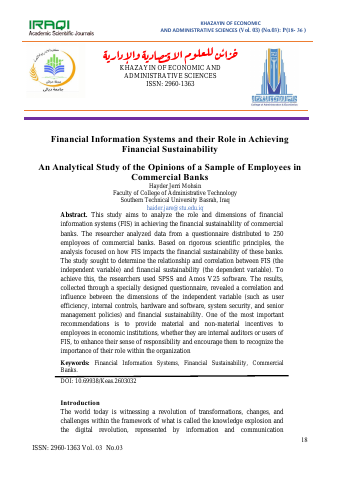
The study analyzed data from a questionnaire distributed to 250 employees of commercial banks to evaluate the impact of financial information systems on financial sustainability.
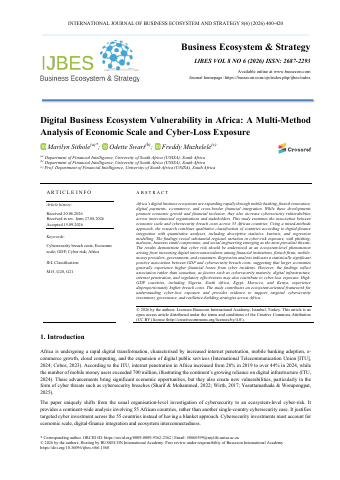
Internet penetration in Africa rose from 28% in 2019 to over 44% in 2024, while mobile money users surpassed 700 million.
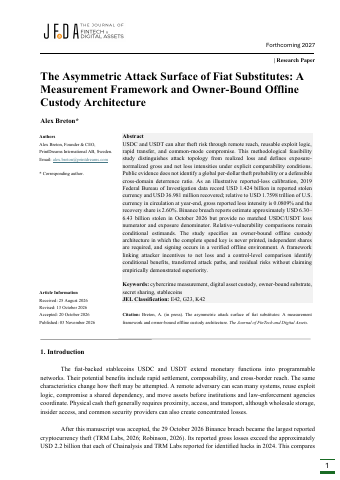
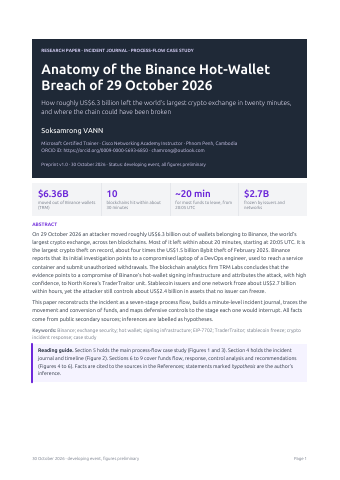
On 29 October 2026, about $6.36 billion was taken from Binance's hot wallets across ten blockchains.
The 29 October 2026 Binance incident resulted in an estimated USD 6.3 billion in unauthorized hot-wallet outflows with initial findings showing no evidence of a private-key leak.
In 2019, Federal Bureau of Investigation data recorded USD 1.424 billion in reported stolen currency and USD 36.981 million recovered relative to USD 1.7598 trillion of U.S. currency in circulation.
An attacker moved roughly US$6.3 billion out of Binance wallets across ten blockchains, with most funds leaving within about 20 minutes starting at 20:05 UTC on 29 October 2026.
Financial services contributors generated 1,260,883 commits to public GitHub repositories in 2026, representing a 63% increase year-over-year.
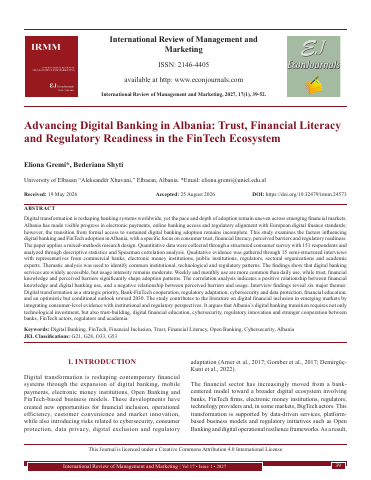
The empirical study analyzed Albania's digital banking ecosystem using quantitative data from a survey of 151 respondents and qualitative data from 15 semi-structured interviews.
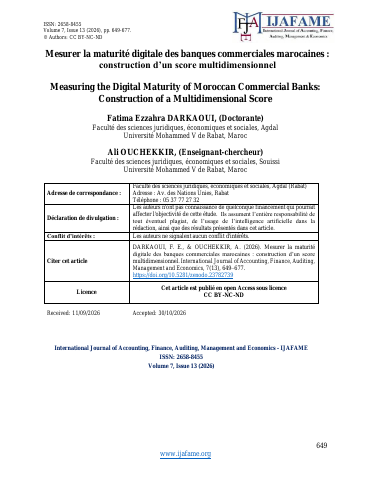
The studied sample of five Moroccan commercial banks achieved an overall average digital maturity score of 3.48 out of 5.
Total Ukrainian banking sector net assets grew by 70.1% from UAH 2,352 billion in 2022 to UAH 4,001 billion in 2025.
A non-probability sample of 249 digitally engaged retail investors in Vietnam was evaluated using PLS-SEM with 5,000 bootstrap subsamples.
The study analyzes a bibliometric dataset of 695 English-language Scopus records published between 2023 and 2025 to map the intellectual structure of GenAI in finance.
The Financial Stability Board (FSB) identified 12 sound practices to help all financial institutions realise the benefits of AI while managing its risks responsibly.
According to KPMG, 71% of surveyed financial firms have deployed AI tools, with global banking sector AI spending estimated at USD 31.3 billion in 2024.
The report presents findings from 307 family offices across more than 30 markets worldwide, with an average net worth of USD 2.7 billion.
Deloitte interviewed 35 decision makers, including COOs, CTOs, and heads of transformation at wealth management firms globally.
Over 1 billion people currently live in Fragile and Conflict-Affected States, where payment ecosystem disruptions present severe risks to economic stability.
In a 2023 BIS survey, almost all surveyed central banks reported considering offline CBDC payments to be vital or advantageous.
Only 24% of surveyed banks report being highly successful in achieving their cost reduction goals.
Over 100 central banks around the globe are exploring central bank digital currencies to modernize payment systems.
Central banks must develop a long-term vision for monetary and payment systems spanning a time horizon of at least 5 to 10 years as economic digitalization accelerates.
ChatGPT acquired more than 100 million active users within two months of its launch on November 30, 2022.
In March 2023, the European Commission committed to reducing reporting requirements by 25% to reduce red tape and strengthen European competitiveness.
The IMF note examines the institutional frameworks for fintech regulation and supervision across 10 selected jurisdictions.