Artificial Intelligence in the Financial Sector of the Global Economy: Implementation Directions and Financial Stability Risks (OpenAlex (recherche mondiale))
Summary
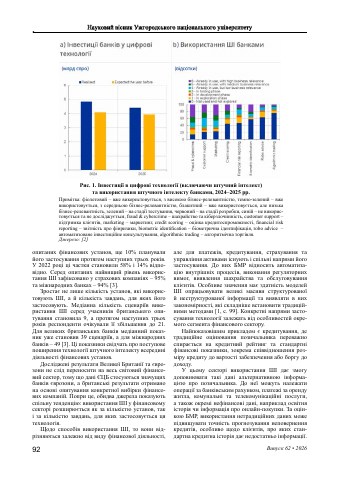
- According to international surveys by the Bank for International Settlements, about 70% of financial sector companies use AI for cash flow forecasting and risk assessment.p.2
- In 2025, nearly 90% of significant euro area banks utilized AI technologies, with over 50% applying them for fraud and cybercrime detection.p.2
- A UK survey recorded an AI adoption rate of 95% among insurance companies and 94% among international banks.p.3
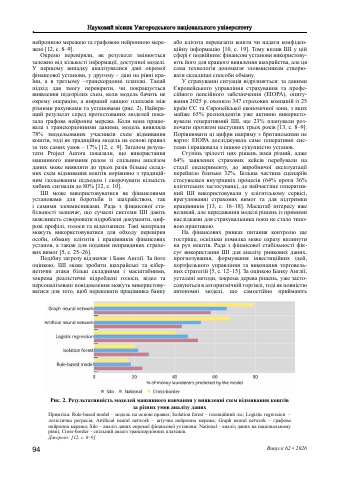
- Testing in Project Aurora demonstrated that graph neural networks using cross-border data detected 78% of simulated money laundering scheme participants compared to 17% for traditional rule-based models.p.5
- An EIOPA survey of 347 insurance companies found that almost 65% were actively using generative AI, while 23% planned adoption within three years.p.5
- In UK financial services, supplier concentration is high, with the top three providers accounting for 73% of cloud services, 44% of AI model providers, and 33% of data providers.p.6
Key insights
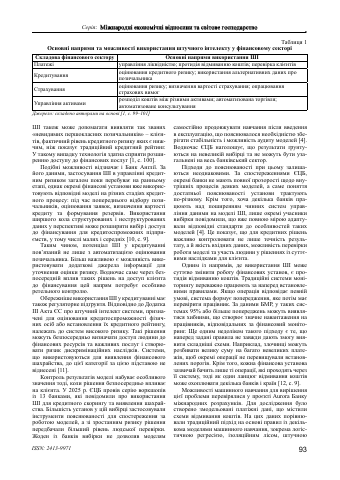
- The Bank for International Settlements identifies four main areas of AI impact in finance: payments, lending, insurance, and asset management.p.2
- AI adoption in credit scoring enables financial institutions to complement traditional credit history with alternative data such as bank account transactions, rent, and utility payments.p.3
- Under the EU Artificial Intelligence Act, credit scoring AI models for individuals are classified as high-risk systems, requiring elevated data quality and oversight.p.4
- Traditional rule-based anti-money laundering monitoring systems suffer from high false positive rates, where 95% or more of generated alerts are false alarms.p.4
- Generative AI creates a dual-use threat vector in finance, as it assists institutions in fraud prevention while simultaneously allowing cybercriminals to generate convincing synthetic identities and audio-visual fakes.p.5
- In the insurance sector, 64% of reported generative AI implementation cases remain at the experimental stage, with 32% reaching production deployment.p.5
- Financial stability bodies warn that market participants relying on identical AI algorithms could exhibit correlated behavior, exacerbating market sell-offs during stress periods.p.6
- Heavy reliance on third-party cloud infrastructure and AI models creates systemic concentration vulnerabilities across the financial ecosystem.p.6
Pages
 p.1
 p.2
 p.3
 p.4
 p.5
 p.6
 p.7
 p.8
Topics and entities
Summary and figures generated from the document and checked automatically: every number shown appears on the cited page. Publishers can request removal.