Beyond Account Ownership: Financial Inclusion, Digital Banking Use and Inclusive Development in Jalgaon District, Maharashtra (OpenAlex (recherche mondiale))
Summary
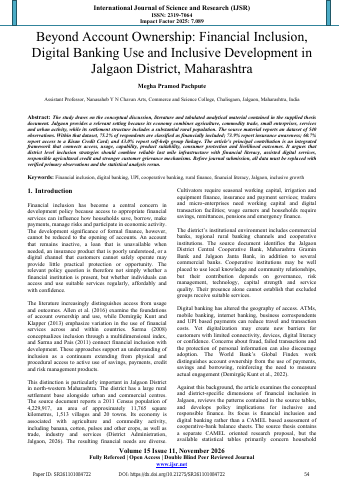
- The source material reports a dataset of 540 observations across Jalgaon district.p.1
- Within the source dataset, 75.2% of respondents are classified as financially included.p.1
- Insurance awareness is reported by 73.9% of respondents in the dataset.p.1
- Access to a Kisan Credit Card is reported by 60.7% of respondents in the study.p.1
- Linkage to a self-help group is reported by 43.0% of the sample respondents.p.1
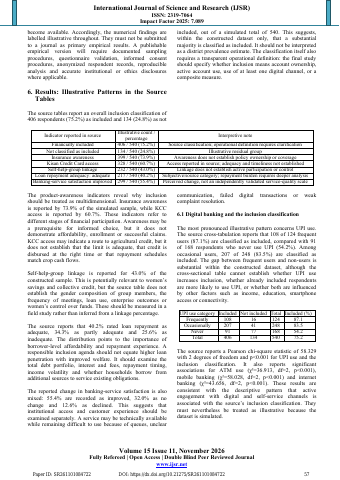
- Among frequent UPI users in the dataset, 87.1% are classified as financially included, compared to 54.2% of non-users.p.4
- A total of 55.4% of respondents report an improved satisfaction with banking services.p.4
Key insights
- The paper distinguishes simple account ownership from regular, affordable, and effective financial service usage.p.1
- The illustrative source data indicates that 87.1% of frequent UPI users are financially included versus 54.2% of respondents who never use UPI.p.4
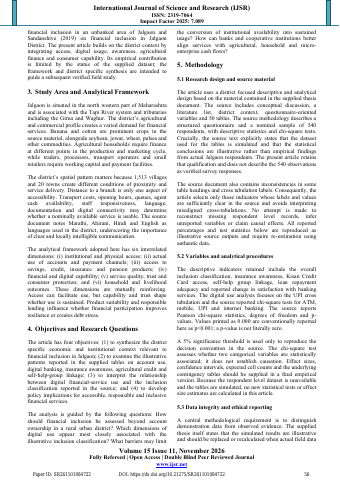
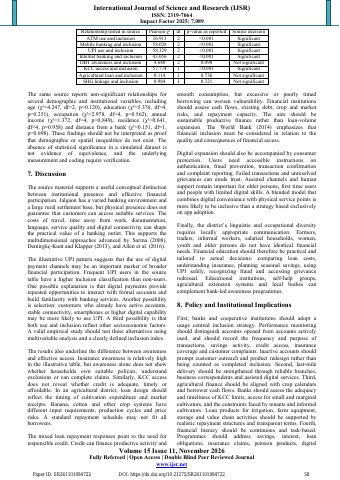
- Demographic variables such as annual income (p = 0.849) and distance from a bank (p = 0.698) showed non-significant relationships in the illustrative source dataset.p.5
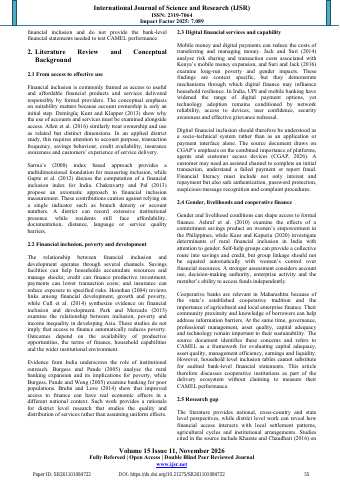
- Digital banking adoption remains influenced by network reliability, access to devices, user confidence, and grievance redressal mechanisms.p.2
- The report highlights that 40.2% of respondents rated loan repayment adequacy as adequate, while 25.6% rated it as inadequate.p.4
- Effective financial inclusion strategies require blending digital payment interfaces with physical service points and human assistance.p.5
Pages
 p.1
 p.2
 p.3
 p.4
 p.5
 p.6
 p.7
Topics and entities
Summary and figures generated from the document and checked automatically: every number shown appears on the cited page. Publishers can request removal.