Money Laundering - The Economic Impact and Its Implications (OpenAlex (recherche mondiale))
Summary
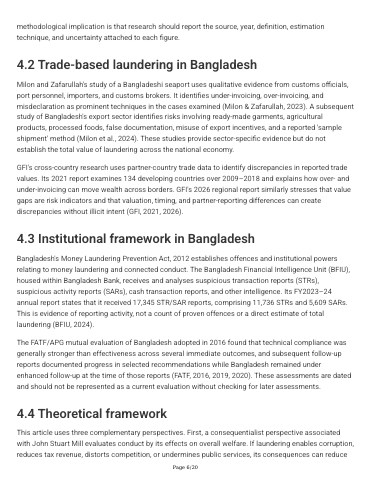
- The Bangladesh Financial Intelligence Unit received 17,345 STR/SAR reports in FY2023–24, consisting of 11,736 STRs and 5,609 SARs.p.6
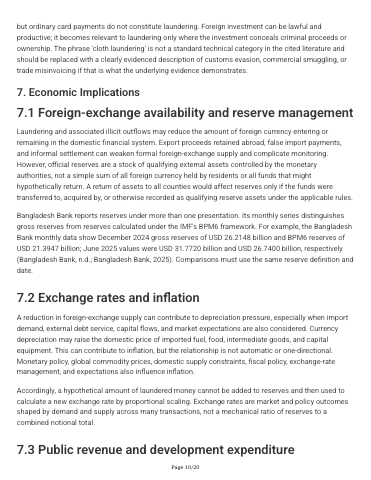
- Bangladesh Bank monthly statistics for December 2024 listed gross reserves of USD 26.2148 billion compared to BPM6 reserves of USD 21.3947 billion.p.10
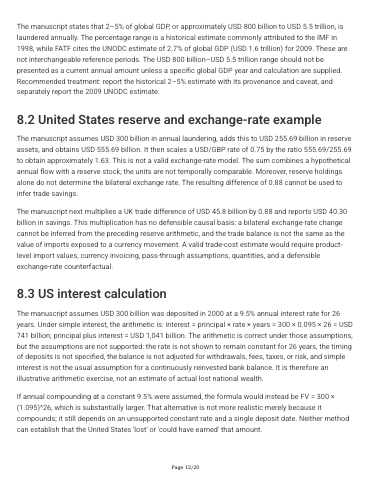
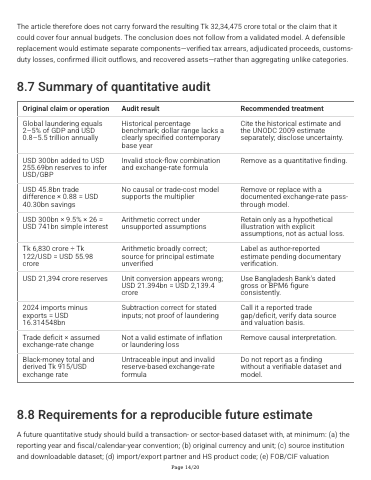
- The manuscript evaluated a hypothetical simple-interest model assuming USD 300 billion deposited at a 9.5% annual rate over 26 years to yield USD 741 billion in interest.p.12
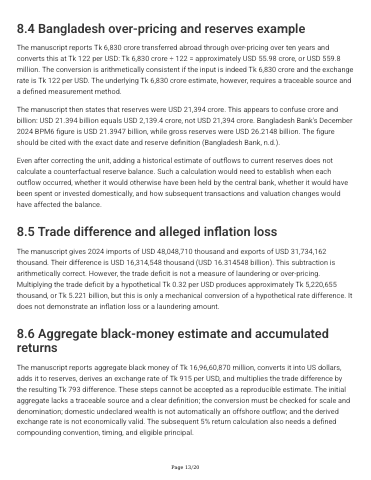
- Reported 2024 trade data showed imports of USD 48,048,710 thousand and exports of USD 31,734,162 thousand, resulting in a trade deficit of USD 16,314,548 thousand.p.13
- Global Financial Integrity evaluated trade misinvoicing risks across 134 developing countries using partner-country trade data for the period 2009–2018.p.6
Key insights
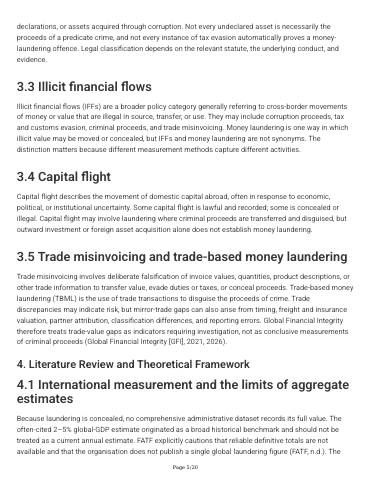
- Widely cited aggregate figures such as 2–5% of global GDP originate as broad historical benchmarks rather than contemporary direct observations.p.2
- Discrepancies in partner-country trade statistics serve as risk indicators requiring investigation rather than direct proof of illicit money laundering.p.5
- The BFIU received 17,345 STR/SAR reports in FY2023–24, which reflects intelligence reporting activity rather than proven criminal convictions.p.6
- Reserve metrics require consistent definitions, demonstrated by June 2025 figures reporting USD 31.7720 billion in gross reserves versus USD 26.7400 billion under IMF BPM6.p.10
- Exchange rates are market outcomes driven by supply and demand across transactions rather than a simple mathematical ratio of reserves to estimated illicit flows.p.10
- Multiplying a national trade deficit by a hypothetical exchange-rate difference does not provide a valid calculation of inflation loss or laundering scale.p.13
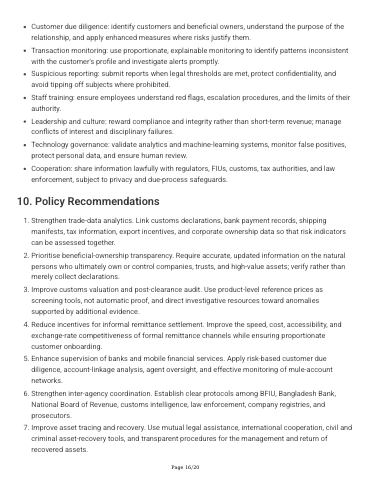
- Effective anti-money laundering strategies require risk-based supervision, beneficial-ownership transparency, and integrated trade-data analytics.p.16
Pages
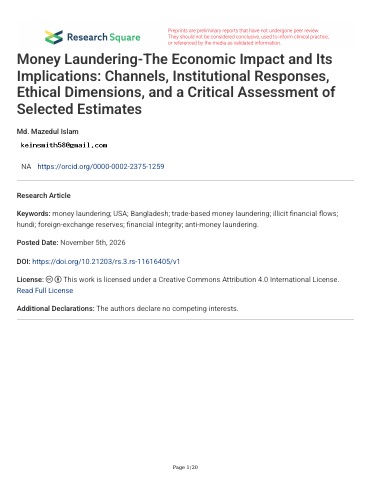 p.1
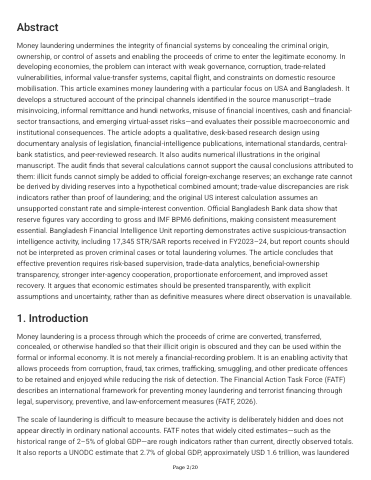 p.2
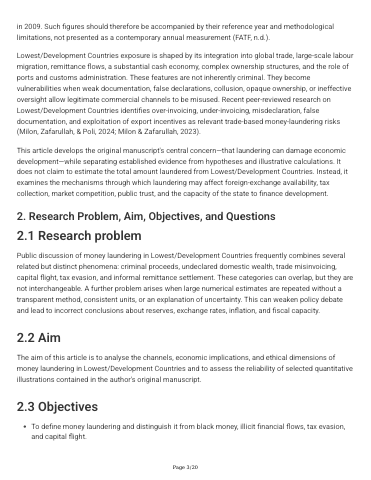 p.3
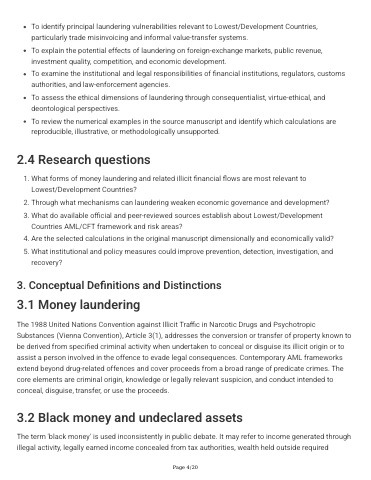 p.4
 p.5
 p.6
 p.7
 p.8
 p.9
 p.10
 p.11
 p.12
 p.13
 p.14
 p.15
 p.16
 p.17
 p.18
 p.19
 p.20
Topics and entities
Summary and figures generated from the document and checked automatically: every number shown appears on the cited page. Publishers can request removal.