Survey of Professional Forecasters - Fourth Quarter of 2026
Headline inflation expectations were revised upward by 0.3 percentage points to 3.0% for 2026 and by 0.4 percentage points to 2.6% for 2027, while staying unchanged at 2.0% for 2028.
142 documents
Headline inflation expectations were revised upward by 0.3 percentage points to 3.0% for 2026 and by 0.4 percentage points to 2.6% for 2027, while staying unchanged at 2.0% for 2028.
The study analyzes a bibliometric dataset of 695 English-language Scopus records published between 2023 and 2025 to map the intellectual structure of GenAI in finance.
On December 31, 2025, six major state-owned banks announced interest payments on real-name digital yuan wallets at demand deposit rates, establishing the Version 2.0 era effective January 1, 2026.
EUR bank bond supply is projected to reach €450bn in 2027, driven primarily by elevated redemptions across segments.
Euro area banks reported a net tightening of credit standards for loans or credit lines to firms of 9% in the third quarter of 2026, up from 7% in the second quarter.
EIOPA issued a staff paper on 27 October 2026 introducing four building blocks to integrate behavioural science into conduct of business supervision.
In a March 2026 survey of 938 U.S. investors, 62% reported using AI tools for investment decisions, 22% used them to assist portfolio decisions, and 24% named "market herding" as a concern.
Global Sharia-compliant financial assets have expanded into an architecture with total assets exceeding US$3 trillion.
The relationship between financial technology firms and traditional banks has evolved through a three-phase progression from initial competition to cooperation and convergence.
As public attention to AI rose following the release of ChatGPT, banks lowered assessed default risk (PD) for borrowers in highly AI-exposed industries by about 5%.
Unsecured interbank lending entails material regulatory costs, estimated at around 35 basis points for lenders in the second half of 2025.
The Financial Stability Board (FSB) identified 12 sound practices to help all financial institutions realise the benefits of AI while managing its risks responsibly.
The IMR review working group was established in 2024 to evaluate the implementation status of international financial reforms and recommend improvements to monitoring.
A stocktake conducted by the FSB gathered 126 modernisation efforts from 24 jurisdictions and 3 SSBs across various financial sectors and entity types.
Global financial wealth is projected to grow by 10.7% in 2025 to reach US$333 trillion according to BCG's report.
As of mid-2026, the total market value for stablecoins stands at around $300 billion.
According to KPMG, 71% of surveyed financial firms have deployed AI tools, with global banking sector AI spending estimated at USD 31.3 billion in 2024.
Only 4 (21%) of reviewed jurisdictions are fully compliant with KA 6, while 8 (42%) are materially non-compliant.
The study conducts an empirical investigation covering 74 countries over the 2002 – 2022 period to evaluate how digital financial innovations impact systemic financial stability.
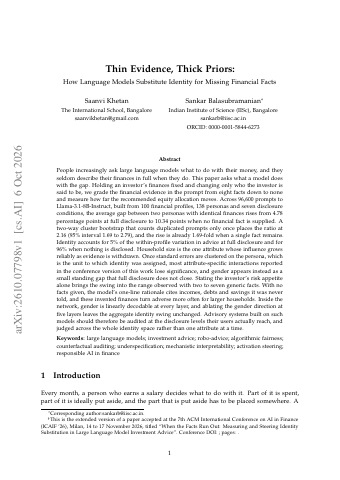
Across 96,600 prompts to Llama-3.1-8B-Instruct, the average identity swing in recommended equity allocation rises from 4.78 percentage points at full disclosure to 10.34 percentage points when no financial facts are supplied.
In 2025, large European companies invested EUR 512 billion in green and transition assets, representing 21% of overall corporate investment in the European Union.
Corporate stablecoin adoption live in production doubled from 9% in 2025 to 18% in 2026.
Total fees and commissions income in the analyzed EU banking sector sample reaches approximately EUR 157 billion, representing 37% of net operating income.
Between 2008 and 2025, real GDP in the Eurozone grew at an average annual rate of just 0.9%, resulting in a 16.9% cumulative increase, while the US economy grew by 40.5% over the same period.
Mario Draghi estimated that the EU requires €1.2 trillion of annual investment to compete globally in an integrated market of 450 million people.
The aggregate monetary base of OECD countries increased from $2.5 trillion in 2000 to a peak of $25 trillion in March 2022.
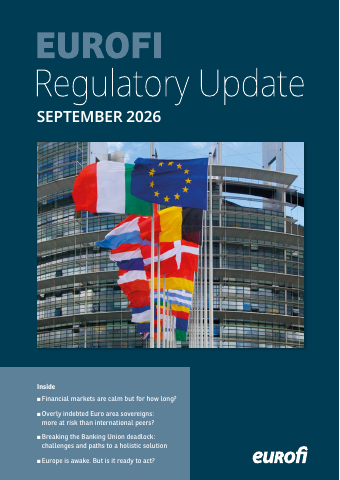
Stock markets remained calm after the start of the conflict in Iran on February 28, 2026, with the S&P 500 gaining a maximum increase of 7% on May 10, 2026.
Swiss real GDP growth is projected to reach 1,0 Prozent in 2026 and 1,4 Prozent in 2027.
In 2025, real growth of the Swiss economy reached 1.5%, remaining below its multi-year average.
Sveriges Riksbank started publishing values for SWESTR on 2 September 2021 based on transaction data from 9 banks.