Financial Stability with Digital Finance Innovation: A BigQuery-Based Empirical Investigation (OpenAlex (recherche mondiale))
Summary
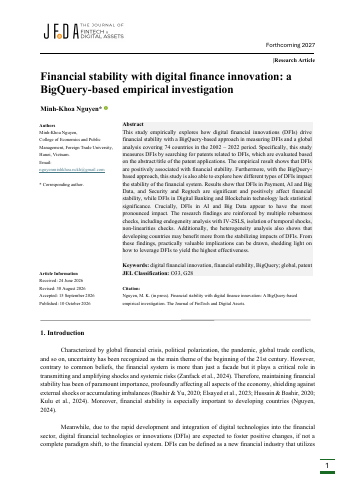
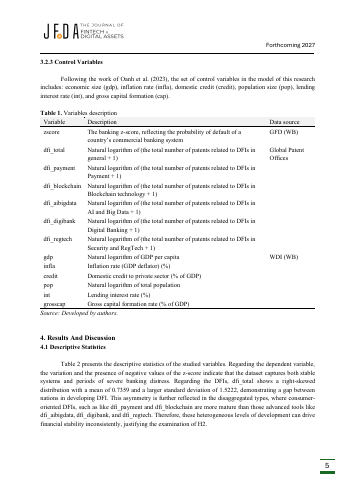
- The study conducts an empirical investigation covering 74 countries over the 2002 – 2022 period to evaluate how digital financial innovations impact systemic financial stability.p.1
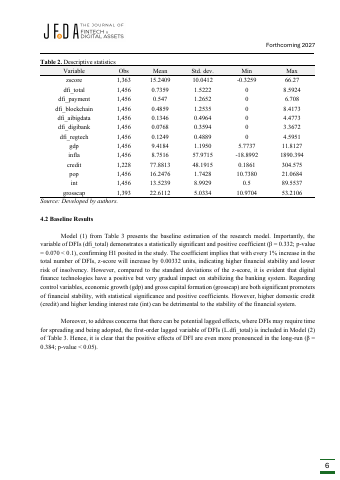
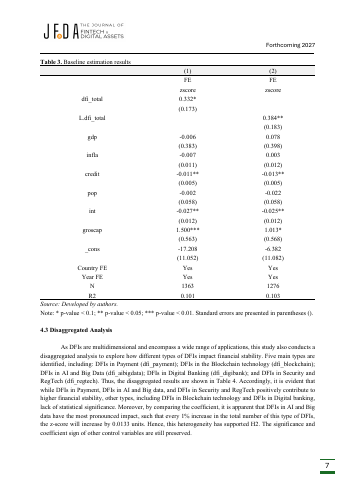
- Baseline estimation shows total digital financial innovation (dfi_total) has a statistically significant positive coefficient of 0.332 with a p-value = 0.070.p.6
- The first-order lagged DFI variable (L.dfi_total) demonstrates a stronger positive relationship with financial stability, yielding a coefficient of 0.384 with a p-value < 0.05.p.6
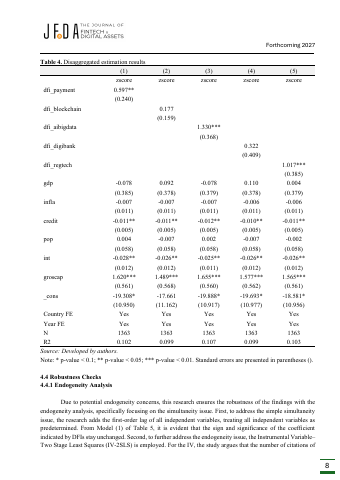
- Disaggregated analysis shows that DFIs in AI and Big Data exert the largest positive coefficient of 1.330*** on the banking z-score.p.8
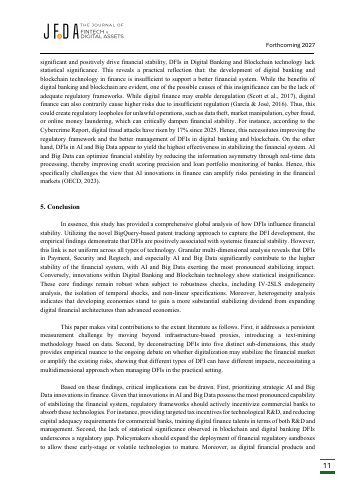
- Recent industry data cited indicates that digital fraud attacks have increased by 17% since 2025.p.11
Key insights
- Digital financial innovations are positively associated with overall systemic financial stability across global banking systems.p.1
- The positive impact of digital finance technologies on banking stability is even more pronounced over longer time horizons when using lagged metrics.p.6
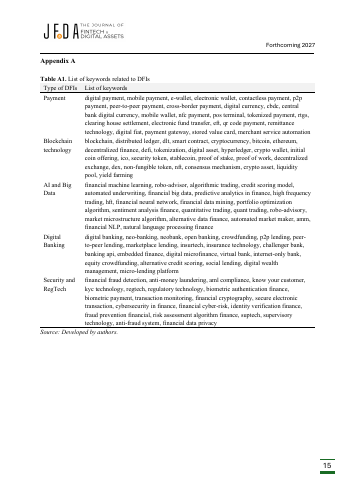
- DFIs in Payment, AI and Big Data, and Security and Regtech significantly promote financial stability, whereas DFIs in Digital Banking and Blockchain technology lack statistical significance.p.1
- Innovations in AI and Big Data provide the most impactful stabilizing influence by reducing information asymmetry and enhancing bank credit scoring.p.11
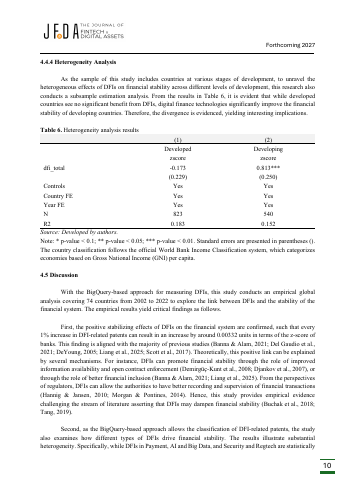
- Developing economies gain a stronger stabilizing dividend from expanding digital financial architectures than advanced economies.p.10
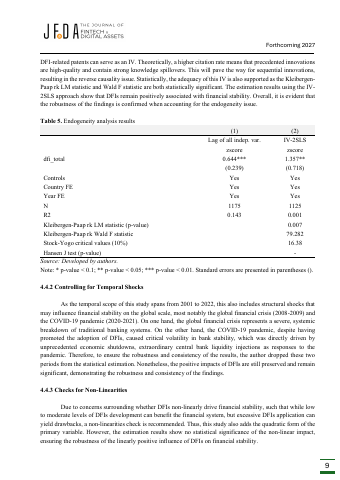
- Empirical tests confirm a linear relationship between DFIs and financial stability, showing no statistically significant non-linear quadratic effects.p.9
Pages
 p.1
 p.2
 p.3
 p.4
 p.5
 p.6
 p.7
 p.8
 p.9
 p.10
 p.11
 p.12
 p.13
 p.14
 p.15
Topics and entities
Summary and figures generated from the document and checked automatically: every number shown appears on the cited page. Publishers can request removal.