The Evolution of Islamic Finance: Contractual Continuity, Institutional Transformation, and the Search for Sharia Substance (OpenAlex (recherche mondiale))
Summary
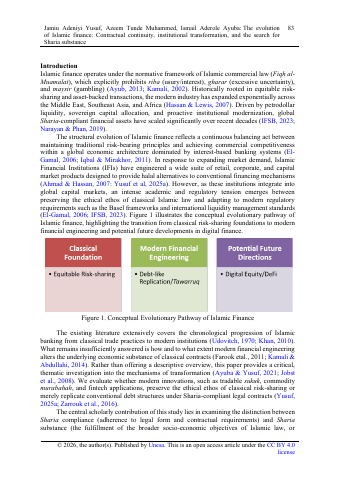
- Global Sharia-compliant financial assets have expanded into an architecture with total assets exceeding US$3 trillion.p.1
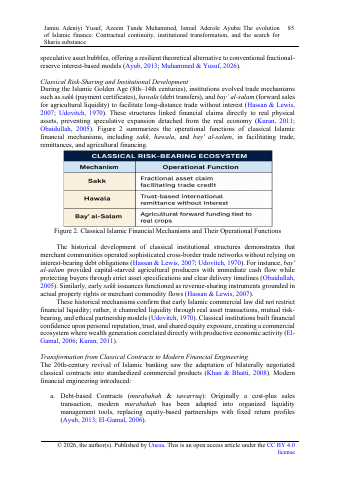
- Classical institutional mechanisms such as sakk, hawala, and bay' al-salam developed during the 8th–14th centuries Islamic Golden Age to facilitate long-distance trade without interest.p.4
- The revival of Islamic banking in the 1970s led to pioneering institutions such as Dubai Islamic Bank and the Islamic Development Bank adapting classical contracts into commercial products.p.5
- The foundational economic principles rest upon the Quranic imperative permitting trade while forbidding interest in Surah Al-Baqarah 2:275.p.3
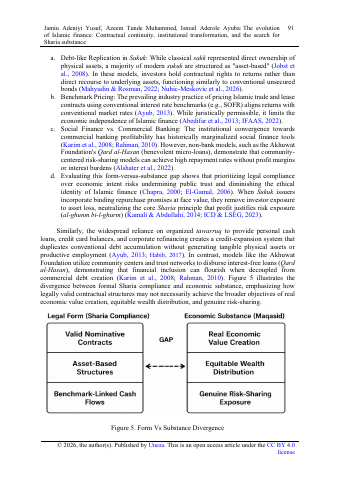
- Non-bank community models like the Akhuwat Foundation provide interest-free benevolent micro-loans (Qard al-Hasan) to demonstrate alternative financial inclusion.p.10
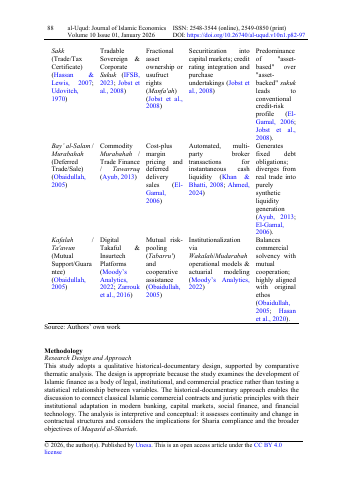
- The study introduces a five-dimensional analytical framework comparing classical foundations, modern forms, continuity mechanisms, transformation dynamics, and Sharia implications.p.1
Key insights
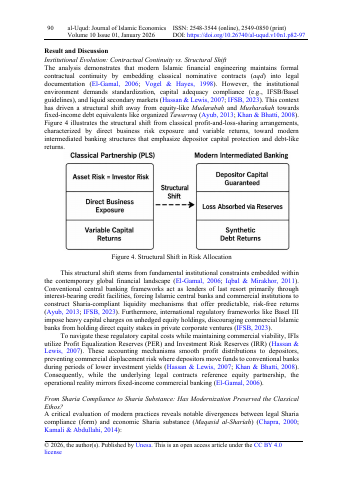
- Modern Islamic financial engineering maintains formal legal contractual continuity while shifting structurally toward fixed-income debt equivalents such as organized Tawarruq.p.9
- Commercial market pressures since the 1970s led institutions to shift product focus away from equity-based partnership models toward synthetic debt instruments.p.5
- International regulatory frameworks like Basel III impose heavy capital charges on unhedged equity holdings, discouraging commercial Islamic banks from taking direct equity stakes.p.9
- Islamic financial institutions utilize Profit Equalization Reserves (PER) to smooth profit distributions to depositors and prevent commercial displacement risk.p.9
- A majority of modern Sukuk issuances are structured as asset-based rather than asset-backed, leaving investors with credit rights rather than direct asset recourse.p.10
- The prevailing practice of pricing Islamic trade and lease contracts against conventional interest rate benchmarks like SOFR aligns returns with conventional borrowing costs.p.10
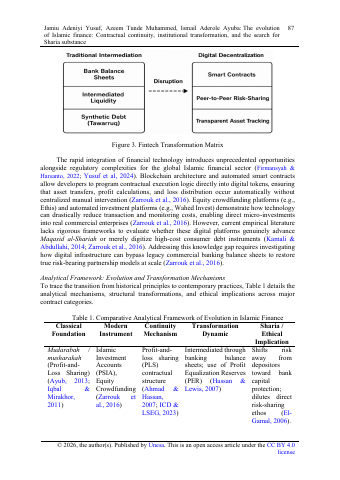
- Blockchain architecture and smart contracts offer technological pathways to disintermediate bank balance sheets and restore direct peer-to-peer risk-sharing.p.11
Pages
 p.1
 p.2
 p.3
 p.4
 p.5
 p.6
 p.7
 p.8
 p.9
 p.10
 p.11
 p.12
 p.13
 p.14
 p.15
 p.16
Topics and entities
Summary and figures generated from the document and checked automatically: every number shown appears on the cited page. Publishers can request removal.