The Jurisdiction of Par: Juridical Singleness and the Legal Identity of Stablecoins (OpenAlex (recherche mondiale))
Summary
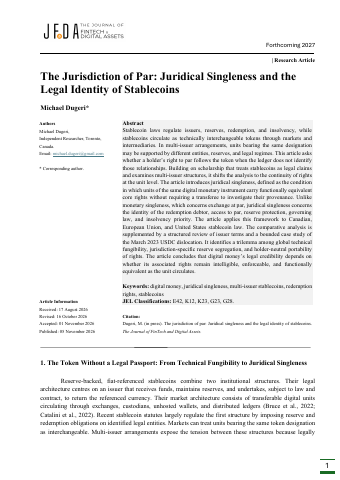
- Expanding access to Tether's arbitrage mechanism reduced the absolute size of peg deviations by approximately one half.p.2
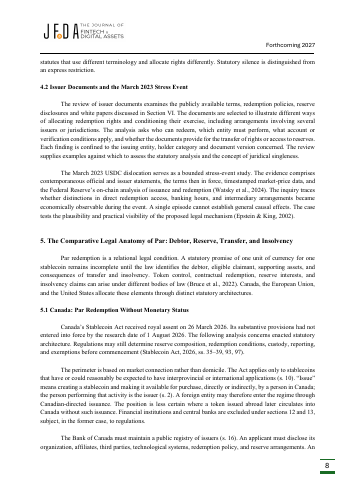
- Canada's Stablecoin Act received royal assent on 26 March 2026, establishing statutory backing and redemption standards for payment stablecoins.p.8
- The United States passed the GENIUS Act on 18 July 2025, requiring permitted issuers to back outstanding stablecoins on at least a one-to-one basis.p.10
- Under the U.S. GENIUS Act, issuers must provide at least seven days' notice before changing stablecoin redemption fees.p.11
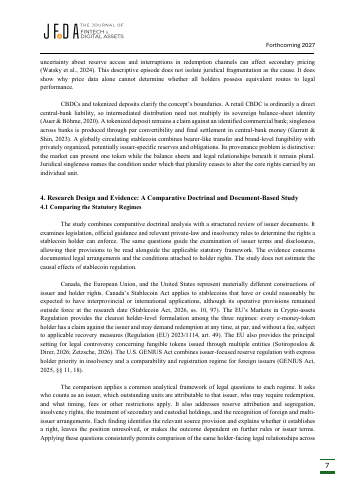
- During market stress on 10 March 2023, Circle disclosed that approximately US$3.3 billion of roughly US$40 billion in USDC reserves remained at Silicon Valley Bank.p.14
- Decentralized-exchange volumes surged past US$20 billion on 11 March 2023, compared to typical daily volumes of US$1–3 billion.p.14
Key insights
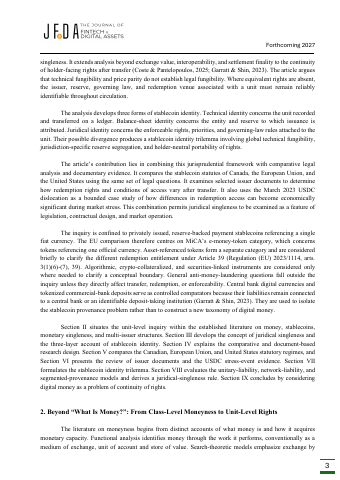
- Juridical singleness requires that units of the same digital monetary instrument carry functionally equivalent core rights throughout circulation without requiring a transferee to investigate their provenance.p.2
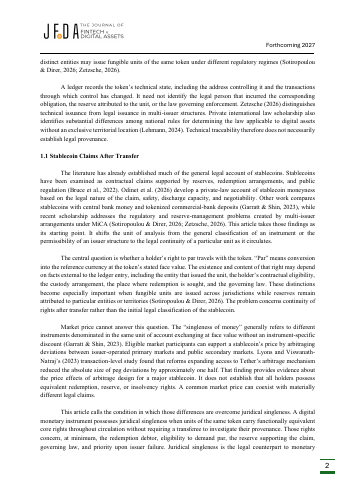
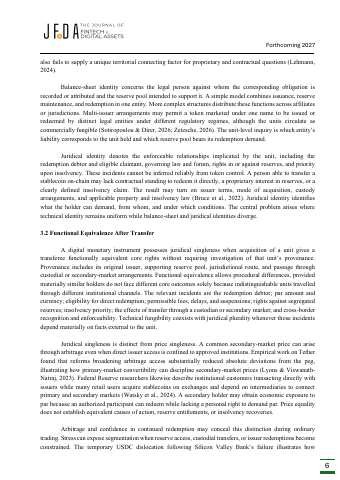
- Technical fungibility and price parity on secondary markets do not guarantee legal fungibility or identical holder rights against stablecoin issuers.p.3
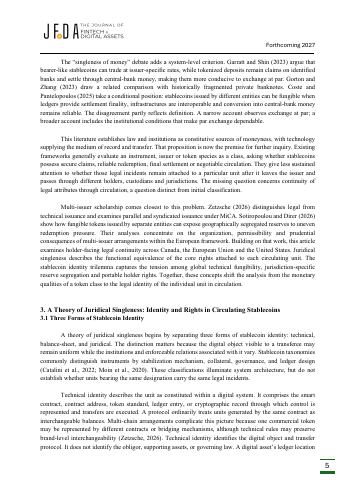
- Stablecoin identity consists of three distinct layers: technical identity on the ledger, balance-sheet identity with the issuer, and juridical identity comprising enforceable rights.p.3
- Article 49 of MiCA grants e-money token holders a statutory claim to demand par redemption at any time without fees, though multi-issuer structures complicate debtor attribution.p.9
- The U.S. GENIUS Act establishes statutory insolvency standing and ratable reserve priority for holders of stablecoins issued by an insolvent permitted issuer.p.11
- A review of major issuer contracts shows that holding a token does not guarantee direct primary redemption access, which is frequently restricted to registered, verified customers.p.13
- The stablecoin identity trilemma demonstrates that an arrangement cannot simultaneously guarantee global technical fungibility, jurisdictional reserve segregation, and holder-neutral portability of rights without a connecting legal mechanism.p.14
- Multi-jurisdictional stablecoin frameworks can be legal design-tested using unitary-liability, network-liability, or segmented-provenance models.p.16
Pages
 p.1
 p.2
 p.3
 p.4
 p.5
 p.6
 p.7
 p.8
 p.9
 p.10
 p.11
 p.12
 p.13
 p.14
 p.15
 p.16
 p.17
 p.18
 p.19
 p.20
 p.21
 p.22
Topics and entities
Summary and figures generated from the document and checked automatically: every number shown appears on the cited page. Publishers can request removal.