Cryptocurrency Regulation and Monetary Policy Trade-offs in Transition Economies (OpenAlex (recherche mondiale))
Summary
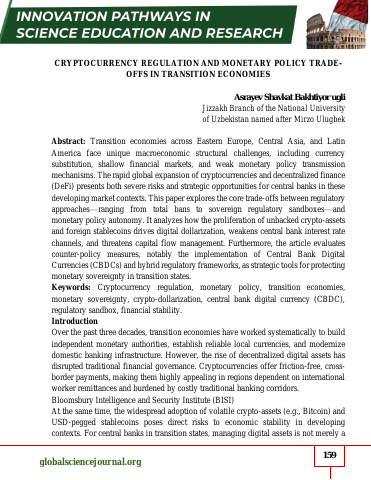
- Transition economies across Eastern Europe, Central Asia, and Latin America face unique structural macroeconomic challenges, including currency substitution and weak monetary policy transmission.p.1
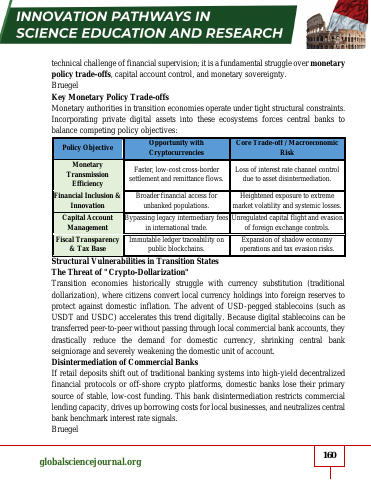
- The adoption of USD-pegged stablecoins like USDT and USDC accelerates crypto-dollarization, reducing demand for local currencies and shrinking central bank seigniorage.p.2
- The migration of retail deposits into decentralized finance protocols causes bank disintermediation, raising borrowing costs for domestic businesses.p.2
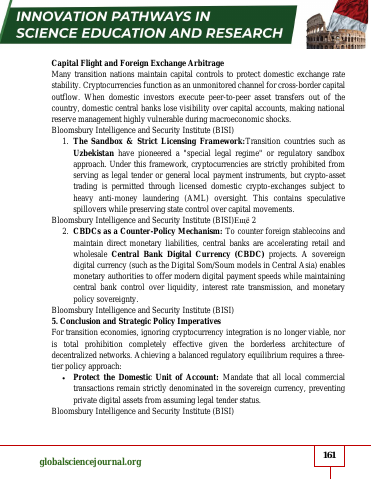
- Unmonitored peer-to-peer transfers enable capital flight, undermining central bank visibility over capital accounts and foreign exchange stability.p.3
- Transition nations like Uzbekistan have implemented regulatory sandboxes that permit licensed trading while prohibiting cryptocurrencies from becoming legal tender.p.3
- Central banks are developing sovereign Central Bank Digital Currency (CBDC) projects, such as Central Asia's Digital Som/Soum models, to protect monetary sovereignty.p.3
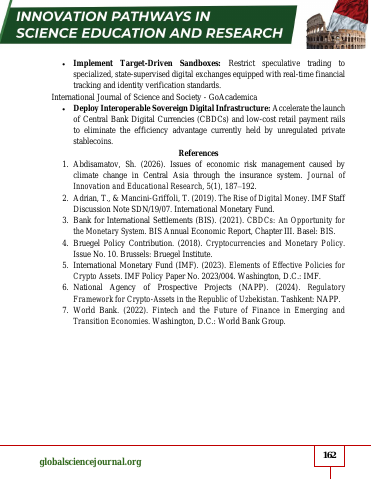
- Effective cryptocurrency governance requires protecting sovereign unit of account status, enforcing target-driven sandboxes, and deploying interoperable CBDC infrastructure.p.4
Key insights
- Cryptocurrencies provide low-cost cross-border remittance solutions while simultaneously risking interest rate channel control due to asset disintermediation.p.2
- Digital stablecoins reduce public demand for domestic fiat currencies by enabling peer-to-peer transfers outside local commercial banking systems.p.2
- Retail deposit shifts into high-yield decentralized finance protocols neutralise central bank benchmark interest rate signals.p.2
- Unregulated cross-border capital outflows leave national reserve management vulnerable during macroeconomic shocks.p.3
- Uzbekistan's regulatory sandbox model isolates speculative risks while retaining state oversight over capital movements.p.3
- Sovereign CBDCs allow central banks to offer modern digital payment speeds while maintaining control over monetary policy transmission.p.3
- Total prohibition of cryptocurrencies is ineffective because of the borderless architecture of decentralized digital networks.p.3
Pages
 p.1
 p.2
 p.3
 p.4
Topics and entities
Summary and figures generated from the document and checked automatically: every number shown appears on the cited page. Publishers can request removal.