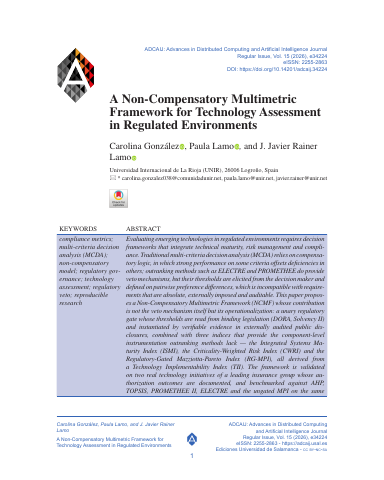
A Non-Compensatory Multimetric Framework for Technology Assessment in Regulated Environments
The Non-Compensatory Multimetric Framework (NCMF) is validated on 2 real technology initiatives of a leading insurance group [p.1].
Research index · 80 documents · Website
The Non-Compensatory Multimetric Framework (NCMF) is validated on 2 real technology initiatives of a leading insurance group [p.1].
Formal legal subsumption fails to fully address decentralized finance, tokens, and autonomous organizations, requiring criteria based on agent behavior, risk, and proportional state response [p.1].
An initial literature search across scholarly databases yielded 150 articles at the first stage.
The study analyzed data from a questionnaire distributed to 250 employees of commercial banks to evaluate the impact of financial information systems on financial sustainability.
The source material reports a dataset of 540 observations across Jalgaon district.
The quantitative study surveyed 406 loan department staff across 14 Zimbabwean commercial banks, achieving an 81.2% response rate from 500 distributed questionnaires.
China committed over $1.3 trillion in development finance to the Global South between 2000 and 2021.
At the beginning of 2026, the registry of electronic money systems of the Central Bank of Uzbekistan contained 12 registered systems.
The document establishes a distinction between voluntary payment digitalisation and forced cashlessness, evaluating welfare trade-offs across financial inclusion, privacy, and system resilience.
Internet penetration in Africa rose from 28% in 2019 to over 44% in 2024, while mobile money users surpassed 700 million.
By end-2025, the global stablecoin market grew from approximately $25 billion in 2020 to over $300 billion.
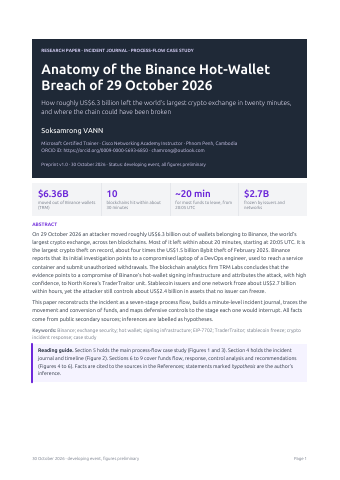
On 29 October 2026, about $6.36 billion was taken from Binance's hot wallets across ten blockchains.
Advanced economies recorded lower vulnerability with a Financial Contagion Index (FCI) of 58 and a Risk Transmission Index (RTI) of 55.
In May 2022, the International Monetary Fund increased the RMB's weight in the Special Drawing Rights basket from 10.92% to 12.28%.
Binance published 167 monitoring tags across 26 announcements between July 2023 and October 2026, of which 155 were first-time tags.
A Scopus bibliometric search conducted on 8 October 2026 retrieved 1,418 records, from which 1,045 were retained for critical analysis.
Islamic crowdfunding currently accounts for only 3-5% of total FinTech funding in the Arab Gulf region.
Virtual currency crimes in China reached a scale of RMB 430.7 billion in 2023.
Expanding access to Tether's arbitrage mechanism reduced the absolute size of peg deviations by approximately one half.
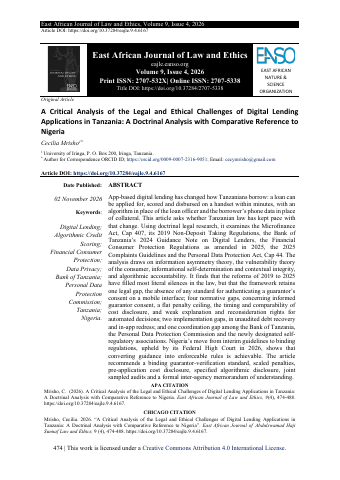
The 29 October 2026 Binance incident resulted in an estimated USD 6.3 billion in unauthorized hot-wallet outflows with initial findings showing no evidence of a private-key leak.
European Union Regulation (UE) 2023/1114 was enacted on 31 May 2023 to establish the MiCA framework for crypto-asset markets.
In 2019, Federal Bureau of Investigation data recorded USD 1.424 billion in reported stolen currency and USD 36.981 million recovered relative to USD 1.7598 trillion of U.S. currency in circulation.
Polish banks account for 4 out of the 40 global Digital Champions, defined as the top 10% of banks.
Regulators actively enforced rules by blocking sixty-nine unlicensed loan applications in November 2024.
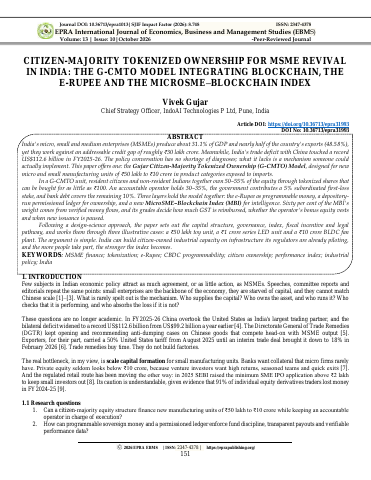
India's MSMEs generate 31.1% of GDP and 48.58% of exports, yet face an addressable credit gap of roughly ₹30 lakh crore.
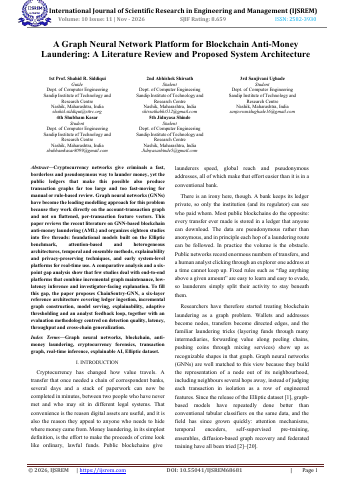
The Elliptic benchmark dataset contains roughly 204 thousand Bitcoin transactions linked by about 234 thousand payment-flow edges across 49 time steps.
An attacker moved roughly US$6.3 billion out of Binance wallets across ten blockchains, with most funds leaving within about 20 minutes starting at 20:05 UTC on 29 October 2026.
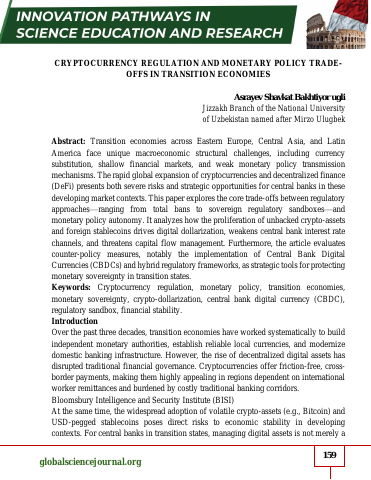
Transition economies across Eastern Europe, Central Asia, and Latin America face unique structural macroeconomic challenges, including currency substitution and weak monetary policy transmission.
Ethereum accounted for $12.3 billion of the $19.08 billion global market for tokenized real-world assets excluding stablecoins in early January 2026.
Financial services contributors generated 1,260,883 commits to public GitHub repositories in 2026, representing a 63% increase year-over-year.