The Future of Work and Finance: A Study of the Intersections between Neo-Banking and the Gig Economy (Journal of Intelligent Decision Making and Information Science)
Summary
- The gig economy accounts for over 1.5 billion workers globally, representing nearly 35% of the global workforce.p.2
- Nearly 40% of the U.S. workforce engaged in freelance or gig work by 2023, a figure projected to reach 50% by 2030.p.2
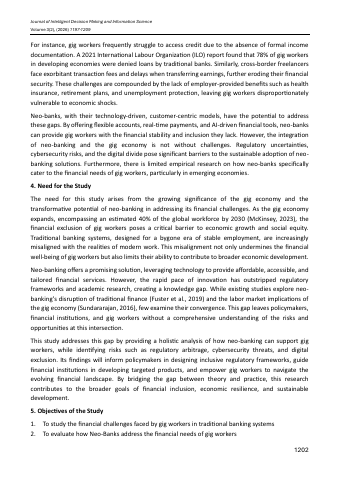
- A 2021 ILO report revealed that 78% of gig workers in developing economies struggle to access credit due to the lack of formal income documentation.p.2
- Globally, 1.7 billion adults remain unbanked, with gig workers disproportionately represented in this group.p.3
- Nearly 3 billion people globally remain offline, restricting the total addressable reach of digital-only banking solutions.p.3
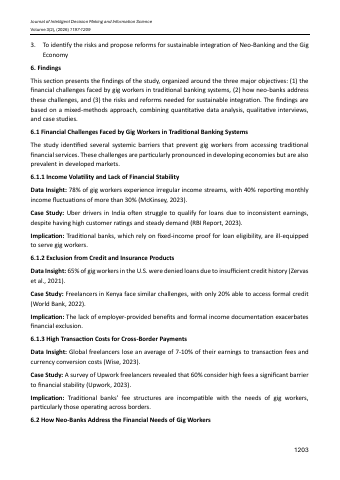
- Approximately 78% of gig workers experience irregular income streams, with 40% reporting monthly income fluctuations exceeding 30%.p.7
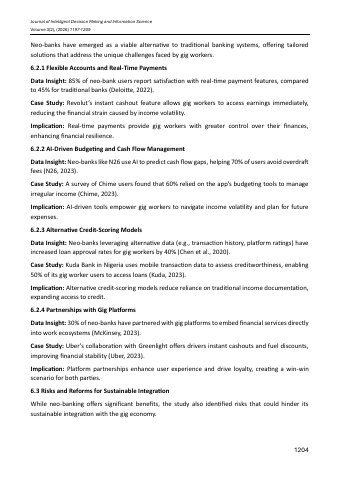
- Neo-banks utilizing alternative credit data have increased loan approval rates for gig workers by 40%.p.8
Key insights
- Traditional banking systems remain misaligned with gig work because 78% of gig workers face irregular earnings and lack traditional proof of income.p.7
- Cross-border freelancers lose between 7% and 10% of their total earnings to traditional transaction fees and currency conversion charges.p.7
- In the United States, 65% of gig workers have been denied loans owing to insufficient traditional credit history.p.7
- AI-driven cash flow prediction tools implemented by neo-banks help 70% of users avoid costly overdraft fees.p.8
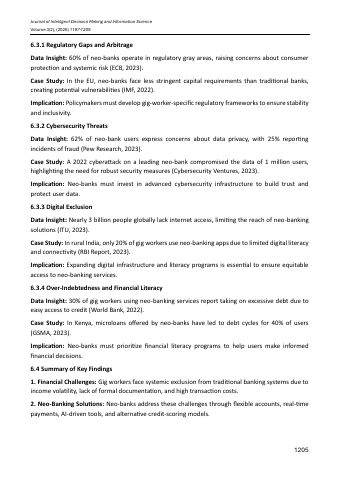
- Approximately 60% of neo-banks operate within regulatory gray areas, raising systemic stability and consumer protection concerns.p.9
- Cybersecurity risks are prominent among digital banking customers, with 62% of neo-bank users reporting concerns over data privacy and 25% reporting fraud incidents.p.9
- Easy access to micro-credit without financial literacy measures has led to 30% of gig-worker users taking on excessive debt.p.9
Pages
 p.1
 p.2
 p.3
 p.4
 p.5
 p.6
 p.7
 p.8
 p.9
 p.10
 p.11
 p.12
 p.13
Topics and entities
Summary and figures generated from the document and checked automatically: every number shown appears on the cited page. Publishers can request removal.