Cryptocurrency Regulation: A Descriptive Case Study on the Policies of India, Vietnam, and the Republic of the Philippines (Zenodo (CERN European Organization for Nuclear Research))
Summary
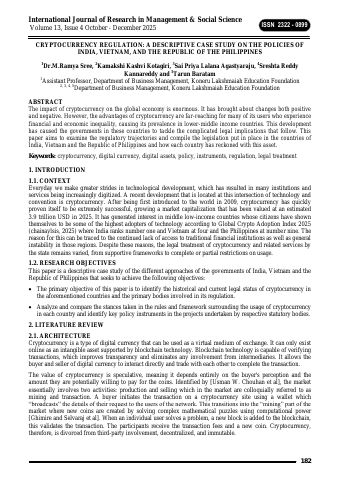
- Cryptocurrency reached an estimated market capitalization of 3.9 trillion USD in 2025, driving high adoption in lower-middle income countries.p.1
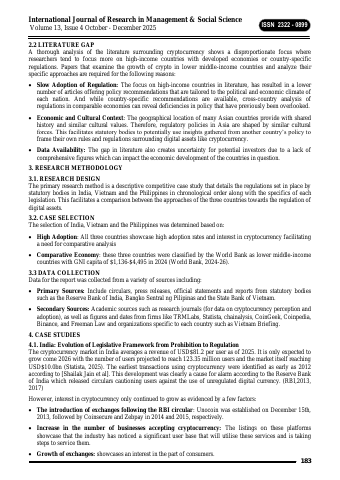
- The World Bank classified India, Vietnam, and the Philippines as lower middle-income countries with GNI per capita between $1,136-$4,495 in 2024.p.2
- India's cryptocurrency market averaged USD$81.2 in revenue per user in 2025, with user numbers projected to reach 123.35 million users and a market size of USD$10.0bn by 2026.p.2
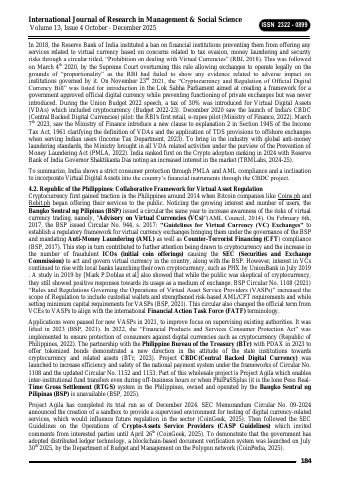
- India introduced a 30% tax on Virtual Digital Assets (VDAs) during the Union Budget 2022-23.p.3
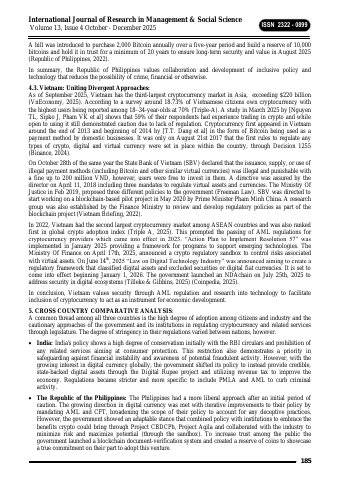
- As of September 2025, Vietnam's cryptocurrency market value exceeded $220 billion, ranking third in Asia.p.4
- The State Bank of Vietnam prohibited the issuance or use of illegal payment methods like Bitcoin under penalties of up to 200 million VND.p.4
Key insights
- 1. India, Vietnam, and the Philippines were ranked first, fourth, and ninth, respectively, in the Global Crypto Adoption Index 2025.p.1
- 2. Existing literature exhibits a gap by disproportionately focusing on crypto regulation in high-income countries rather than lower middle-income economies.p.2
- 3. The Supreme Court of India overturned the Reserve Bank of India's ban on virtual currency services on March 4th 2020 based on the principle of proportionality.p.3
- 4. Bangko Sentral ng Pilipinas Circular No. 1108 in 2021 expanded oversight to Virtual Asset Service Providers (VASPs), including custodial wallets and minimum capital rules.p.3
- 5. A bill introduced in the Philippines in August 2025 proposed purchasing 2,000 Bitcoin annually over five years to build a 10,000 bitcoin strategic reserve.p.4
- 6. Approximately 18.73% of Vietnamese citizens own cryptocurrency, with adoption reaching 70% among individuals aged 18–34.p.4
- 7. Vietnam announced the Law on Digital Technology Industry on June 14th, 2025, setting a framework to classify digital assets starting January 1, 2026.p.4
Pages
 p.1
 p.2
 p.3
 p.4
 p.5
 p.6
Topics and entities
Summary and figures generated from the document and checked automatically: every number shown appears on the cited page. Publishers can request removal.