Intelligent FinTech Architecture for Liquidity Management in Agribusiness Enterprises: A Methodological Approach to Differentiating Financial Decisions (Financial and credit activity problems of theory and practice)
Summary
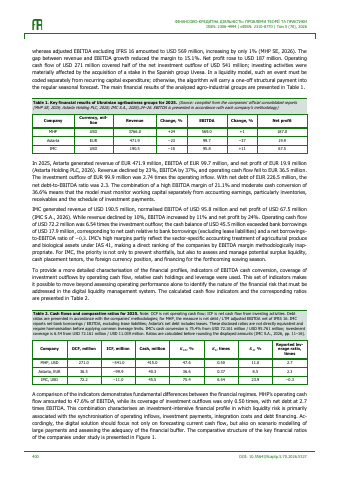
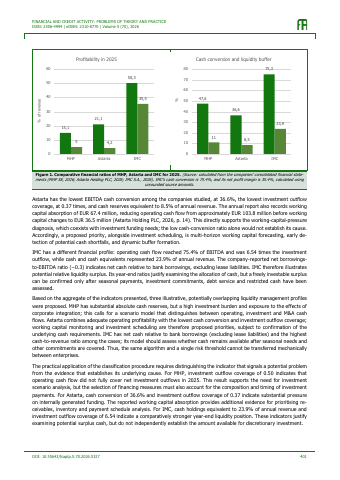
- MHP reported 2025 revenue of $3766.0 million (+24%) and adjusted EBITDA of $569.0 million (+1%), with operating cash flow covering 0.50 of net investment outflows.p.7
- IMC achieved normalised EBITDA of $95.8 million (+11%) on revenue of $190.5 million (-10%), with operating cash flow reaching 6.54 times investment outflows.p.7
- Cash and cash equivalents represented 11.0% of annual revenue for MHP, 8.5% for Astarta, and 23.9% for IMC.p.1
Key insights
- High accounting profitability does not guarantee sufficient liquidity without explicit evaluation of cash flow conversion and investment commitments.p.13
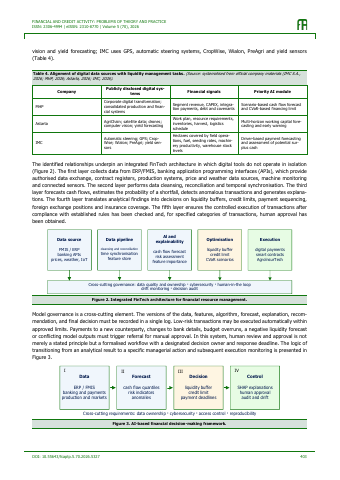
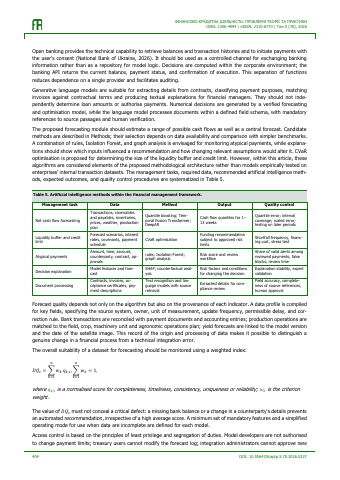
- Open banking serves as a secure data exchange and transaction initiation channel while financial decision models remain inside corporate systems.p.11
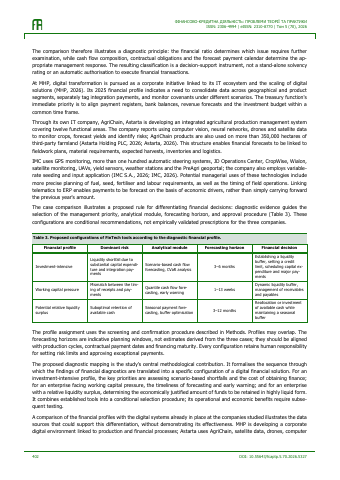
- An investment-intensive profile requires scenario-based cash flow forecasting and CVaR analysis across a 3–6 months planning horizon.p.9
- Working capital pressure profiles necessitate quantile cash flow forecasting and early warning alerts over a 1–13 weeks planning horizon.p.9
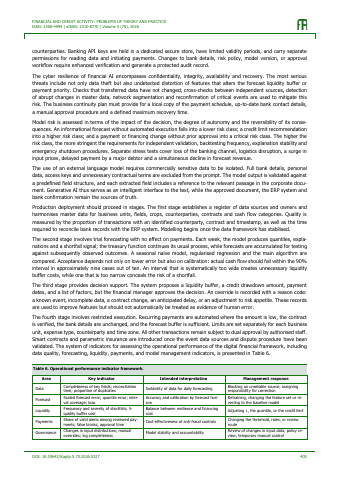
- Generative language models should function as structured document extraction interfaces with mandatory source references rather than autonomous payment tools.p.11
- Astarta's proprietary AgriChain system covers twelve functional areas and supports precision farming on over 350,000 hectares of third-party farmland.p.9
- Model governance requires logging all versions of input features, algorithms, explanations, and decisions in a unified audit record.p.10
Pages
 p.1
 p.2
 p.3
 p.4
 p.5
 p.6
 p.7
 p.8
 p.9
 p.10
 p.11
 p.12
 p.13
 p.14
 p.15
 p.16
 p.17
Topics and entities
Summary and figures generated from the document and checked automatically: every number shown appears on the cited page. Publishers can request removal.