From Digital Transactions to Formal Credit: A Review of FinTech-Enabled MSME Financing in India
The study gathers primary data using a structured questionnaire administered to a sample size of 100 respondents from MSMEs.
11 documents
The study gathers primary data using a structured questionnaire administered to a sample size of 100 respondents from MSMEs.
As of January 1, 2025, the total number of users of remote banking service systems in Uzbekistan reached 52,917,166, comprising 51,455,447 individuals and 1,461,719 legal entities and individual entrepreneurs.
Primary data was gathered from 2,168 investors, fintech users, and financial professionals across seven Arab countries to evaluate regional digital transformation.
Between 1 January 2021 and 1 January 2026, total banking assets in Uzbekistan grew from UZS 366.1 trillion to UZS 925.0 trillion, achieving a compound annual growth rate of 20.4 percent.
At the beginning of 2026, the registry of electronic money systems of the Central Bank of Uzbekistan contained 12 registered systems.
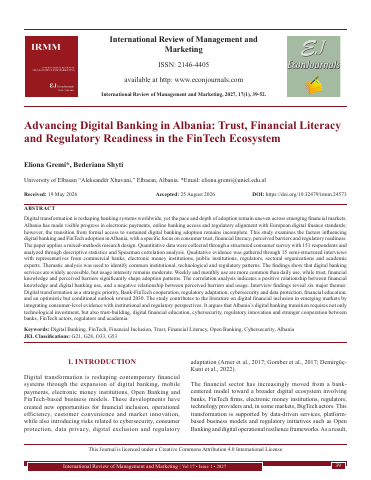
The empirical study analyzed Albania's digital banking ecosystem using quantitative data from a survey of 151 respondents and qualitative data from 15 semi-structured interviews.
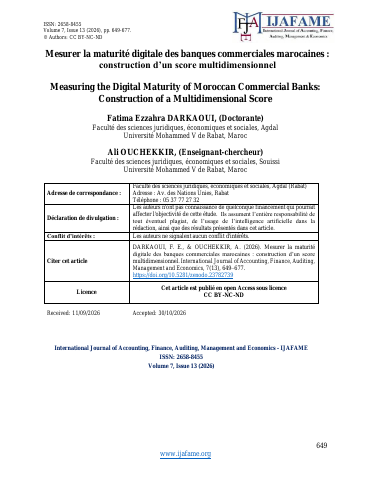
The studied sample of five Moroccan commercial banks achieved an overall average digital maturity score of 3.48 out of 5.
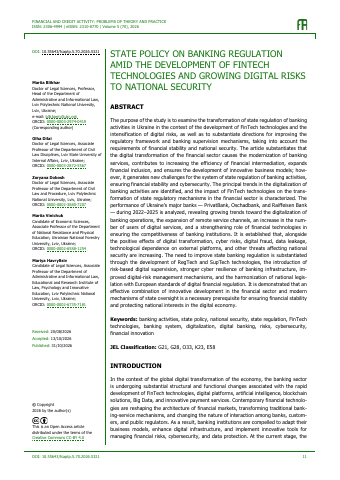
Total Ukrainian banking sector net assets grew by 70.1% from UAH 2,352 billion in 2022 to UAH 4,001 billion in 2025.
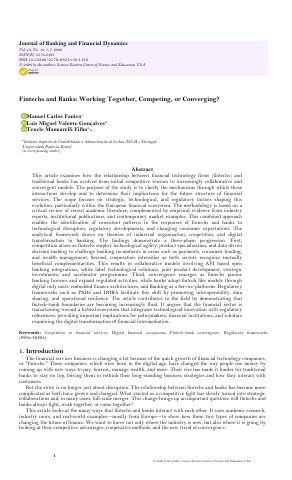
The relationship between financial technology firms and traditional banks has evolved through a three-phase progression from initial competition to cooperation and convergence.
Global financial wealth is projected to grow by 10.7% in 2025 to reach US$333 trillion according to BCG's report.
In 2021, there were more than 300 million users of digital payments and more than 30 million users of digital banks across Latin America.