Disruptions in Large-Value Payment Systems: An Experimental Approach (Economic Journal of Emerging Markets)
Summary
- In 2008, TARGET2 settled a daily average of EUR 3.126 billion in value with 348,000 transactions.p.2
- UK throughput guidelines require banks to settle 50 percent of payment value by noon and 75 percent by 2:30 p.m.p.5
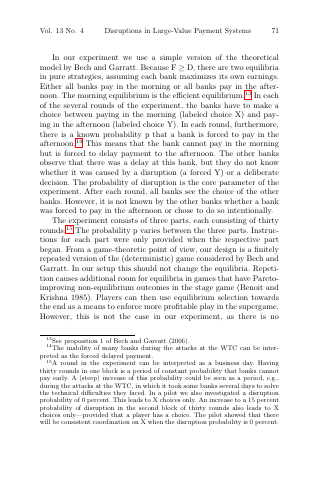
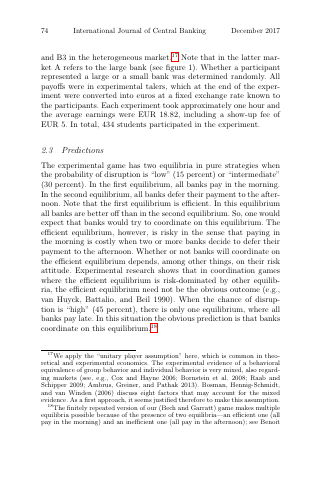
- The laboratory experiment involved 434 student participants who earned an average of EUR 18.82, including a EUR 5 show-up fee.p.12
Key insights
- Experimental results demonstrate significant path dependency based on the history of disruptions in large-value payment systems.p.1
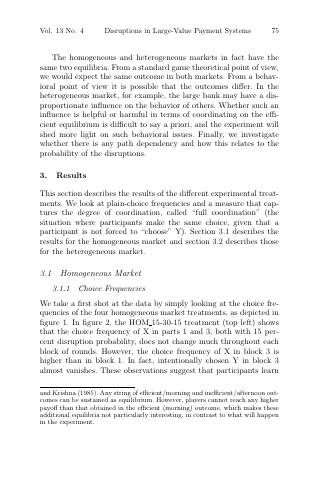
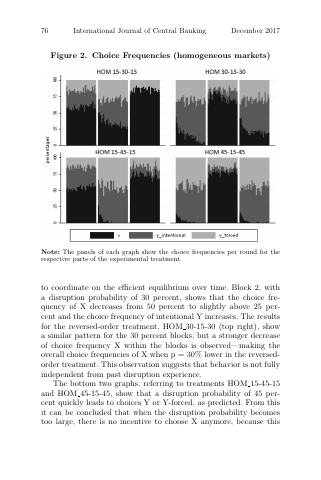
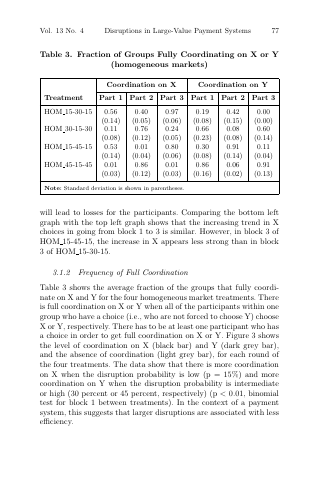
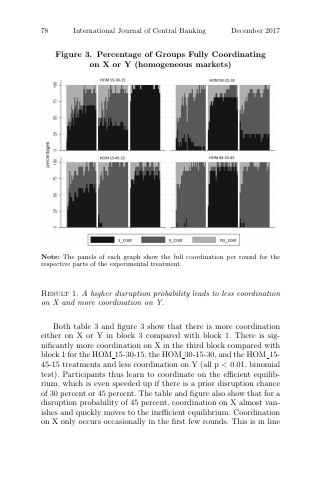
- Higher disruption probabilities systematically lead to less coordination on efficient early payments and more coordination on late payments.p.16
- Once a payment system begins moving toward an inefficient late-payment equilibrium, it does not easily transition back to the efficient one.p.1
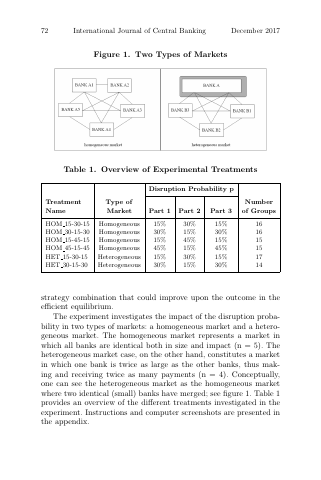
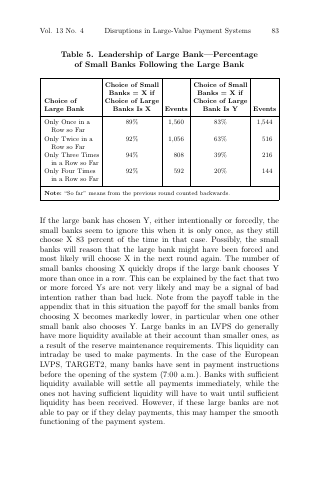
- Heterogeneous markets with a dominant large bank achieve higher coordination on efficient outcomes than homogeneous markets.p.20
- When disruption probability rises to 45 percent, coordination on early payments vanishes almost completely.p.15
- History of disruption exposure heavily impacts participant choices even when current disruption probabilities are identical.p.17
Pages
 p.1
 p.2
 p.3
 p.4
 p.5
 p.6
 p.7
 p.8
 p.9
 p.10
 p.11
 p.12
 p.13
 p.14
 p.15
 p.16
 p.17
 p.18
 p.19
 p.20
 p.21
 p.22
 p.23
 p.24
 p.25
 p.26
 p.27
 p.28
 p.29
 p.30
 p.31
 p.32
 p.33
Topics and entities
Summary and figures generated from the document and checked automatically: every number shown appears on the cited page. Publishers can request removal.