Digital Development of Innovative Corporate Lending Models in Banks (ACCESS Access to science business innovation in digital economy)
Summary
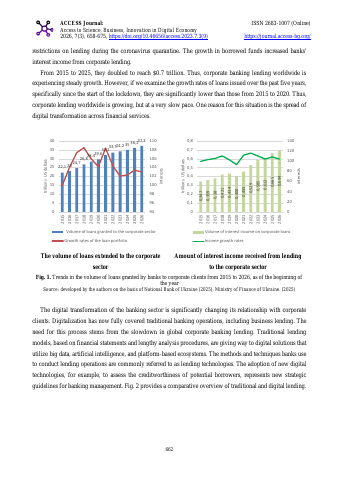
- Global bank investments in corporate lending reached $37.3 trillion as of early 2026, marking an increase of almost 70% over a 10-year period.p.4
- Annual interest income earned by banking institutions from corporate loans doubled between 2015 and 2025, reaching $0.7 trillion.p.5
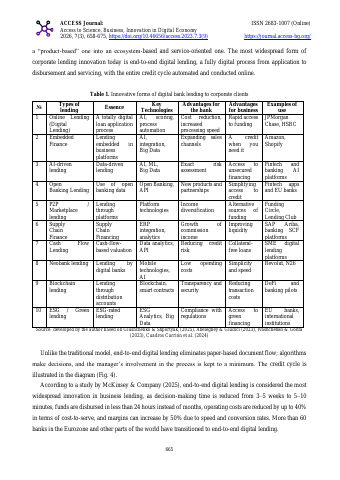
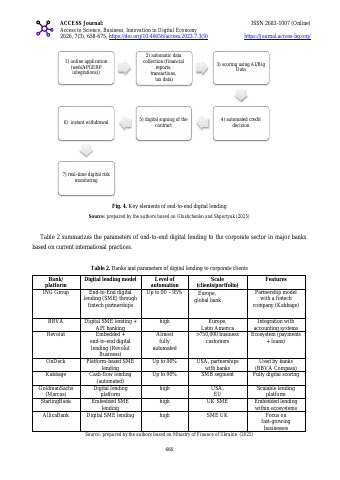
- Adopting end-to-end digital lending reduces loan decision-making times from 3–5 weeks down to 5–10 minutes and cuts operating costs by up to 40%.p.8
- More than 60 banks across the Eurozone and other global regions have transitioned to end-to-end digital corporate lending.p.8
- In 2025, Ukraine's hryvnia-denominated business loan portfolio expanded by 28.4%, supported by a drop in the National Bank of Ukraine discount rate from 25% in 2022 to 15% in 2025.p.10
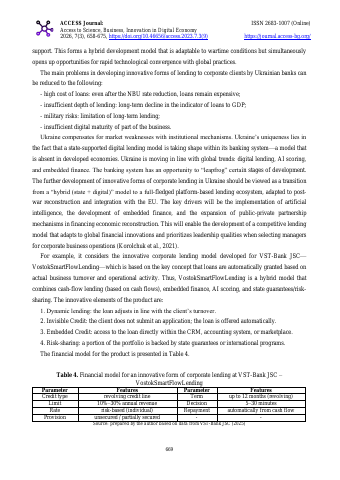
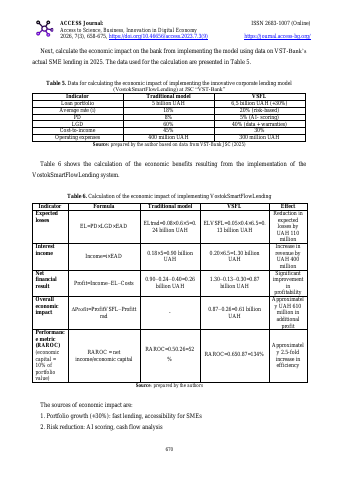
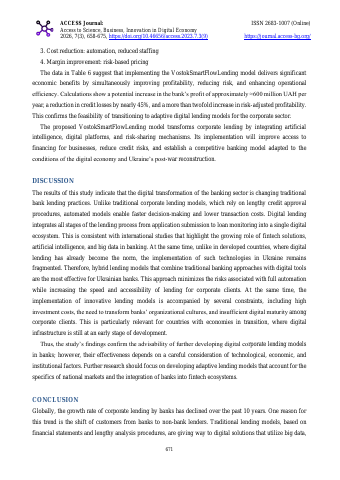
- Econometric calculations for JSC VST-Bank show that adopting the VostokSmartFlowLending model increases its SME loan portfolio from 5 billion UAH to 6,5 billion UAH.p.13
- Implementing VostokSmartFlowLending delivers an estimated annual profit increase of 0.61 billion UAH while raising the bank's RAROC from 52% to 134%.p.13
Key insights
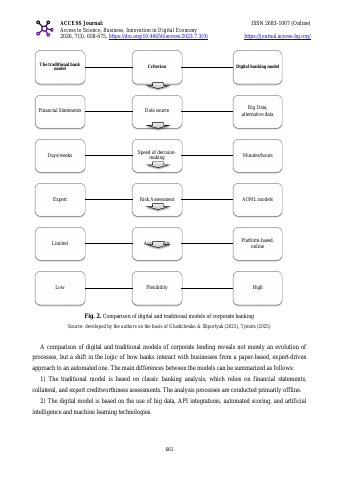
- Traditional corporate lending models reliant on financial statements and physical collateral fail to provide the speed and flexibility required in a digitalized economy.p.1
- Global corporate loan portfolio growth rates slowed over the 2020–2025 period compared to the 2015–2020 period.p.5
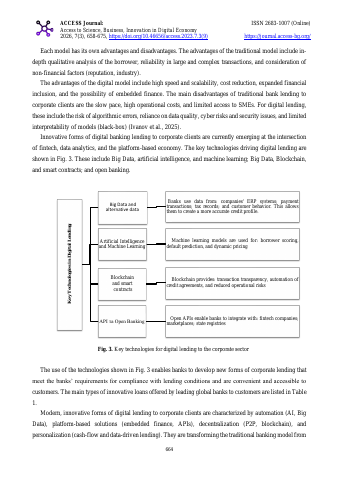
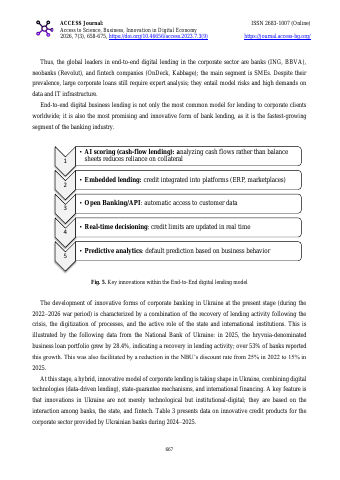
- End-to-end digital lending has emerged as the most widespread and promising corporate lending innovation globally.p.8
- Neobanks and fintech platforms like Revolut, OnDeck, and Kabbage lead end-to-end digital lending, focusing primarily on the SME market.p.10
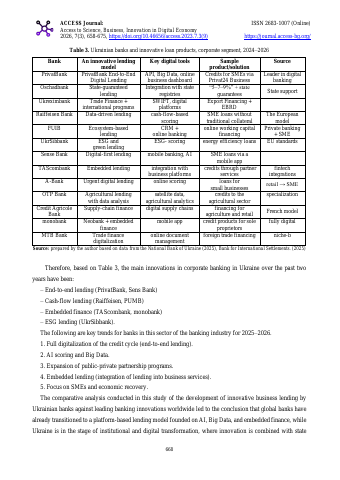
- Ukraine's corporate lending sector operates under a hybrid model combining digital data-driven tools, state guarantees, and international funding mechanisms.p.10
- While global banks have transitioned to platform-based AI models, Ukraine remains in an institutional-digital transition state tailored to wartime recovery.p.11
- Cash-flow-based AI scoring enables banks to extend credit based on real-time business operational turnover, reducing reliance on traditional collateral.p.12
Pages
 p.1
 p.2
 p.3
 p.4
 p.5
 p.6
 p.7
 p.8
 p.9
 p.10
 p.11
 p.12
 p.13
 p.14
 p.15
 p.16
 p.17
 p.18
Topics and entities
Summary and figures generated from the document and checked automatically: every number shown appears on the cited page. Publishers can request removal.