Cyber Security Challenges in Digital Finance: Future Strategies (Zenodo (CERN European Organization for Nuclear Research))
Summary
- Digital finance has transformed financial services while expanding the cyber-attack surface across banking, FinTech platforms, and decentralized systems [p.1].p.1
- The International Monetary Fund observed that cyberattacks have more than doubled since the pandemic, expanding operational and financial stability risks [p.2].p.2
- The IMF's 2024 Global Financial Stability Report stresses that severe cyber incidents can trigger macro-financial spillovers and loss of public confidence [p.3].p.3
- The study establishes 5 core objectives to analyze digital financial threats, including AI-driven attacks, third-party reliance, and quantum computing risks [p.4].p.4
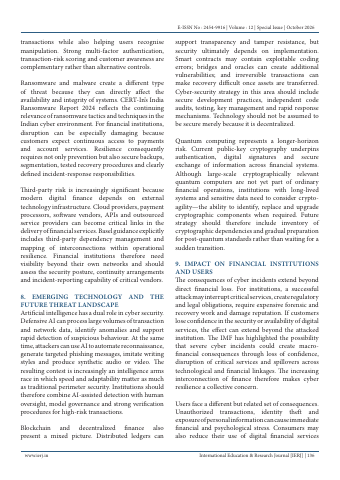
- Findings from CERT-In's India Ransomware Report 2024 emphasize that ransomware continuously threatens financial operational availability and data integrity [p.5].p.5
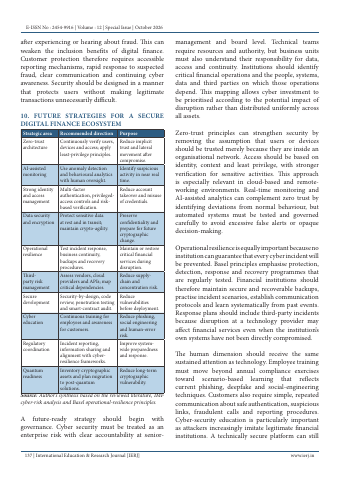
- A comprehensive resilience strategy requires action across 10 strategic areas, including zero-trust architecture, strong identity controls, and third-party risk management [p.6].p.6
Key insights
- Traditional perimeter-based security controls are insufficient for modern digital finance systems reliant on remote work, cloud infrastructure, and APIs [p.2].p.2
- Generative AI and deepfake technologies significantly enhance social engineering deception by imitating legitimate individuals with high realism [p.3].p.3
- Decentralized finance systems are vulnerable to machine-speed exploits stemming from smart-contract coding errors, bridge flaws, and oracle manipulation [p.5].p.5
- Financial institutions need crypto-agility to inventory and upgrade public-key cryptographic assets before quantum computing compromises current standards [p.5].p.5
- Zero-trust architecture strengthens financial network defense by enforcing continuous verification and least-privilege access rules [p.6].p.6
- Third-party vendor dependencies, including cloud and API providers, create indirect systemic operational and concentration risks [p.6].p.6
- Cyber security in digital finance must evolve from threat prevention alone toward tested operational resilience and rapid service recovery capability [p.7].p.7
Pages
 p.1
 p.2
 p.3
 p.4
 p.5
 p.6
 p.7
 p.8
Topics and entities
Summary and figures generated from the document and checked automatically: every number shown appears on the cited page. Publishers can request removal.