The Impact of the Transformation of Central Bank Digital Currencies (CBDC)-Based Global Payments on the Financial Efficiency of Multinational Corporations (Ekonis Jurnal Ekonomi dan Bisnis)
Summary
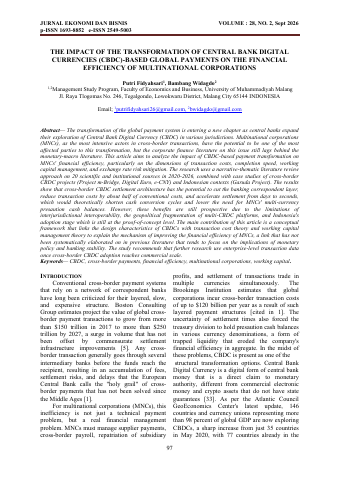
- Global cross-border payment transactions are projected to expand from over $150 trillion in 2017 to more than $250 trillion by 2027.p.1
- Layered payment structures cause global corporations to incur cross-border transaction costs of up to $120 billion annually.p.1
- Global CBDC exploration grew from 35 countries in May 2020 to 146 countries in 2026, with 77 reaching advanced development, pilot, or launch stages.p.4
- Project m-Bridge completed over 4,000 cross-border transactions valued at approximately $55.5 billion by early 2026.p.5
- CBDC implementation is projected to shorten MNC cross-border Days Sales Outstanding from 45 days to 31 days, representing a 31% reduction.p.5
- Cross-border transaction costs for corporations are projected to decrease from 2.5% to 1.3% of transaction value, achieving a 48% savings.p.5
- MNC multi-currency preventive cash balances are projected to fall from 18% to 11% of average monthly cross-border debt, a 39% reduction.p.5
Key insights
- CBDC-based cross-border settlement architectures eliminate intermediate correspondent banking layers, cutting transaction fees by around 50% compared to conventional payment rails.p.5
- Transitioning cross-border payments to instant wholesale CBDC execution shifts liquidity management from multi-day processing to near real-time seconds.p.5
- The e-CNY digital currency accounts for approximately 95 percent of total settlement volume on the multi-jurisdictional m-Bridge platform.p.4
- Payment-versus-payment mechanisms within cross-border CBDCs reduce fund transit risks, allowing corporate treasurers to lower short-term currency hedging allocations.p.6
- Bank Indonesia completed the wholesale w-Rupiah proof of concept under Project Garuda in December 2024 and acts as an observer on Project m-Bridge.p.6
- The Bank for International Settlements divested from Project m-Bridge in 2024 due to regulatory and sanctions compliance concerns.p.6
- CBDC holding limits designed to protect commercial bank deposits from disintermediation may constrain large corporate liquidity transfers.p.6
Pages
 p.1
 p.2
 p.3
 p.4
 p.5
 p.6
 p.7
 p.8
Topics and entities
Summary and figures generated from the document and checked automatically: every number shown appears on the cited page. Publishers can request removal.