The Effect of Fintech Competition on the Profitability of Deposit Money Banks in Nigeria (International Journal of Accounting Management and Economic Review)
Summary
- During H1 2022, 10 Nigerian Deposit Money Banks expended N81.92 billion on ICT, representing a 58.7% rise from 2021 to construct digital channels and connect with fintechs.p.6
- The sampled Deposit Money Banks recorded an average Return on Assets of 0.2912 during the study period, with a maximum of 0.4031 and a minimum of 0.0792.p.14
- Mobile Money Transaction Volume posted a mean value of 12.3280, ranging between a minimum of 10.4984 and a maximum of 13.9875.p.14
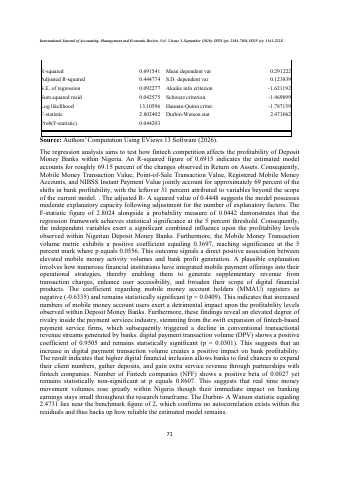
- The panel regression framework produced an R-squared value of 0.6915, indicating that the model explains approximately 69.15 percent of changes in bank profitability.p.18
- Mobile money account users demonstrated a statistically significant negative relationship with bank profitability, exhibiting a coefficient of -0.6335 with a p-value of 0.0409.p.18
Key insights
- Mobile money transaction volume exerts a statistically significant positive effect on the profitability of Deposit Money Banks in Nigeria.p.1
- The total number of mobile money account users negatively impacts bank profitability as payment service fintechs directly contest retail banking revenue.p.1
- The number of licensed fintech firms displays a positive but statistically non-significant effect on the profitability of commercial banks.p.1
- Competitive stress from fintech entrants forces traditional banks to make significant investments in software, network infrastructure, and cyber security.p.6
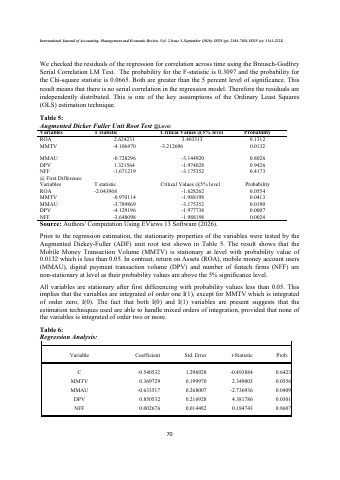
- Centered Variance Inflation Factor values ranging between 1.06 and 1.29 confirm that multicollinearity is not present among the explanatory variables.p.16
- Diagnostic tests using the Breusch-Pagan-Godfrey test confirm that regression residuals are homoskedastic with a Chi-square probability of 0.3506.p.16
- The Breusch-Godfrey Serial Correlation LM test confirms the absence of autocorrelation, validating the OLS panel estimation assumptions.p.17
- Fintech competition presents dual characteristics for traditional banks, acting simultaneously as an operational challenge and a strategic innovation catalyst.p.19
Pages
 p.1
 p.2
 p.3
 p.4
 p.5
 p.6
 p.7
 p.8
 p.9
 p.10
 p.11
 p.12
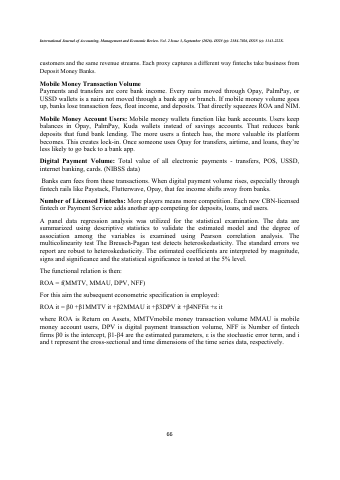 p.13
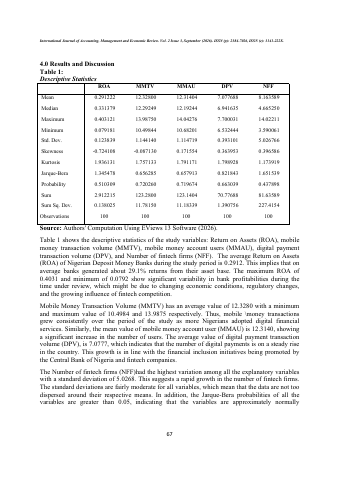 p.14
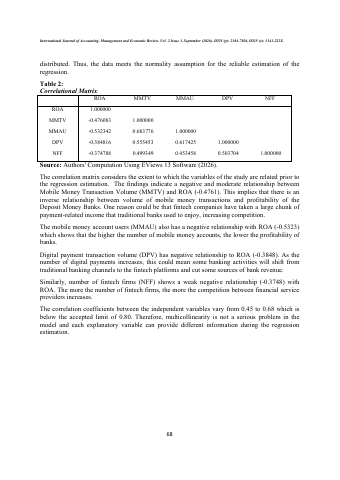 p.15
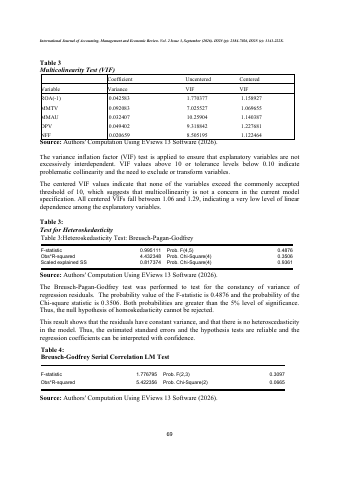 p.16
 p.17
 p.18
 p.19
 p.20
 p.21
 p.22
Topics and entities
Summary and figures generated from the document and checked automatically: every number shown appears on the cited page. Publishers can request removal.