Machine Learning Based Fraud Detection System (INTERANTIONAL JOURNAL OF SCIENTIFIC RESEARCH IN ENGINEERING AND MANAGEMENT)
Summary
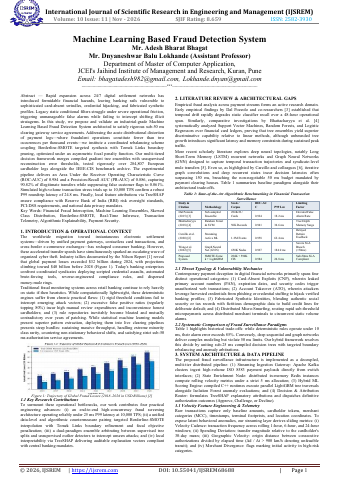
- The proposed machine learning fraud detection pipeline achieves an ROC-AUC of 0.984 and a PR-AUC of 0.886 across 284,807 European cardholder logs.p.1
- The experimental model captures 90.82% of illegitimate transfers while suppressing false customer flags to 0.061%.p.1
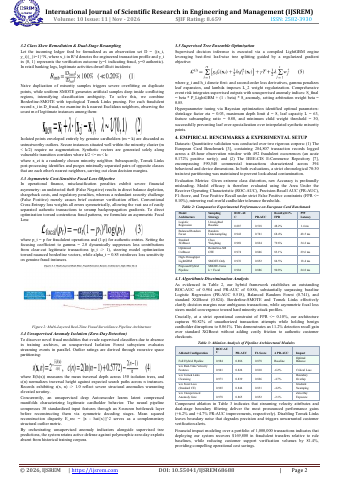
- The European Card Benchmark evaluation corpus consists of 284,807 transaction records with 492 fraudulent occurrences, reflecting a 0.172% positive rarity.p.2
- The IEEE-CIS E-Commerce Repository dataset encompasses 590,540 commercial transactions characterized across 394 behavioral and device dimensions.p.2
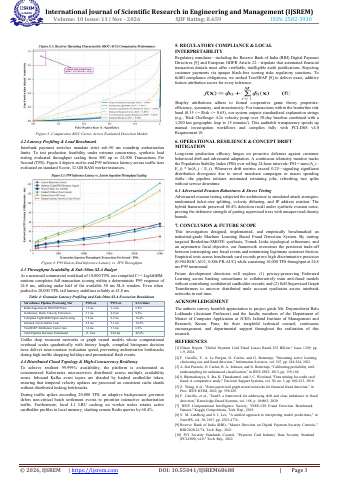
- Under simulated stress trials at 10,000 TPS, the compiled C++ LightGBM runtime completes full transaction scoring with a P99 response of 24.8 ms.p.3
- When transaction load is increased to 20,000 TPS, tail latency stabilizes at 43.8 ms.p.3
Key insights
- Legacy static conditional filters struggle under operational friction, triggering false alarms while failing to intercept shifting illicit stratagems.p.1
- Deep neural topologies like LSTM and Graph Neural Networks often surpass 150 ms latencies, breaching the sub-50 ms clearing gateway service agreements.p.1
- Supervised tree outputs are merged with unsupervised anomaly indices using an arbitration weight beta of 0.85.p.2
- Both evaluation benchmarks maintained a strict chronological 70:30 train-test partitioning to prevent look-ahead contamination.p.2
- TreeSHAP integration provides exact, additive feature attribution scores to comply with Reserve Bank of India directives and GDPR Article 22 requirements.p.3
- Continuous Population Stability Index monitoring triggers automated model retraining whenever drift metrics exceed 0.25 over rolling 24-hour intervals.p.3
- The hybrid framework preserved 88.4% detection recall under simulated adversarial evasion attacks.p.3
Pages
 p.1
 p.2
 p.3
Topics and entities
Summary and figures generated from the document and checked automatically: every number shown appears on the cited page. Publishers can request removal.