Implementation of Machine Learning for Waqif Honesty Detection in Blockchain-Based Digital Waqf Systems (Computer Journal)
Summary
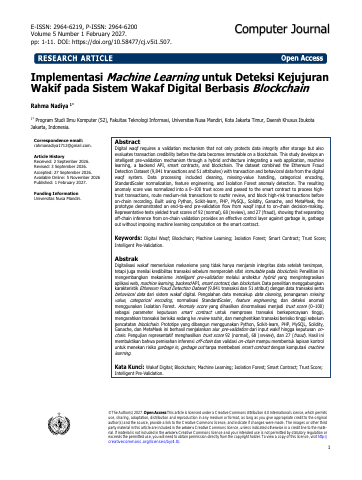
- The study integrated the Ethereum Fraud Detection Dataset containing 9,841 transactions and 51 attributes with digital waqf system behavioral data.p.1
- Data preprocessing involved cleaning, missing value handling, categorical encoding, StandardScaler normalization, and Isolation Forest anomaly detection.p.1
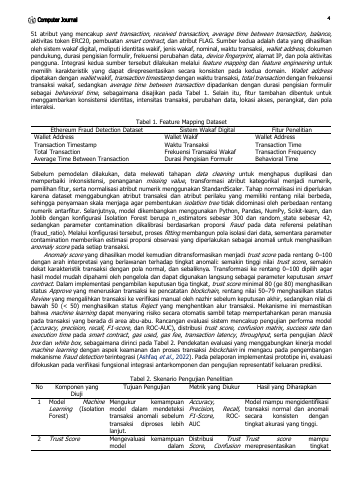
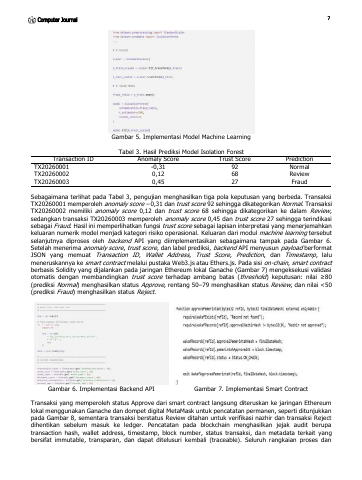
- The Isolation Forest model was configured with 300 n_estimators and a random_state parameter of 42 off-chain.p.4
- Transactions with a trust score of minimal 80 are assigned an Approve status and recorded on the blockchain.p.4
- Transactions in the 50–79 trust score range are assigned a Review status for manual nazhir verification.p.4
- Transactions with a trust score below 50 are assigned a Reject status and stopped prior to blockchain recording.p.4
- Representative testing generated trust scores of 92 for normal transactions, 68 for review transactions, and 27 for fraud transactions.p.1
Key insights
- Executing machine learning inferencing off-chain prevents imposing heavy computational costs on smart contracts while establishing an effective input control layer.p.1
- Blockchain guarantees post-recording data integrity but cannot automatically ensure the credibility of data before it is recorded.p.2
- Smart contracts execute deterministic rules based on received trust score parameters rather than detecting novel anomaly patterns adaptively.p.2
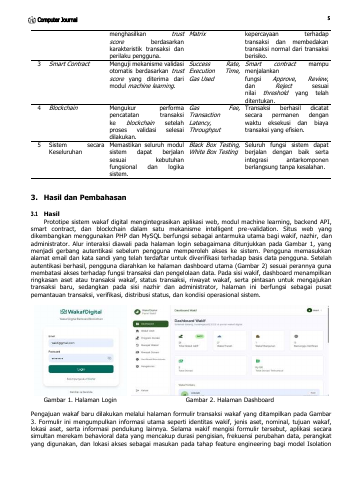
- The web application layer automatically records behavioral data, including access time, IP address, device fingerprints, and form input duration.p.3
- Converting anomaly scores to a 0–100 trust score provides an interpretable operational bridge between statistical models and smart contract decision logic.p.4
- Representative sample transaction TX20260001 yielded an anomaly score of -0,31 and a trust score of 92, resulting in a Normal prediction.p.7
- Representative sample transaction TX20260002 produced an anomaly score of 0,12 and a trust score of 68, resulting in a Review prediction.p.7
- Representative sample transaction TX20260003 resulted in an anomaly score of 0,45 and a trust score of 27, resulting in a Fraud prediction.p.7
Pages
 p.1
 p.2
 p.3
 p.4
 p.5
 p.6
 p.7
 p.8
 p.9
 p.10
 p.11
Topics and entities
Summary and figures generated from the document and checked automatically: every number shown appears on the cited page. Publishers can request removal.