Digital Transformation of Banking in Improving Efficiency: A Study on Indonesian Digital Banks (Management Analysis Journal)
Summary
- The study analyzes secondary financial data from 5 Indonesian digital banks across the 2018–2025 period using a panel ARDL model.p.1
- Digital banks in Indonesia maintain high capital adequacy levels exceeding the minimum regulatory requirement of 8%.p.3
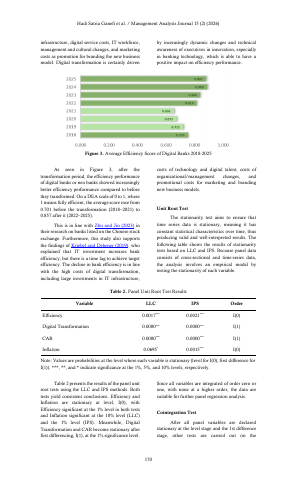
- Average Data Envelopment Analysis efficiency scores for the banks increased from 0.701 during 2018–2021 to 0.857 during 2022–2025.p.5
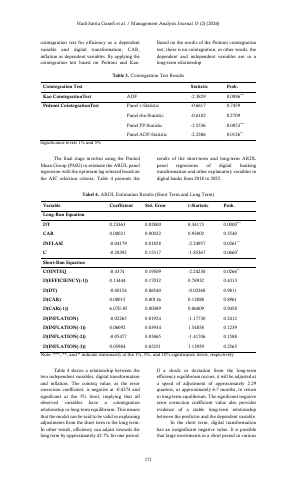
- Panel unit root tests confirm that efficiency is stationary at level I(0) with an LLC test probability of 0.0017.p.5
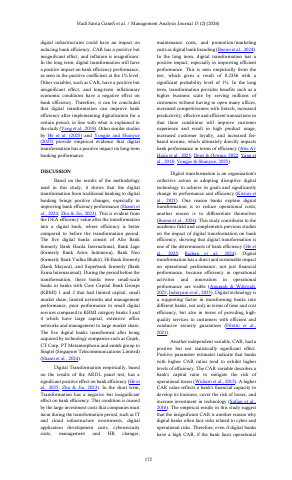
- The short-run error correction coefficient COINTEQ is -0.4374, showing adjustment back to long-term equilibrium at a rate of 43.7% per period.p.6
Key insights
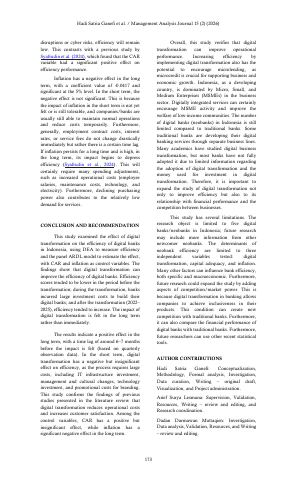
- Digital transformation has no significant effect on Indonesian digital bank efficiency in the short term but exerts a positive and significant effect in the long term.p.1
- Pre-transformation investment costs in technology infrastructure, digital outsourcing, talent, and branding temporarily depress bank operational efficiency.p.5
- The average efficiency score of digital banks improved from 0.701 before transformation to 0.857 after transformation.p.5
- Capital Adequacy Ratio has a positive but statistically insignificant impact on bank efficiency in both short-term and long-term periods.p.6
- Long-term inflation exhibits a statistically significant negative effect on digital bank efficiency performance.p.6
- Short-term deviations from long-term efficiency equilibrium adjust at a speed of approximately 6-7 months.p.6
Pages
 p.1
 p.2
 p.3
 p.4
 p.5
 p.6
 p.7
 p.8
 p.9
 p.10
Topics and entities
Summary and figures generated from the document and checked automatically: every number shown appears on the cited page. Publishers can request removal.