Blockchain-Based Data Security for Digital Payment Systems in India (Zenodo (CERN European Organization for Nuclear Research))
Summary
- The paper introduces a permissioned blockchain layer to enhance data security for digital payment systems in India across volume 3, issue 10(III) published on 31 Oct. 2026.p.1
- The study sets 8 major research objectives and 5 research questions addressing data-security threats and architectural design for digital payments.p.2
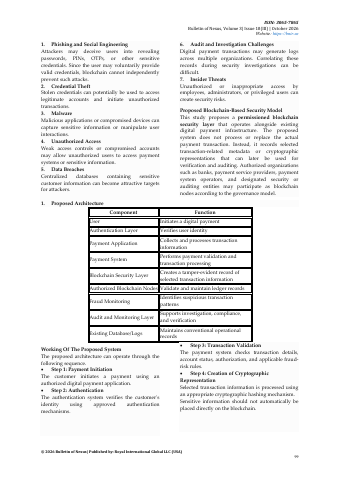
- The proposed model uses an 8-step workflow where selected transaction metadata is processed into cryptographic hashes without replacing actual payment execution.p.4
- The architecture leverages 7 security properties including permissioned access, digital signatures, and tamper-evident records to support cross-organizational auditability.p.5
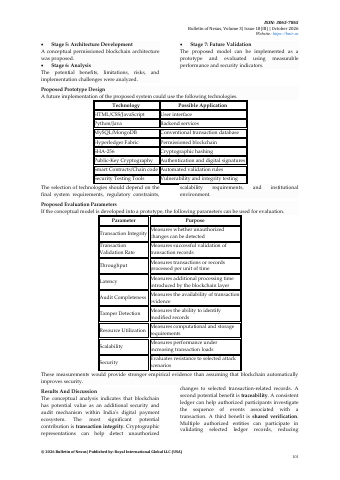
- The conceptual model presents 10 evaluation parameters such as transaction validation rate, throughput, latency, and tamper detection for future prototype benchmarking.p.6
- Future research outlines 8 focus areas including AI-based fraud detection, zero-knowledge privacy techniques, and quantum-resistant cryptography.p.7
Key insights
- A permissioned blockchain acts as an additional security and audit layer rather than replacing existing payment infrastructure.p.1
- Permissioned blockchain networks restrict participation to authorized entities, making them suitable for regulated financial environments.p.2
- Blockchain serves as one component of a broader security architecture alongside controls like multi-factor authentication and fraud monitoring.p.3
- The proposed security model records cryptographic metadata on-chain rather than directly processing or storing actual payment transactions.p.4
- Applying a data-minimization principle by storing only transaction hashes and proofs on-chain mitigates privacy risks while preserving integrity.p.5
- Hyperledger Fabric and SHA-256 are selected as primary candidate technologies for prototyping the permissioned security layer.p.6
- Blockchain integrity records cannot independently prevent phishing or social-engineering attacks where valid credentials are used.p.7
- Future payment-security architectures will need post-quantum cryptographic techniques to withstand risks from quantum computing.p.7
Pages
 p.1
 p.2
 p.3
 p.4
 p.5
 p.6
 p.7
 p.8
 p.9
Topics and entities
Summary and figures generated from the document and checked automatically: every number shown appears on the cited page. Publishers can request removal.