Beyond Adoption: Behavioural Validation of an Integrated FinTech Engagement Framework in India (Journal of Intelligent Decision Making and Information Science)
Summary
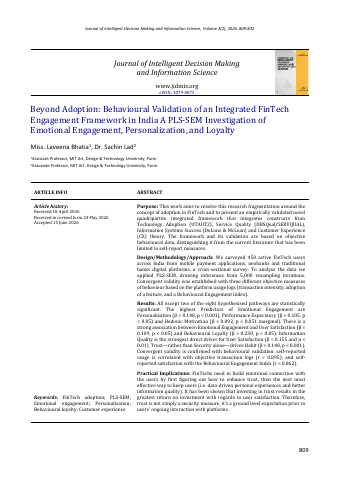
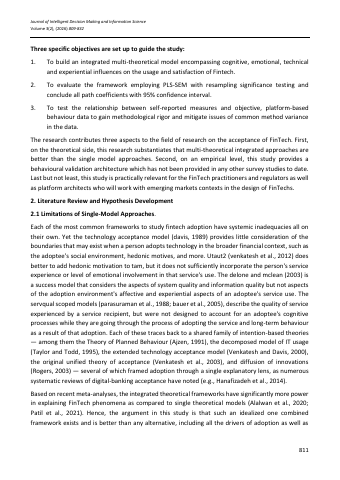
- The study surveyed 450 active FinTech users across India to empirically validate a quadripartite integrated framework using PLS-SEM with 5,000 resampling iterations.p.1
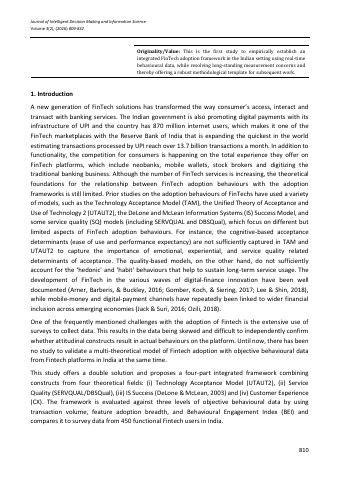
- The Reserve Bank of India estimates that monthly transactions processed by UPI reach over 13.7 billion transactions.p.2
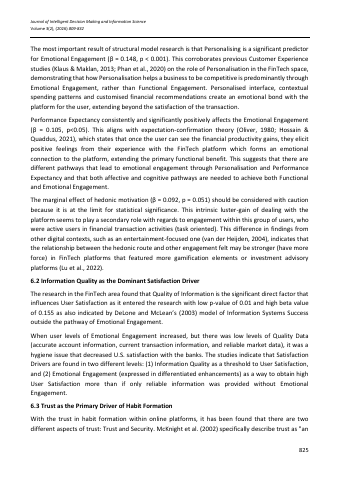
- Personalisation emerged as the strongest direct predictor of Emotional Engagement with a path coefficient of β = 0.148 (p < 0.001).p.1
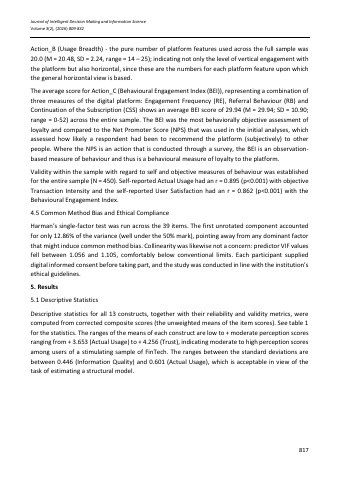
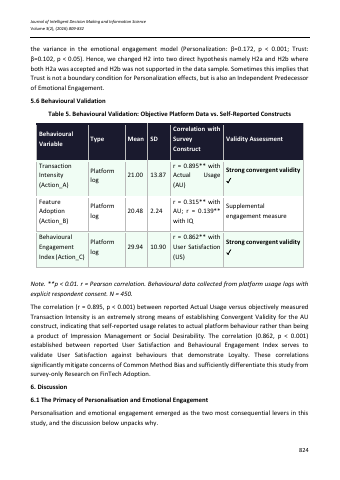
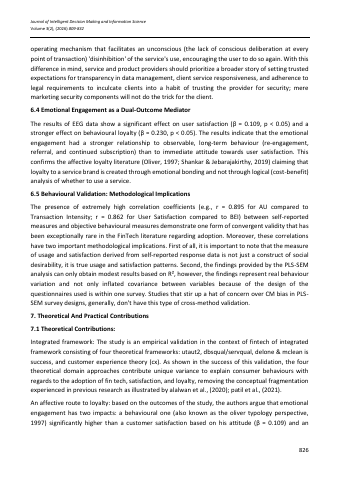
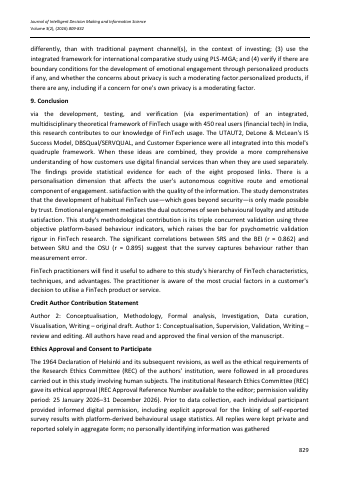
- Self-reported actual usage demonstrated strong convergent validity with objective platform transaction logs, showing a correlation of r = 0.895 (p < 0.001).p.9
- Self-reported user satisfaction correlated strongly with the objective Behavioural Engagement Index at r = 0.862 (p < 0.001).p.9
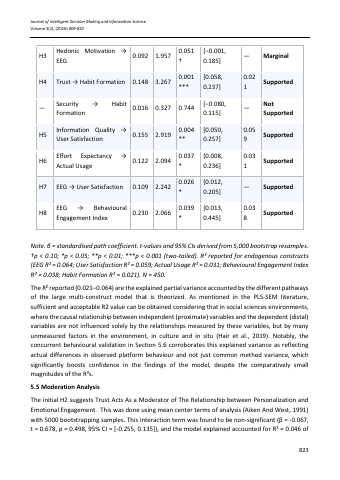
- Information Quality was determined to be the strongest direct driver of User Satisfaction, recording a path coefficient of β = 0.155 (p < 0.01).p.1
- The sample of 450 FinTech users comprised 47.30% wallet/UPI users, 18.70% neobank users, 17.10% broker/investment app users, and 16.90% bank app users.p.8
Key insights
- Emotional Engagement significantly drives both User Satisfaction (β = 0.109, p < 0.05) and Behavioural Loyalty (β = 0.230, p < 0.05).p.1
- Trust directly drives Habit Formation (β = 0.148, p < 0.001), whereas Security alone does not show a statistically significant effect.p.1
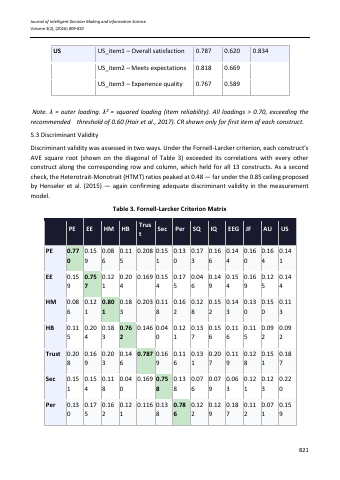
- Harman's single-factor test accounted for 12.86% of total variance, confirming minimal risk of common method bias.p.9
- The sample recorded a mean score of 29.94 for the objective Behavioural Engagement Index.p.9
Pages
 p.1
 p.2
 p.3
 p.4
 p.5
 p.6
 p.7
 p.8
 p.9
 p.10
 p.11
 p.12
 p.13
 p.14
 p.15
 p.16
 p.17
 p.18
 p.19
 p.20
 p.21
 p.22
 p.23
 p.24
Topics and entities
Summary and figures generated from the document and checked automatically: every number shown appears on the cited page. Publishers can request removal.