AI-Based Fraud Detection and Financial Risk Management (Zenodo (CERN European Organization for Nuclear Research))
Summary
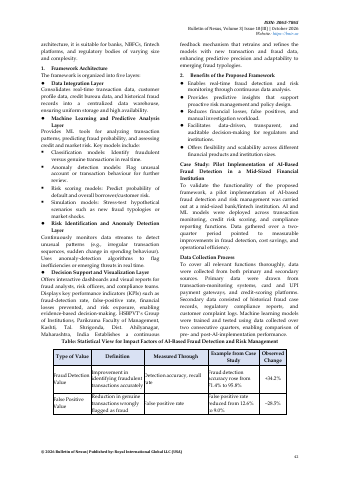
- In a pilot study, AI-based fraud detection accuracy rose from 71.4% to 95.8%.p.4
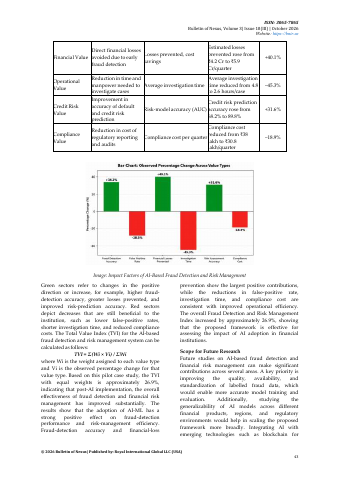
- Direct financial losses prevented due to early fraud detection increased from ₹4.2 Cr to ₹5.9 Cr/quarter.p.5
- Average case investigation time for fraud cases was reduced from 4.8 to 2.6 hours/case.p.5
- Credit risk prediction accuracy (AUC) improved from 68.2% to 89.8%.p.5
- Compliance costs associated with regulatory reporting and audits decreased from ₹38 lakh to ₹30.8 lakh/quarter.p.5
- The overall Fraud Detection and Risk Management Index increased by approximately 26.9% following AI implementation.p.5
Key insights
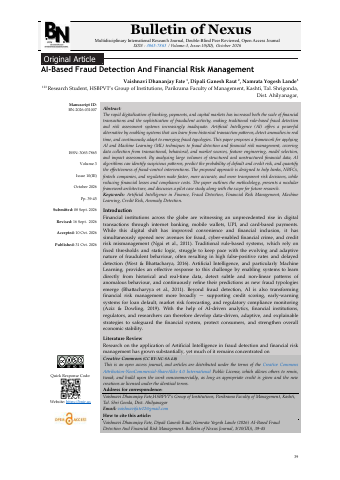
- Traditional rule-based detection systems rely on static thresholds, resulting in high false-positive rates and delayed responses.p.1
- Deploying machine learning models achieved an observed positive change of +34.2% in fraud detection accuracy.p.4
- Early fraud detection enabled a +40.1% increase in quarterly financial savings from prevented losses.p.5
- Operational efficiency improved significantly with a -45.3% reduction in average case investigation duration.p.5
- Default prediction and credit risk scoring accuracy demonstrated a +31.6% observed improvement.p.5
- Quarterly regulatory reporting and audit compliance costs dropped by -18.9% post-implementation.p.5
- Equal-weight calculation of the Total Value Index showed an overall system effectiveness gain of approximately 26.9%.p.5
Pages
 p.1
 p.2
 p.3
 p.4
 p.5
 p.6
 p.7
Topics and entities
Summary and figures generated from the document and checked automatically: every number shown appears on the cited page. Publishers can request removal.