A Hybrid Approach Based on Ensemble Learning and SMOTE Technique for Credit Card Fraud Detection (INTERANTIONAL JOURNAL OF SCIENTIFIC RESEARCH IN ENGINEERING AND MANAGEMENT)
Summary
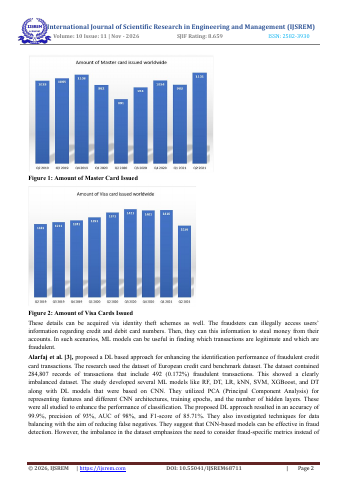
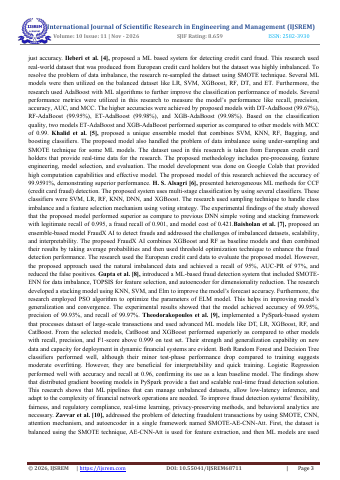
- By 2020, Mastercard and Visa issued 2,287 million credit cards worldwide, with Mastercard issuing 1156 million and Visa issuing 1131 million cards.p.1
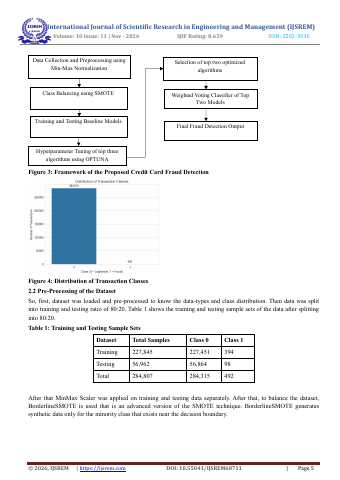
- The benchmark Kaggle credit card dataset comprises 284,807 transaction records, where 99.83% are non-fraud transactions and 0.17% represent credit card fraud.p.4
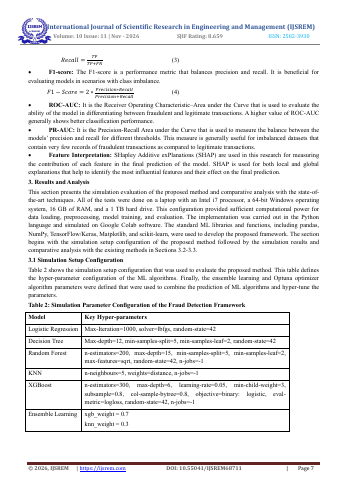
- Applying BorderlineSMOTE to the training set expanded the fraud class from 394 to 68,235 samples.p.8
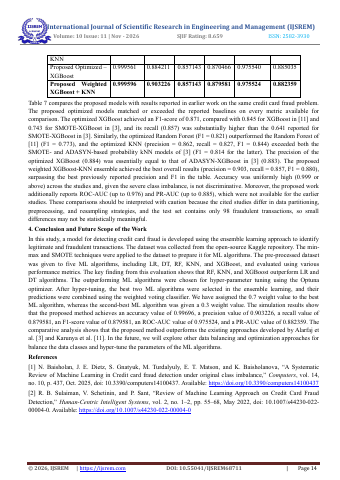
- Across overall framework evaluations, the proposed method reached an accuracy of 0.99696, precision of 0.903226, recall of 0.879581, and ROC-AUC of 0.975524.p.14
Key insights
- The Kaggle benchmark credit card transaction dataset exhibits severe class imbalance, with fraud transactions constituting only 0.17% of total records.p.4
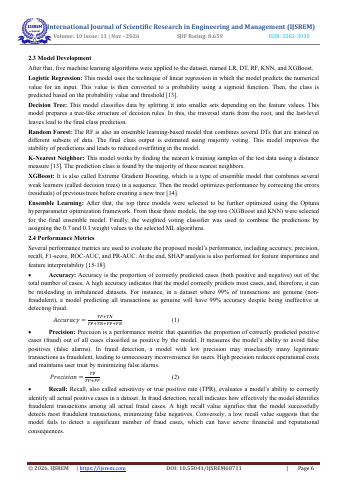
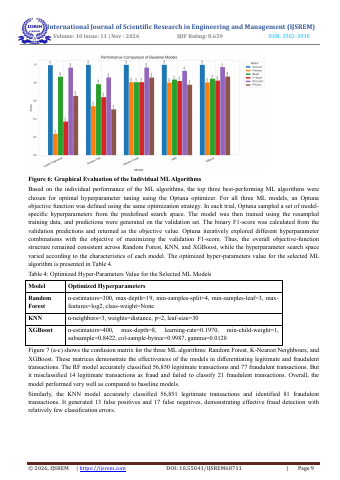
- Hyperparameter optimization using the Optuna framework was executed across candidate models to maximize validation F1-scores.p.9
- Applying BorderlineSMOTE exclusively to the training set increased fraud cases from 394 to 68,235 without altering test data distributions.p.8
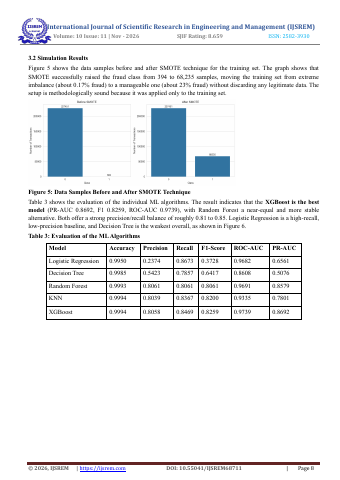
- XGBoost demonstrated superior individual baseline performance among evaluated standalone machine learning models prior to hyperparameter tuning.p.8
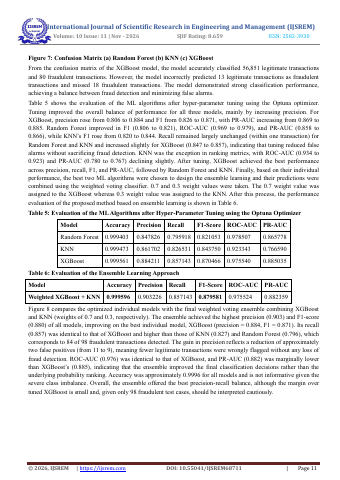
- Assigning voting weights of 0.7 to XGBoost and 0.3 to KNN achieved higher precision than any individual tuned algorithm.p.11
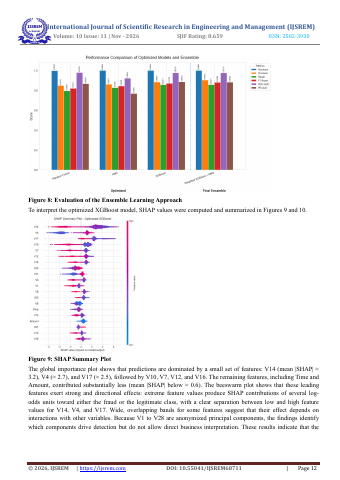
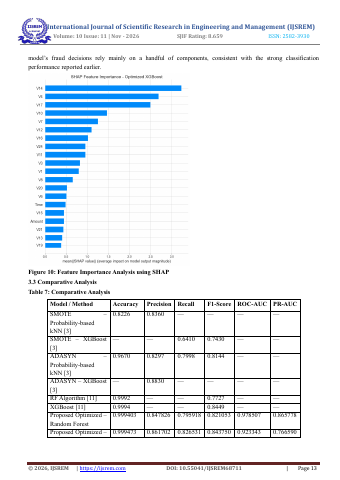
- SHAP feature analysis revealed that model fraud predictions are primarily driven by components V14, V4, and V17.p.12
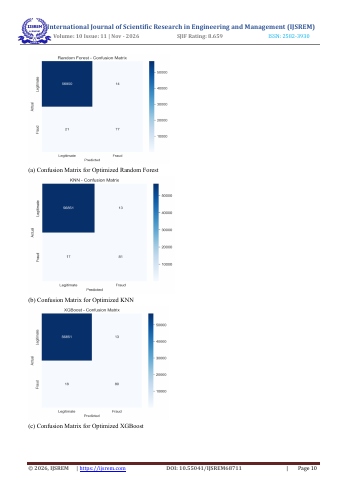
- The weighted voting classifier reduced false positive predictions from 11 to 9 compared to the single best tuned model.p.11
- Comparative evaluations confirmed that the proposed hybrid ensemble achieves higher precision and F1-score metrics than previous literature benchmarks.p.14
Pages
 p.1
 p.2
 p.3
 p.4
 p.5
 p.6
 p.7
 p.8
 p.9
 p.10
 p.11
 p.12
 p.13
 p.14
 p.15
 p.16
Topics and entities
Summary and figures generated from the document and checked automatically: every number shown appears on the cited page. Publishers can request removal.