A Deep Learning Ensemble With Data Resampling For Credit Card Fraud Detection (Adolescencia e Saude)
Summary
- The proposed deep learning ensemble combined with the SMOTE-ENN method achieved a sensitivity of 1.000 and a specificity of 0.997.p.1
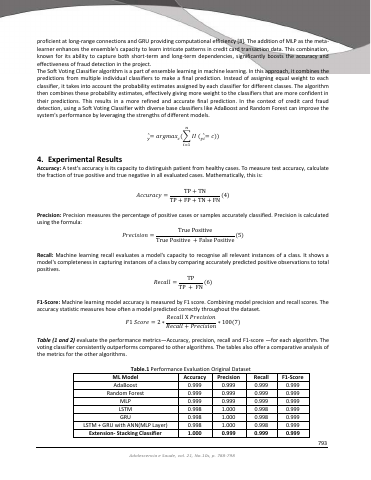
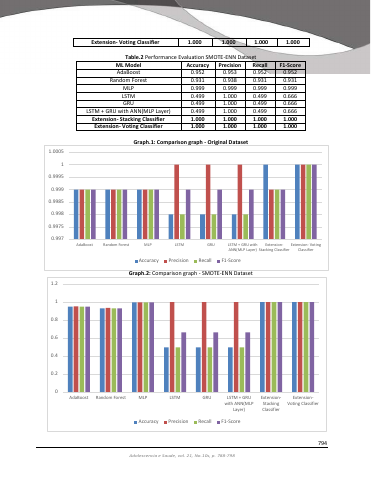
- When evaluated on the original dataset, the extension Voting Classifier achieved performance scores of 1.000 across accuracy, precision, recall, and F1-score.p.6
- On the SMOTE-ENN dataset, both the Stacking Classifier and Voting Classifier recorded scores of 1.000 across all evaluation metrics.p.7
- Resampling training data only with ADASYN resulted in logistic regression obtaining a precision of 1.81% and an F1 score of 3.55%.p.3
- Deep reinforcement learning models performed weakly on imbalanced credit card datasets, achieving 34.8% accuracy.p.3
Key insights
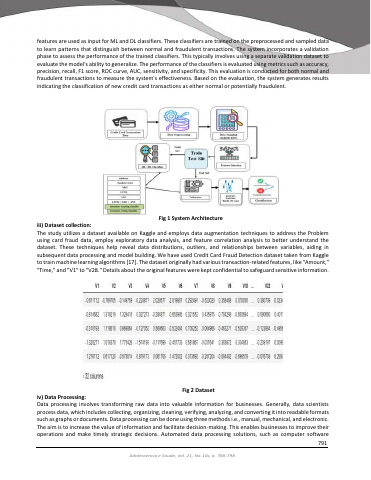
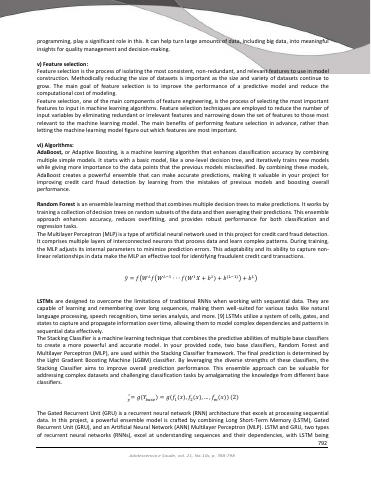
- The framework utilizes long short-term memory (LSTM) and gated recurrent unit (GRU) base learners combined with a multilayer perceptron (MLP) meta-learner to handle dynamic shopping patterns and class imbalance.p.1
- A systematic review of 40 articles published from 2015 to 2021 revealed limited research on deep learning techniques for credit card fraud detection.p.2
- Applying resampling techniques before the train/test split artificially inflates machine learning model outcomes to over 99% accuracy.p.3
- Deep reinforcement learning models evaluated on imbalanced transaction data showed poor performance with 34.8% accuracy.p.3
- The extension Voting Classifier consistently outperformed base models across both the original and SMOTE-ENN datasets.p.6
- The implementation includes a web front-end built on the Flask framework integrated with SQLite for authentication and fraud testing.p.1
Pages
 p.1
 p.2
 p.3
 p.4
 p.5
 p.6
 p.7
 p.8
 p.9
 p.10
 p.11
Topics and entities
Summary and figures generated from the document and checked automatically: every number shown appears on the cited page. Publishers can request removal.