The 2026 State of Open Source in Financial Services
Financial services contributors generated 1,260,883 commits to public GitHub repositories in 2026, representing a 63% increase year-over-year.
90 documents
Financial services contributors generated 1,260,883 commits to public GitHub repositories in 2026, representing a 63% increase year-over-year.
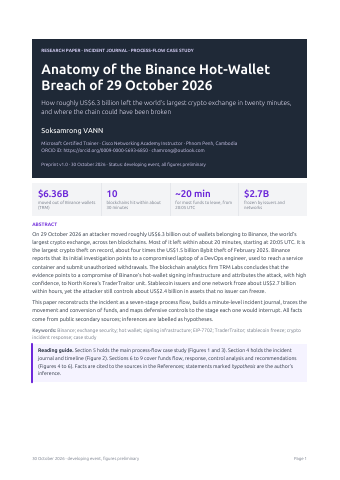
An attacker moved roughly US$6.3 billion out of Binance wallets across ten blockchains, with most funds leaving within about 20 minutes starting at 20:05 UTC on 29 October 2026.
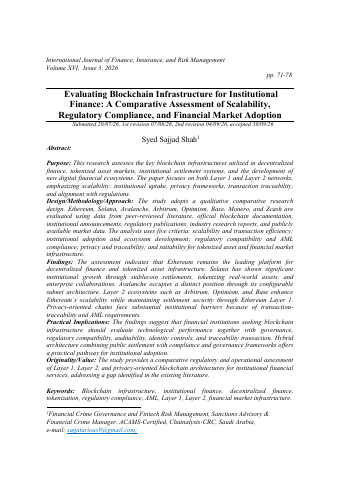
Ethereum accounted for $12.3 billion of the $19.08 billion global market for tokenized real-world assets excluding stablecoins in early January 2026.
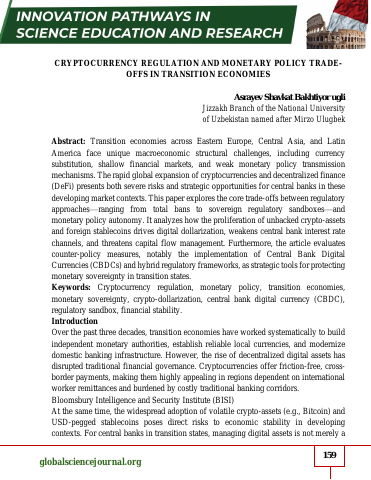
Transition economies across Eastern Europe, Central Asia, and Latin America face unique structural macroeconomic challenges, including currency substitution and weak monetary policy transmission.
In 2022, global real premium growth contracted by −0.8% for general insurance and −3.8% for life insurance before recovering in 2023.
The study analyzes a bibliometric dataset of 695 English-language Scopus records published between 2023 and 2025 to map the intellectual structure of GenAI in finance.
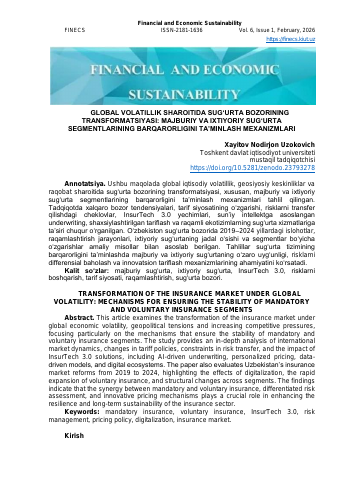
In 2025, gross written premiums in Uzbekistan reached UZS 13.46 trillion, representing a year-on-year increase of 37.8%.
In a March 2026 survey of 938 U.S. investors, 62% reported using AI tools for investment decisions, 22% used them to assist portfolio decisions, and 24% named "market herding" as a concern.
Global Sharia-compliant financial assets have expanded into an architecture with total assets exceeding US$3 trillion.
The Financial Stability Board (FSB) identified 12 sound practices to help all financial institutions realise the benefits of AI while managing its risks responsibly.
The IMR review working group was established in 2024 to evaluate the implementation status of international financial reforms and recommend improvements to monitoring.
A stocktake conducted by the FSB gathered 126 modernisation efforts from 24 jurisdictions and 3 SSBs across various financial sectors and entity types.
Global financial wealth is projected to grow by 10.7% in 2025 to reach US$333 trillion according to BCG's report.
As of mid-2026, the total market value for stablecoins stands at around $300 billion.
The study conducts an empirical investigation covering 74 countries over the 2002 – 2022 period to evaluate how digital financial innovations impact systemic financial stability.
Only 4 (21%) of reviewed jurisdictions are fully compliant with KA 6, while 8 (42%) are materially non-compliant.
Corporate stablecoin adoption live in production doubled from 9% in 2025 to 18% in 2026.
In 2025, large European companies invested EUR 512 billion in green and transition assets, representing 21% of overall corporate investment in the European Union.
Mario Draghi estimated that the EU requires €1.2 trillion of annual investment to compete globally in an integrated market of 450 million people.
The aggregate monetary base of OECD countries increased from $2.5 trillion in 2000 to a peak of $25 trillion in March 2022.
Between 2008 and 2025, real GDP in the Eurozone grew at an average annual rate of just 0.9%, resulting in a 16.9% cumulative increase, while the US economy grew by 40.5% over the same period.
Around 70% of respondents reported that the escalation of the conflict in the Middle East negatively affected their business during Q2.
Industrials led global sector distribution in Q1 2026, accounting for 61 IPOs and $14b in proceeds.
Deloitte interviewed 35 decision makers, including COOs, CTOs, and heads of transformation at wealth management firms globally.
The report presents findings from 307 family offices across more than 30 markets worldwide, with an average net worth of USD 2.7 billion.
Over 90 percent of surveyed central banks are engaged in some form of CBDC work, with more than half involved in experiments or pilot projects.
The note categorizes single-ledger arrangements into 4 operating models: integration, distribution, separation, and permissionless.
Over 1 billion people currently live in Fragile and Conflict-Affected States, where payment ecosystem disruptions present severe risks to economic stability.
In a 2023 BIS survey, almost all surveyed central banks reported considering offline CBDC payments to be vital or advantageous.
In 2024, Swiss real gross domestic product (GDP) growth slowed to 1,0 %, while the State Secretariat for Economic Affairs (SECO) forecasts a slight recovery to 1,3 % for 2025.