Voting Ensemble Framework with SMOTE for Financial Fraud Detection in Highly Imbalanced Transaction Data (INTERANTIONAL JOURNAL OF SCIENTIFIC RESEARCH IN ENGINEERING AND MANAGEMENT)
Summary
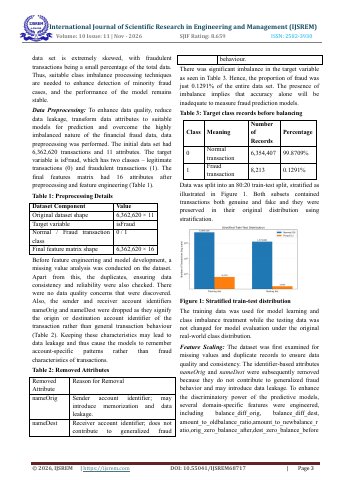
- The framework addresses extreme class imbalance in a dataset comprising 6,362,620 transaction records, where only 8,213 records (0.1291%) represent fraudulent activity.p.1
- Data preprocessing transformed the initial dataset shape from 6,362,620 × 11 into a engineered matrix of 6,362,620 × 16 attributes.p.3
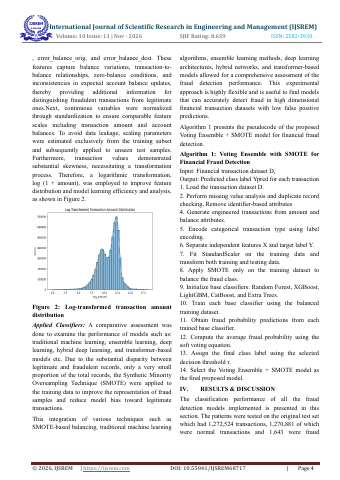
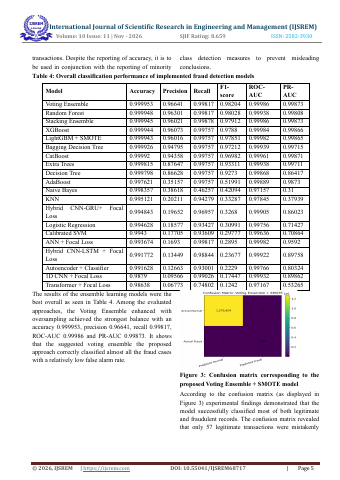
- The experimental evaluation used an unmanipulated test subset of 1,272,524 transactions containing 1,270,881 legitimate records and 1,643 fraudulent records.p.4
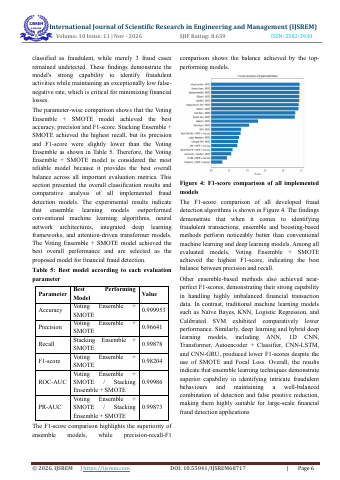
- While the Voting Ensemble achieved the top F1-score of 0.98204, the Stacking Ensemble + SMOTE configuration attained the highest recall score of 0.99878.p.6
Key insights
- Traditional threshold-based fraud monitoring systems lack the capability to detect emerging fraud patterns compared to modern machine learning algorithms.p.1
- Account identifiers nameOrig and nameDest were intentionally removed prior to training to eliminate data leakage and account-specific memorization.p.3
- Continuous transaction variables were standardized using parameters calculated strictly from training data to maintain evaluation integrity on unseen test samples.p.4
- Ensemble and boosting methods consistently outperformed neural networks and transformer-based architectures across all primary classification metrics.p.5
- Stacking Ensemble + SMOTE obtained the highest recall rate of 0.99878, though with slightly lower precision than the soft voting ensemble.p.6
- Deep learning architectures combined with Focal Loss, including 1D CNN and Transformer models, recorded lower overall F1-scores than tree-based ensemble methods.p.6
Pages
 p.1
 p.2
 p.3
 p.4
 p.5
 p.6
 p.7
 p.8
Topics and entities
Summary and figures generated from the document and checked automatically: every number shown appears on the cited page. Publishers can request removal.