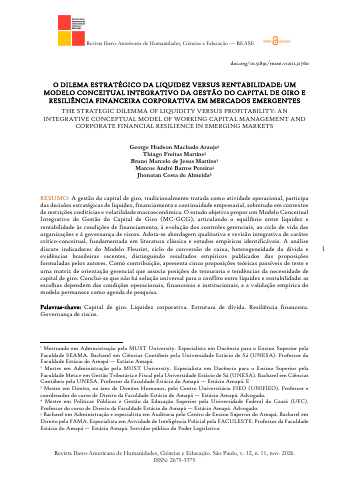
The Strategic Dilemma of Liquidity Versus Profitability: An Integrative Conceptual Model of Working Capital Management and Corporate Financial Resilience in Emerging Markets (Revista Ibero-Americana de Humanidades, Ciências e Educação)
Summary
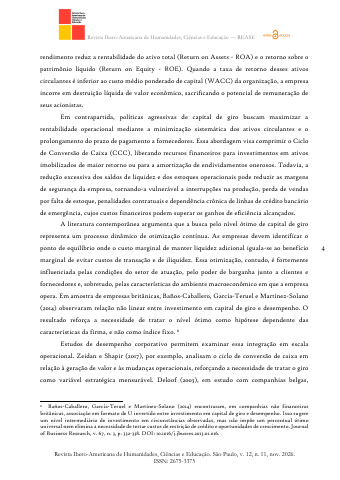
- Deloof investigated working capital management and profitability using a sample of 1,009 Belgian non-financial companies observed between 1992 and 1996.p.5
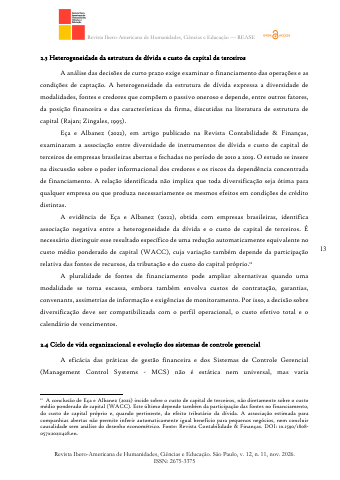
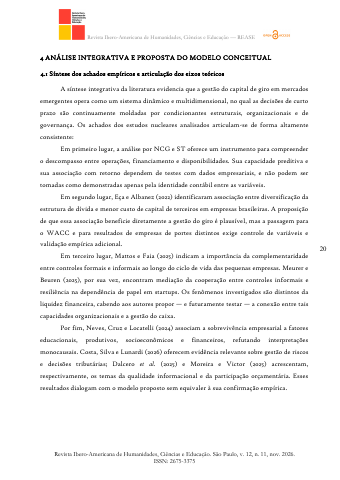
- Eça and Albanez analyzed the relationship between debt structure heterogeneity and capital costs across Brazilian listed and unlisted firms during the 2010 to 2019 period.p.13
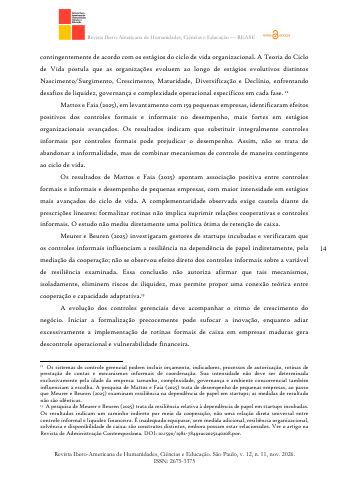
- An empirical study on small business management control systems and performance by Mattos and Faia was based on a survey of 159 small companies.p.14
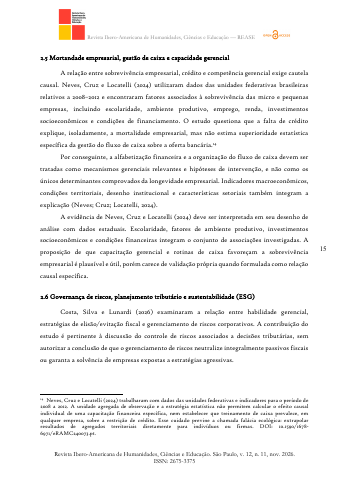
- Neves, Cruz and Locatelli evaluated factors influencing micro and small enterprise survival in Brazil using regional indicators from 2008 to 2012.p.15
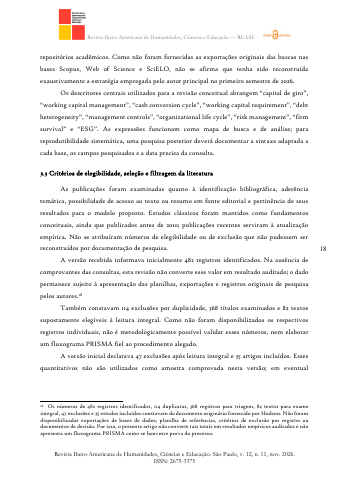
- The literature retrieval process described in the document noted 482 identified records, from which 114 duplicate entries were removed.p.18
- From the remaining 368 screened titles in the initial literature review phase, 82 full-text articles were evaluated for potential inclusion.p.18
Key insights
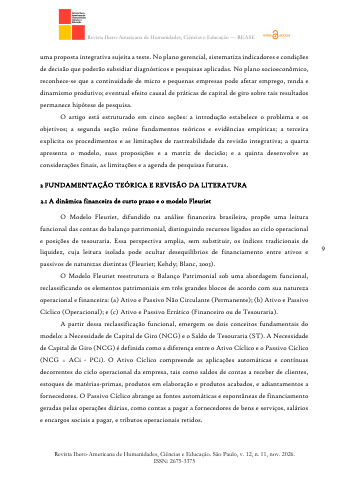
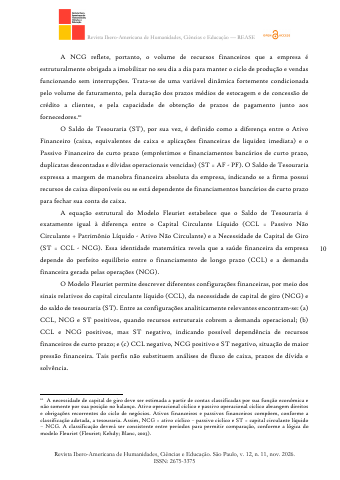
- The Fleuriet framework reclassifies balance sheet accounts functionally into cyclical, permanent, and financial categories to assess working capital requirements and treasury positions.p.9
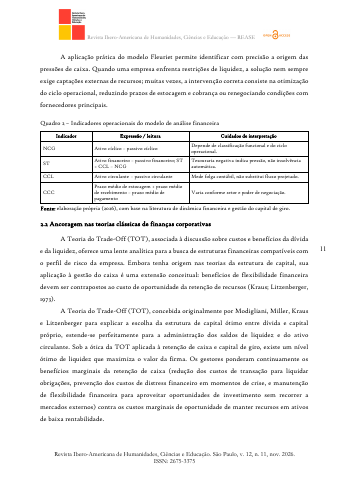
- Trade-Off Theory posits that optimal corporate cash retention balances the marginal benefits of liquidity against the marginal opportunity costs of holding low-yield assets.p.11
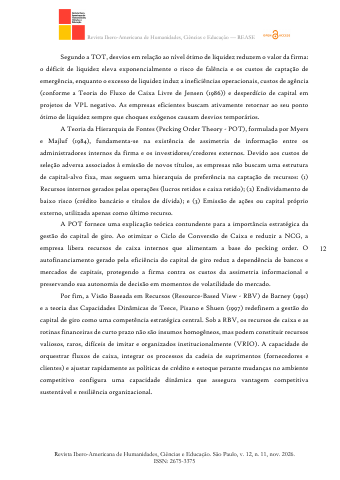
- Pecking Order Theory suggests that firms prioritize cash generated from working capital efficiency to minimize asymmetric information costs associated with external financing.p.12
- Empirical evidence from Brazilian corporate data demonstrates a negative association between debt structure heterogeneity and the cost of debt capital.p.13
- Informal management controls in incubated startups foster organizational resilience indirectly through increased inter-firm cooperation.p.14
- Small business survival in emerging markets is driven by a multidimensional set of socio-economic, educational, and financial factors rather than credit availability alone.p.15
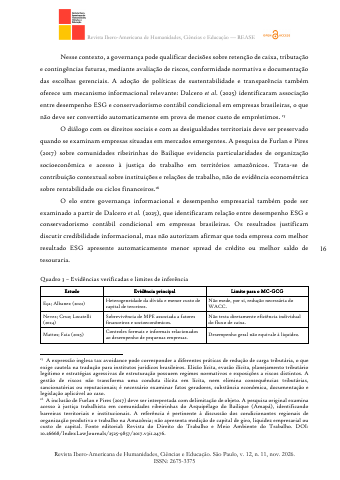
- Higher corporate ESG performance in Brazilian companies is positively associated with conditional accounting conservatism.p.16
Pages
 p.1
 p.2
 p.3
 p.4
 p.5
 p.6
 p.7
 p.8
 p.9
 p.10
 p.11
 p.12
 p.13
 p.14
 p.15
 p.16
 p.17
 p.18
 p.19
 p.20
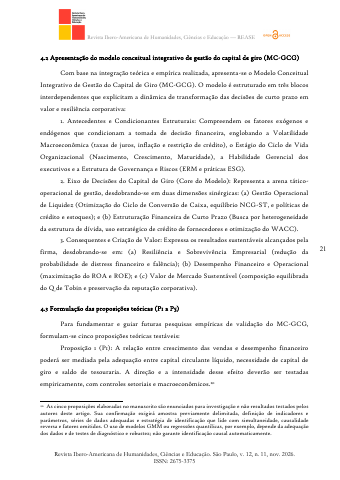 p.21
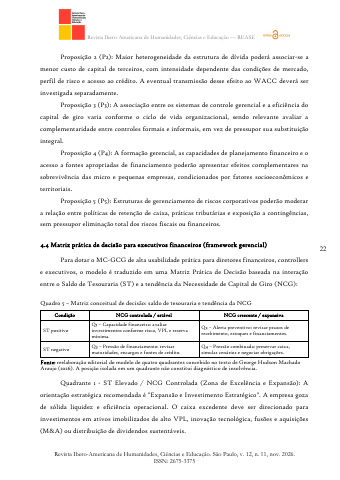 p.22
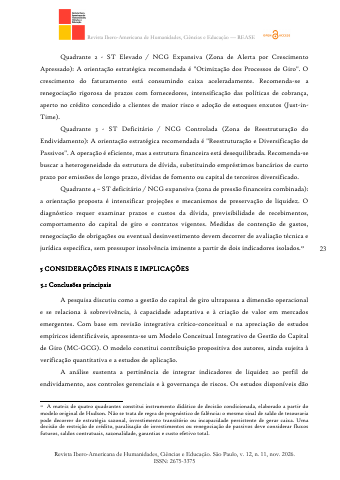 p.23
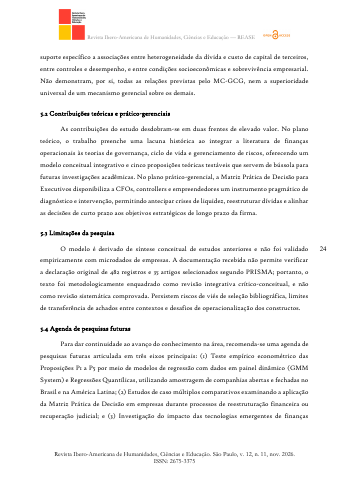 p.24
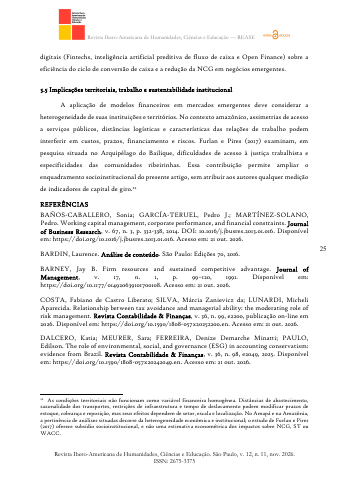 p.25
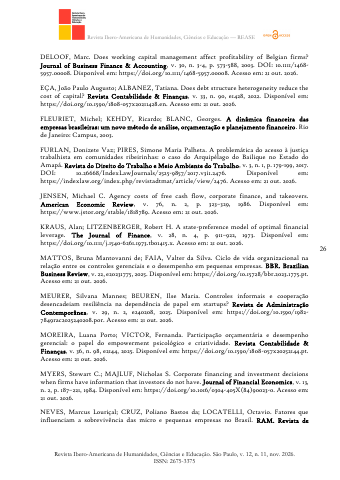 p.26
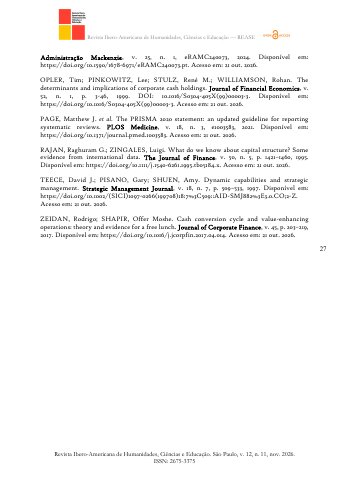 p.27
Topics and entities
Summary and figures generated from the document and checked automatically: every number shown appears on the cited page. Publishers can request removal.