The Influence of Financial Literacy and Fear of Missing Out on Forex Overtrading Behavior in Generation Z Investors (Jurnal EMT KITA)
Summary
- The study surveyed 97 Generation Z retail forex traders aged 17–29 years in Surabaya City to examine overtrading behavior.p.1
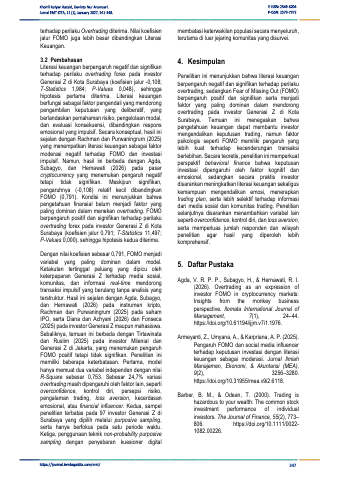
- Financial literacy showed a negative and significant effect on forex overtrading with a path coefficient of -0.108, T-statistics of 1.984, and P-values of 0.048.p.1
- Fear of Missing Out (FOMO) demonstrated a positive and significant effect on overtrading with a path coefficient of 0.791, T-statistics of 11.497, and P-values of 0.000.p.1
- Together, financial literacy and FOMO yielded an R-Square value of 0.753, explaining 75.3% of the variation in overtrading behavior.p.1
- Indonesia's national financial literacy index reached 66,46%, while the financial inclusion index stood at 80,51%.p.2
- Data from KSEI as of December 2025 showed total Indonesian capital market investors reached 20.347.147 SID, with 54,24% aged ≤30 years.p.2
Key insights
- Fear of Missing Out (FOMO) is the dominant factor driving forex overtrading behavior among Generation Z investors in Surabaya.p.1
- Financial literacy plays a significant role in reducing excessive trading tendencies by encouraging deliberative decision-making.p.7
- Global daily forex transaction value reached approximately US$9,6 triliun per day in April 2025 according to BIS data.p.2
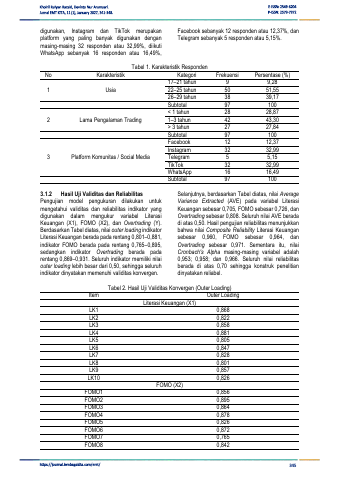
- Instagram and TikTok are the most popular social platforms among respondents, used by 32 respondents (32,99%) each.p.5
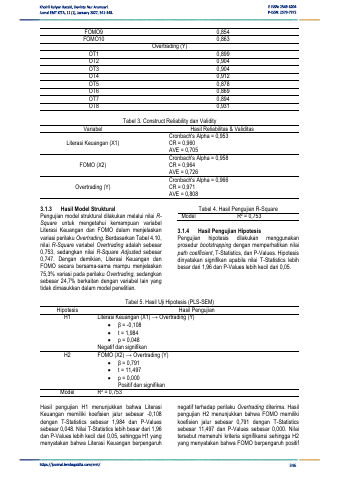
- The measurement model confirmed high construct validity, with Overtrading achieving an AVE of 0,808 and Composite Reliability of 0,971.p.6
- The adjusted R-Square value of 0,747 leaves 24,7% of overtrading variance attributable to unmodeled external factors.p.6
Pages
 p.1
 p.2
 p.3
 p.4
 p.5
 p.6
 p.7
 p.8
Topics and entities
Summary and figures generated from the document and checked automatically: every number shown appears on the cited page. Publishers can request removal.