The Growth of Crypto Assets and Its Impact on CBDC Design and Central Banking Roles: Evidence from Indonesia (Jurnal Manajemen dan Bisnis Madani)
Summary
- Crypto transaction value in Indonesia experienced significant growth, expanding by 335.91 percent annually to 650.61 trillion rupiahp.2
- Demographic shifts drive digital financial adoption in Indonesia, where Millennials, Generation Z, and Gen Alpha comprise 69.64 percent of the populationp.2
- Survey data reveals that only 14.9 percent of crypto holders in Indonesia use crypto assets as payment instruments, with the vast majority treating them as investment vehiclesp.8
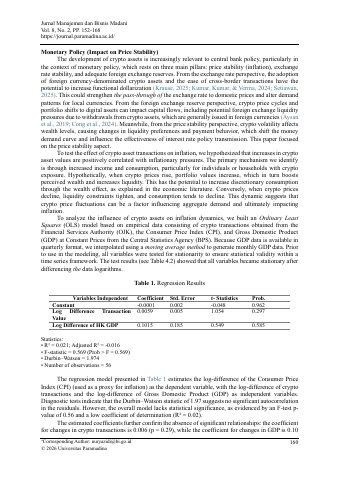
- An OLS regression model covering 56 observations shows an R² of 0.021 and an F-statistic p-value of 0.569, confirming no significant effect of crypto transactions on inflationp.9
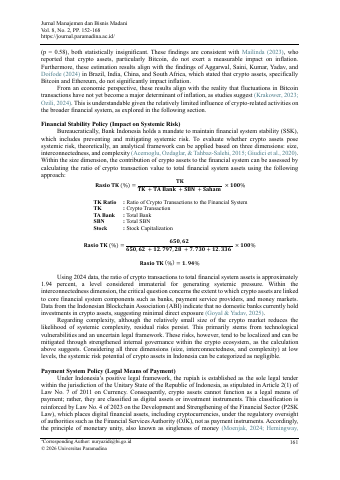
- The ratio of crypto transactions to total financial system assets in Indonesia was 1.94 percent, posing negligible systemic risk to financial stabilityp.10
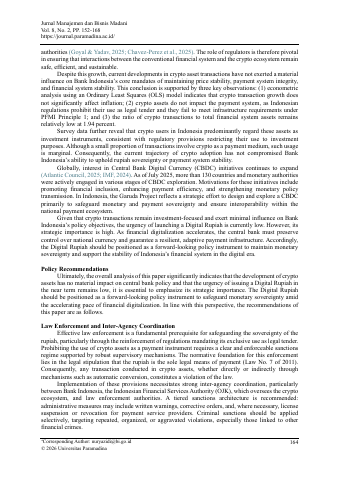
- Global CBDC exploration continues to expand, with over 130 countries and monetary authorities engaged in CBDC research or development as of July 2025p.13
Key insights
- 1. Cryptocurrency adoption in Indonesia is overwhelmingly driven by investment motives, as 66.7 percent of surveyed users state they would not substitute crypto with a CBDC.p.8
- 2. Empirical analysis demonstrates that crypto asset transactions do not exert a statistically significant influence on domestic price stability or inflation.p.9
- 3. Financial stability risks from crypto assets remain minimal, supported by a 1.94 percent transaction-to-asset ratio and zero direct bank asset exposure.p.10
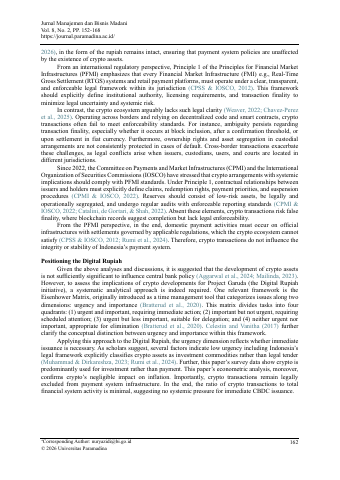
- 4. Under Law No. 7 of 2011, crypto assets cannot function as legal tender in Indonesia, maintaining the singleness of the rupiah.p.10
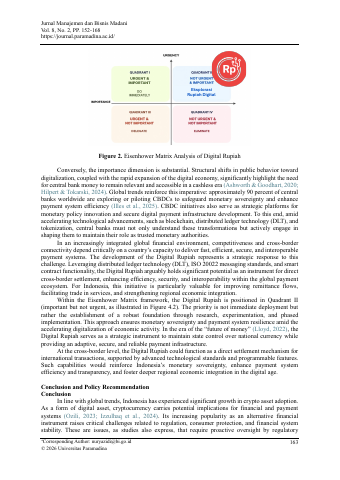
- 5. The Eisenhower Matrix positions the issuance of a Digital Rupiah in Quadrant II as an important but not urgent central bank initiative.p.12
- 6. Over 90 percent of global central banks are actively exploring CBDCs to preserve monetary sovereignty and modernize payment infrastructure.p.12
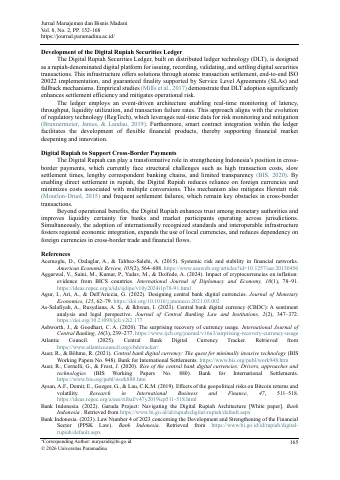
- 7. The proposed Digital Rupiah Securities Ledger utilizes distributed ledger technology and ISO 20022 standards to enable atomic settlement and reduce operational risk.p.14
Pages
 p.1
 p.2
 p.3
 p.4
 p.5
 p.6
 p.7
 p.8
 p.9
 p.10
 p.11
 p.12
 p.13
 p.14
 p.15
 p.16
 p.17
Topics and entities
Summary and figures generated from the document and checked automatically: every number shown appears on the cited page. Publishers can request removal.