State, Regions and Strategic Governance in Europe and India: Land Tokenisation and AI Stack in Finance (ShodhPrabandhan Journal of Management Studies)
Summary
- India's UPI digital public infrastructure processes 14 billion transactions monthly.p.2
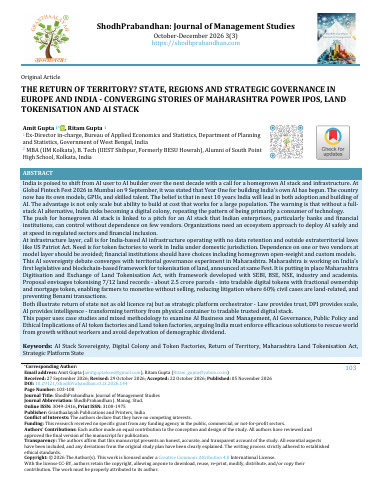
- The Maharashtra government plans to tokenise 7/12 land records covering about 2.5 crore parcels into tradable digital tokens.p.1
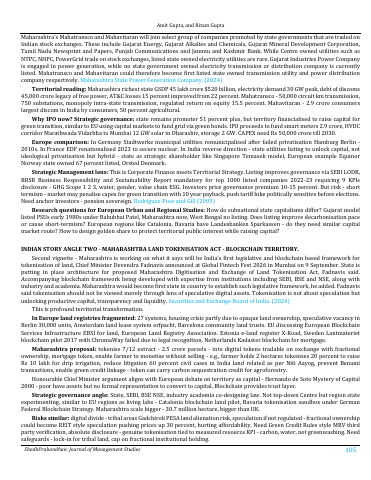
- Maharashtra maintains a GSDP of 45 lakh crore ($520 billion), with discom legacy debt standing at 45,000 crore.p.3
- Mahavitaran serves 2.9 crore consumers and requires a total capital expenditure of Rs 50,000 crore till 2030.p.3
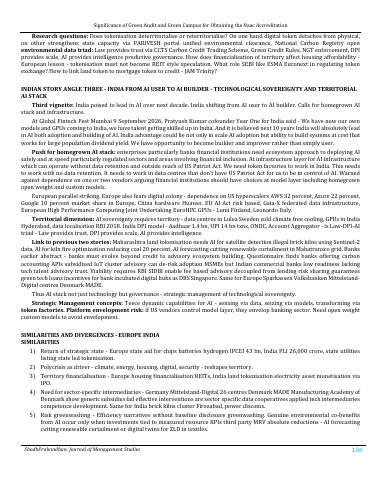
- US hyperscalers retain strong cloud dominance in Europe, with AWS holding 32 percent, Azure 22 percent, and Google 10 percent market share.p.4
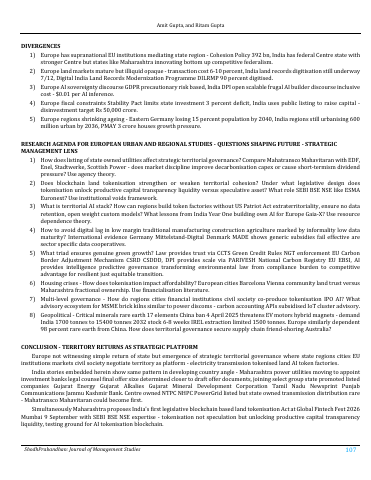
- India targets a public listing disinvestment goal of Rs 50,000 crore while managing urban growth expected to reach 600 million urban residents by 2036.p.5
Key insights
- India is positioning itself to shift from an AI user to an AI builder by establishing its own homegrown AI stack and data infrastructure.p.1
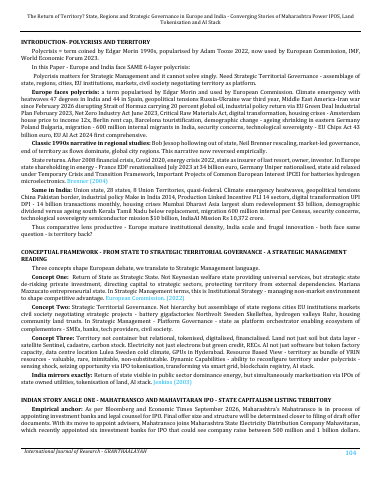
- European and Indian governance structures face a shared 6-layer polycrisis covering climate, geopolitics, industrial policy, housing, demographics, and technological sovereignty.p.2
- Maharashtra is introducing the Maharashtra Digitisation and Exchange of Land Tokenisation Act to streamline property records and reduce land-related civil litigation, which currently accounts for 60% of civil cases.p.1
- State-owned utilities Mahatransco and Mahavitaran in Maharashtra are preparing for public stock market listings to unlock capital for the green transition.p.3
- Proponents call for India-based AI token factories to operate without data retention and outside extraterritorial laws like the US Patriot Act.p.4
- European entities rely on frameworks like Gaia-X and EuroHPC to build federated infrastructure and prevent digital colonization by foreign hyperscalers.p.4
Pages
 p.1
 p.2
 p.3
 p.4
 p.5
 p.6
Topics and entities
Summary and figures generated from the document and checked automatically: every number shown appears on the cited page. Publishers can request removal.