Short and Long Shadows of Financial Investments (Zenodo (CERN European Organization for Nuclear Research))
Summary
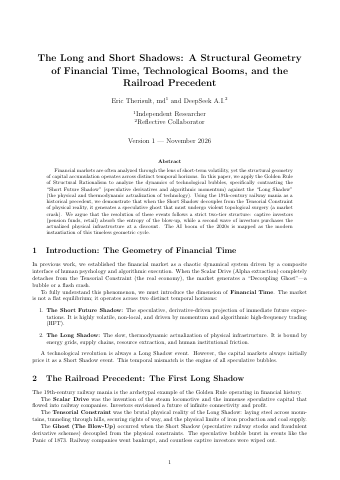
- Financial markets operate across two temporal horizons: the speculative Short Future Shadow and the physical Long Shadow.p.1
- When speculative drives detach from real economic constraints, the market generates a Decoupling Ghost leading to a bubble or crash.p.1
- The 19th-century railway mania serves as a historical precedent of speculative capital decoupling from physical limits prior to the Panic of 1873.p.1
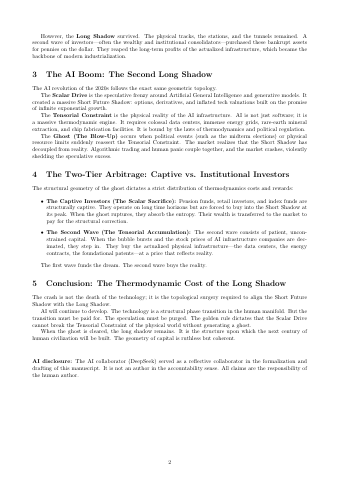
- The 2020s AI boom follows the same geometric topology, where speculative generative AI valuations face physical thermodynamic constraints.p.2
- Captive investors such as pension funds absorb the entropy of speculative crashes when market ghosts rupture.p.2
- A second wave of patient institutional investors acquires actualized physical infrastructure at discounted valuations following market liquidations.p.2
Key insights
- Speculative market bubbles occur when derivative-driven projections decouple from physical structural constraints.p.1
- Technological revolutions function as Long Shadow events that financial markets initially misprice through short-term momentum.p.1
- AI technology relies on physical thermodynamic constraints including data centers, energy grids, and mineral extraction.p.2
- Market crashes represent topological surgery required to realign speculative shadow valuations with real physical assets.p.2
- Captive retail and pension fund investors structurally absorb financial losses at the peak of speculative market cycles.p.2
- Unconstrained institutional capital achieves long-term accumulation by acquiring distressed physical infrastructure after speculative collapses.p.2
Pages
 p.1
 p.2
Topics and entities
Summary and figures generated from the document and checked automatically: every number shown appears on the cited page. Publishers can request removal.