Sentiment Analysis of BCA and Mandiri Branch and Mobile Banking User Satisfaction Using Support Vector Machine (IDEALIS : InDonEsiA journaL Information System)
Summary
- The research collected and evaluated a dataset consisting of 1,934 Google Maps reviews and 5,786 Google Play Store reviews for BCA and Mandiri.p.1
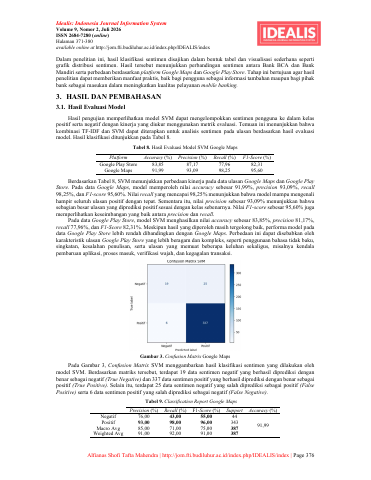
- Testing of the Support Vector Machine (SVM) model on Google Maps data achieved an accuracy of 91.99%, precision of 93.09%, recall of 98.25%, and F1-score of 95.60%.p.1
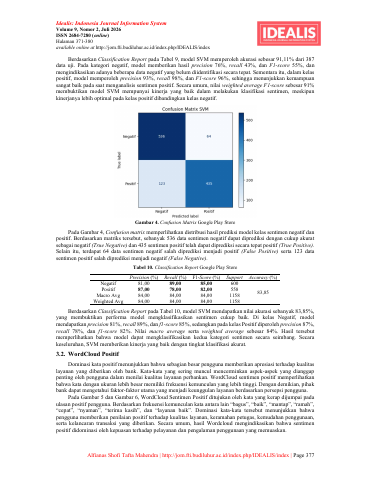
- Testing on Google Play Store data yielded an accuracy of 83.85%, precision of 87.17%, recall of 77.96%, and F1-score of 82.31%.p.1
- Positive sentiment on Google Maps reached 87.79% for Bank BCA and 88.96% for Bank Mandiri.p.1
- On Google Play Store, BCA Mobile obtained 43.68% positive sentiment, while Livin’ by Mandiri obtained 52.74%.p.1
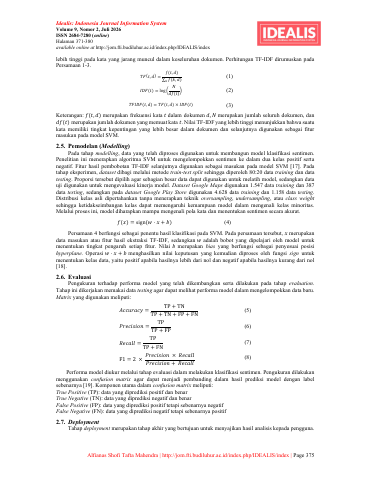
- The experimental setup used an 80:20 train-test split, resulting in 1,547 training data and 387 testing data for Google Maps, and 4,628 training data and 1,158 testing data for Google Play Store.p.5
Key insights
- Bank Mandiri obtained a higher proportion of positive sentiment than Bank BCA across both Google Maps and Google Play Store platforms.p.1
- The SVM model demonstrated strong performance on Google Maps data with a recall of 98.25%, showing high capability in correctly identifying positive sentiment reviews.p.6
- Model accuracy on Google Play Store was lower than on Google Maps due to complex review texts containing non-standard language, typos, and multiple simultaneous user complaints.p.6
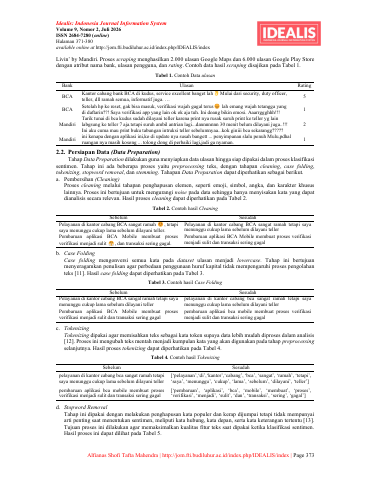
- Text preparation was executed through five distinct stages: cleaning, case folding, tokenizing, stopword removal, and stemming.p.3
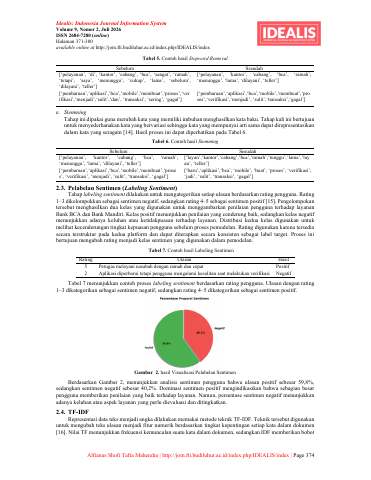
- User ratings were converted into target sentiment labels by grouping ratings 1–3 as negative sentiment and ratings 4–5 as positive sentiment.p.4
- Initial overall user sentiment analysis prior to modeling revealed that 59.8% of reviews were positive and 40.2% were negative.p.4
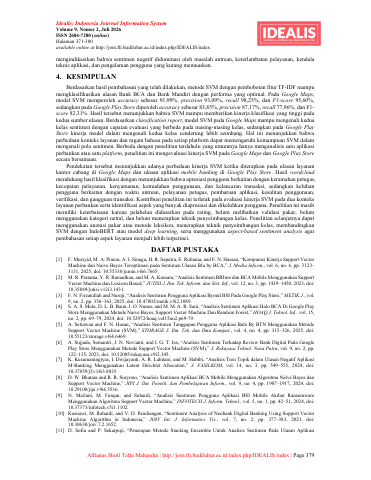
- WordCloud visualizations indicated that positive sentiment focused on staff friendliness and speed, while negative sentiment centered around physical queue waiting times and app update issues.p.9
Pages
 p.1
 p.2
 p.3
 p.4
 p.5
 p.6
 p.7
 p.8
 p.9
 p.10
Topics and entities
Summary and figures generated from the document and checked automatically: every number shown appears on the cited page. Publishers can request removal.