Leadership Turnover and Financial Inclusion Policy in the UK: Assessing Impact of Prime Ministerial Changes on Access to Banking Credit and Fintech Adoption (2021-2026) (Singaporean Journal of Business Economics and Management)
Summary
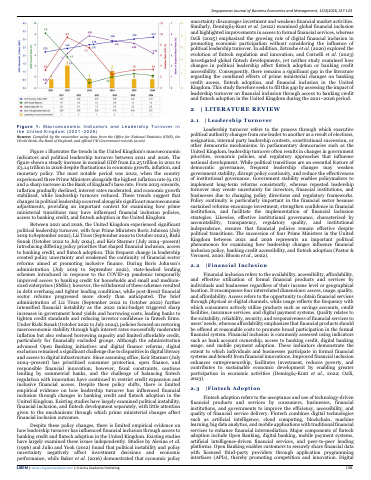
- During 2022, the UK experienced three Prime Ministers alongside a peak inflation rate of 9.1%.p.2
- Nominal UK GDP grew steadily from £2.25 trillion in 2021 to £3.14 trillion in 2026 despite macroeconomic and political shifts.p.2
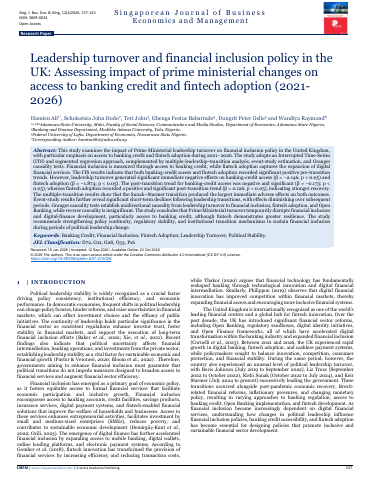
- Interrupted time-series analysis shows that Prime Ministerial leadership turnover generated an immediate negative effect on banking-credit access (β = −2.146; p < 0.05).p.1
- Leadership turnover had an immediate negative impact on fintech adoption (β = −1.874; p < 0.05).p.1
- The post-transition trend for banking-credit access was negative (β = −0.173; p < 0.05), whereas fintech adoption recorded a positive post-transition recovery trend (β = 0.126; p < 0.05).p.1
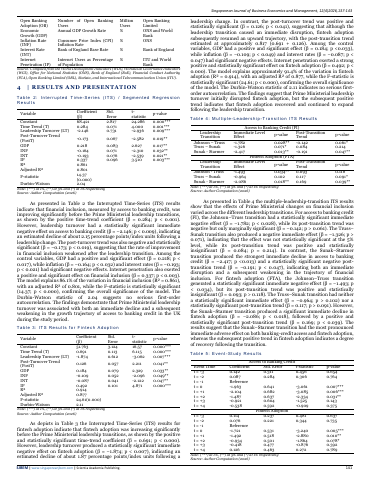
- The Sunak–Starmer transition caused the largest immediate level decline in banking credit access (β = -2.417; p = 0.013).p.5
- The empirical model for fintech adoption explains approximately 91.4% of its total variation (R² = 0.914).p.5
Key insights
- Prime Ministerial leadership turnover caused immediate short-term disruptions in access to UK banking credit (β = −2.146; p < 0.05).p.1
- Fintech adoption displayed greater post-transition resilience than banking credit access, achieving a positive post-transition recovery trend (β = 0.126; p < 0.05).p.1
- UK nominal GDP expanded from £2.25 trillion in 2021 to £3.14 trillion in 2026.p.2
- The Sunak–Starmer transition created the largest immediate adverse impact on both banking credit access (β = -2.417) and fintech adoption (β = -2.086).p.5
- Internet penetration exerted a strong positive effect on fintech adoption (β = 0.492; p < 0.000).p.5
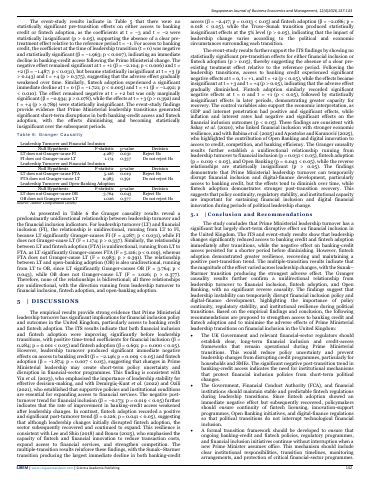
- Event-study analysis confirms a statistically significant drop in banking credit access at the transition point t = 0 (β = -1.963; p < 0.007).p.6
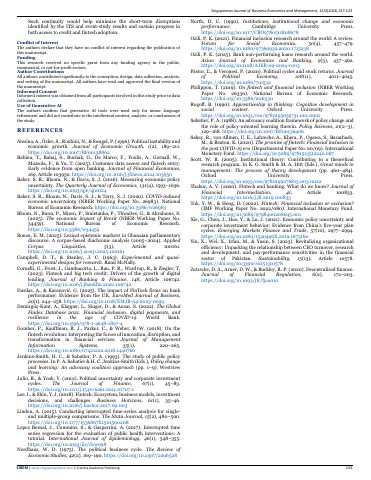
- Granger causality tests establish unidirectional causality running from political leadership turnover to financial inclusion (F = 4.287, p = 0.031) and fintech adoption (F = 5.126, p = 0.019).p.6
Pages
 p.1
 p.2
 p.3
 p.4
 p.5
 p.6
 p.7
Topics and entities
Summary and figures generated from the document and checked automatically: every number shown appears on the cited page. Publishers can request removal.