K-Means Clustering for Identifying Suspicious Patterns in Ethereum Networks (International Journal of Industrial Engineering)
Summary
- The experimental results show that the proposed K-Means clustering model achieved a classification accuracy of 98.07% and an F1-score of 98.08%.p.1
- Ethereum daily block creation exceeds 6,000 blocks, with total accounts surpassing 207 million.p.1
- Analysis of an Ethereum dataset with 9840 transactions revealed that the XGBoost classifier achieved an accuracy of 99.65%.p.3
- The study examined 184 Ponzi scheme addresses from an open-source dataset, successfully recovering bytecode for 172 of them.p.4
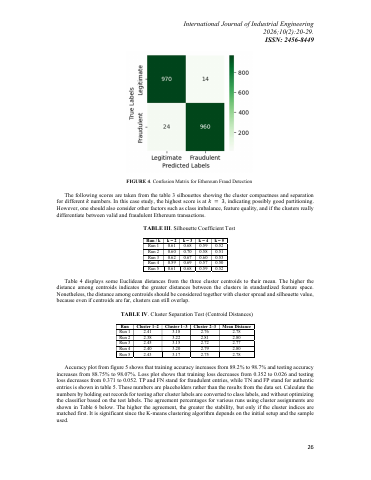
- Evaluation of the confusion matrix showed 1930 out of 1968 total transactions were correctly classified, including 970 legitimate and 960 fraudulent transactions.p.6
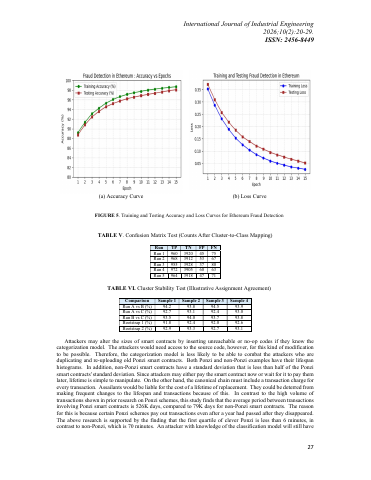
- Testing accuracy of the model increased from 88.75% to 98.07%, while testing loss decreased from 0.371 to 0.052.p.7
- The average period between transactions involving Ponzi smart contracts was measured at 526K days, compared to 79K days for non-Ponzi smart contracts.p.8
Key insights
- The K-Means clustering model differentiates fraudulent transactions from genuine activities with a 98.07% accuracy using an 80:20 train-test split.p.1
- Machine learning models trained on 30 million Bitcoin transactions achieved a recall and accuracy of 0.987.p.1
- XGBoost outperformed Decision Tree and Random Forest classifiers on Ethereum fraud detection with a 99.65% accuracy rate.p.3
- Ether-scan source code validation was utilized to collect 3,203 non-Ponzi smart contracts engaged in at least 10 transactions.p.4
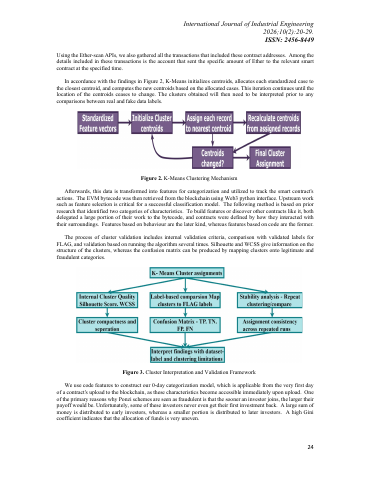
- Code-based features provide immediate 0-day categorization capabilities upon uploading a smart contract to the blockchain.p.5
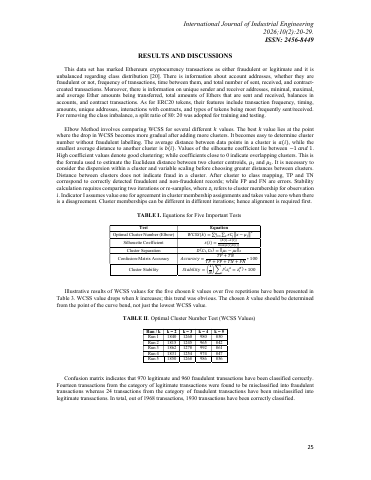
- Cluster evaluation using the Silhouette coefficient identified k = 3 as the optimal number of clusters for transaction partitioning.p.7
- Ponzi smart contracts exhibit a significantly lower first quartile transaction interval under 6 minutes compared to non-Ponzi contracts at 70 minutes.p.8
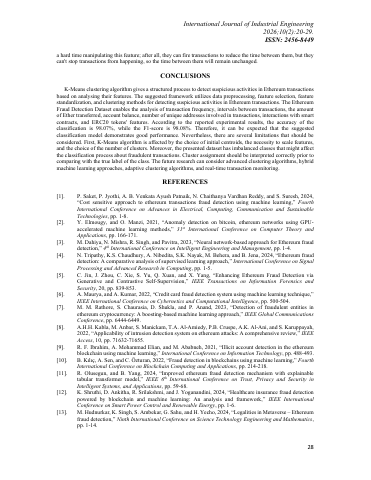
- Initial centroid selection and class imbalance present key operational limitations for K-Means clustering in cryptocurrency fraud detection.p.9
Pages
 p.1
 p.2
 p.3
 p.4
 p.5
 p.6
 p.7
 p.8
 p.9
 p.10
Topics and entities
Summary and figures generated from the document and checked automatically: every number shown appears on the cited page. Publishers can request removal.