Research on the Impact and Transformation of Artificial Intelligence Technology on the Development of Traditional Accounting Industry (Accounting Marketing and Organization)
Summary
- At Kaisheng Haofeng Agricultural Group, AI tools enabled invoice sorting that originally took 3 people 3 days to be completed by 1 person in half a day, increasing efficiency by 18 times.p.2
- By executing Python scripts via AI, automated reconciliation enabled comparing over 3,000 monthly transactions across subsidiaries, cutting the reconciliation cycle from five days to half a day.p.3
- CHINALCO Finance Company Limited improved business processing efficiency by 93% with data matching accuracy exceeding 99%, reducing annual consumption of paper vouchers by approximately 2 million.p.3
- Deployment of Yonyou BIP Financial Cloud at Fuhe Group raised asset reconciliation efficiency by 30% and achieved 99% accuracy in current account write-offs.p.3
- China Southern Power Grid Yunnan Power Grid Co., Ltd. increased reimbursement audit efficiency to 95% using an AI-powered intelligent system.p.3
- Automated labor cost recording at Kaisheng Haofeng Agricultural Group reduced workload from 7 accountants working for 6-7 days to a fully automated process.p.4
- Deloitte Australia issued a refund of 440,000 Australian dollars to the Australian government after an unverified AI-generated report contained fictitious citations and erroneous legal quotes.p.7
Key insights
- Operational automation leveraging RPA and OCR replaces manual labor in repetitive, rule-based accounting operations.p.2
- Intelligent processes powered by machine learning enhance audit efficiency and risk identification by replacing manual judgment with algorithmic routines.p.3
- Integrating AI with cloud computing enables real-time accounting by unifying business, financial, and management data flows.p.3
- Artificial intelligence shifts the focus of accounting from historical data recording to forward-looking value creation and strategic analysis.p.4
- Corporate finance departments are adopting financial shared service centers to centralize cross-departmental data processing and standardize accounting policies.p.5
- Industry talent demand is shifting from traditional bookkeeping to compound skill sets combining accounting principles with programming and data analytics.p.5
- Higher education institutions must reform accounting curricula by incorporating project-based learning and financial data analysis tools.p.6
- Blind reliance on AI tools without manual review mechanisms creates severe technical, legal, and operational risks for financial institutions.p.7
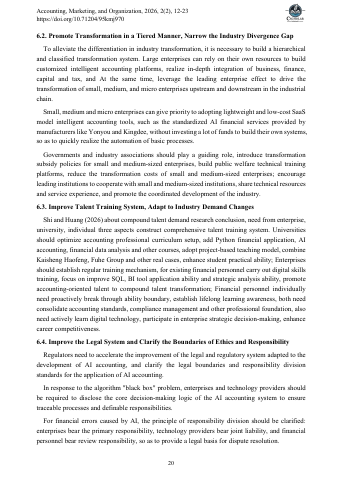
- Small and medium-sized enterprises can adopt lightweight SaaS-based AI financial accounting models to mitigate digital transformation disparities.p.9
Pages
 p.1
 p.2
 p.3
 p.4
 p.5
 p.6
 p.7
 p.8
 p.9
 p.10
 p.11
 p.12
Topics and entities
AI in financeBankingRegulationBench AccountingChina Communications Construction GroupCHINALCO Finance Company LimitedChina Southern Power Grid Yunnan Power Grid Co., Ltd.Deloitte AustraliaJiujiang Fuhe Construction Investment GroupKaisheng Haofeng Agricultural GroupLenovo GroupPricewaterhouseCoopersYonyou BIP Financial Cloud
Summary and figures generated from the document and checked automatically: every number shown appears on the cited page. Publishers can request removal.