Generation Z's Intention to Use Islamic FinTech: Extending UTAUT with Personal Innovativeness (International Journal of Management Science and Information Technology)
Summary
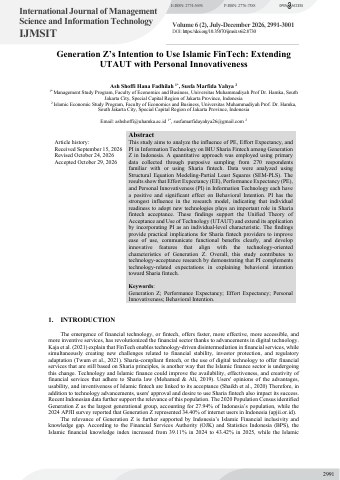
- Generation Z represented 27.94% of Indonesia's total population in the 2020 Population Census.p.1
- The 2024 APJII survey reported that Generation Z represented 34.40% of internet users in Indonesia.p.1
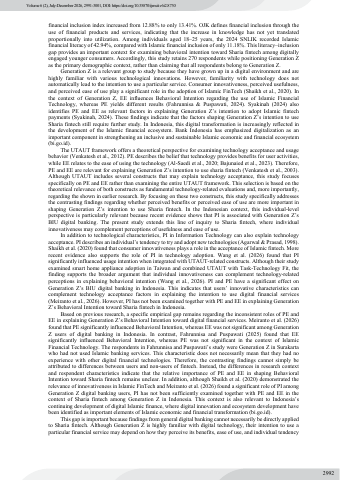
- Among individuals aged 18–25 years, the 2024 SNLIK recorded Islamic financial literacy of 42.94% compared with Islamic financial inclusion of only 11.18%.p.2
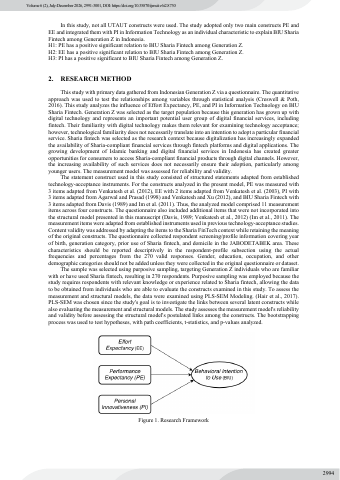
- The research analyzed primary data collected from 270 respondents using Structural Equation Modeling-Partial Least Squares (SEM-PLS).p.1
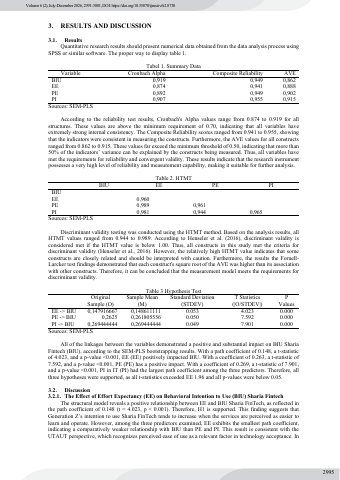
- Personal Innovativeness in IT showed the strongest influence on Behavioral Intention with a path coefficient of 0.269 and a t-statistic of 7.901.p.5
- Performance Expectancy positively influenced Behavioral Intention with a path coefficient of 0.263 and a t-statistic of 7.592.p.5
- Effort Expectancy positively impacted Behavioral Intention with a path coefficient of 0.148 and a t-statistic of 4.023.p.5
Key insights
- Personal Innovativeness in Information Technology exerts the strongest positive effect on Generation Z's intention to adopt Sharia fintech.p.1
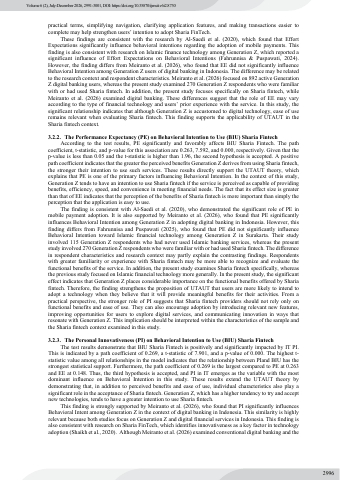
- Performance Expectancy has a greater influence on behavioral intention than Effort Expectancy, indicating that functional benefits are more critical than perceived ease of use.p.6
- Bootstrapping results confirmed that Effort Expectancy, Performance Expectancy, and Personal Innovativeness all have statistically significant positive impacts on Behavioral Intention.p.5
- Measurement model testing showed strong internal consistency and validity, with Cronbach's Alpha ranging from 0.874 to 0.919 and AVE values ranging from 0.862 to 0.915.p.5
- A substantial literacy-inclusion gap exists among Indonesian youth aged 18–25, where 42.94% financial literacy contrasts with only 11.18% financial inclusion.p.2
- High general familiarity with digital technology among Generation Z does not automatically convert into an intention to adopt specific financial products.p.2
Pages
 p.1
 p.2
 p.3
 p.4
 p.5
 p.6
 p.7
 p.8
 p.9
 p.10
 p.11
Topics and entities
Summary and figures generated from the document and checked automatically: every number shown appears on the cited page. Publishers can request removal.