Forecasting Bank Credit to Small Business with Short Panels: Partial Pooling Versus Country-Specific Trends, With An Application to Uzbekistan (Academic Journal of Digital Economics and Stability)
Summary
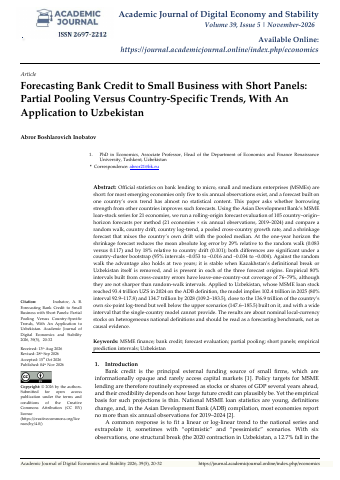
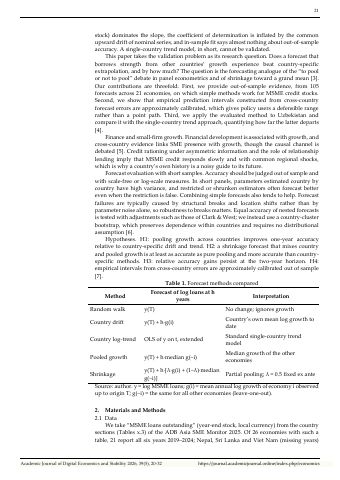
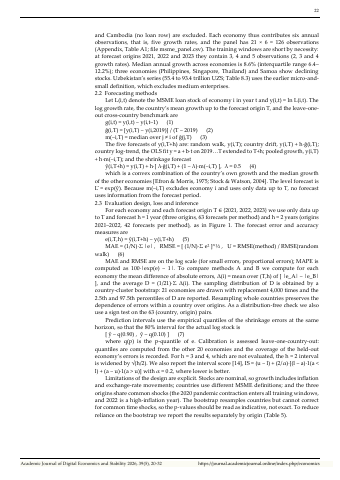
- The study evaluates rolling-origin forecasts across 21 economies using Asian Development Bank MSME loan-stock data for 2019–2024.p.1
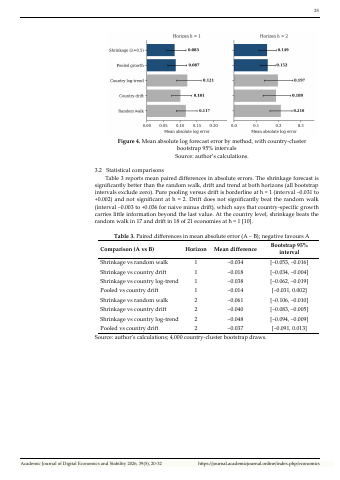
- At a one-year horizon, the shrinkage forecast reduces the mean absolute log error by 29% compared to a random walk baseline (0.083 versus 0.117).p.1
- The shrinkage approach cuts the one-year mean absolute log error by 18% compared to country drift (0.083 versus 0.101).p.1
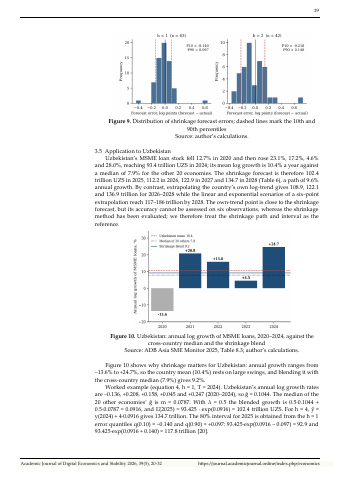
- Empirical 80% intervals constructed from cross-country forecast errors achieve leave-one-country-out coverage of 76–79%.p.1
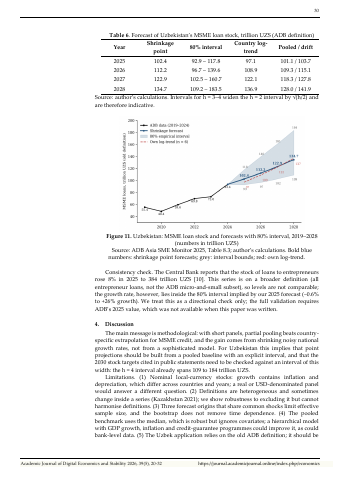
- Applying the shrinkage model to Uzbekistan projects its MSME loan stock from 93.4 trillion UZS in 2024 to 102.4 trillion UZS in 2025.p.1
- By 2028, Uzbekistan's MSME loan stock is projected to reach 134.7 trillion UZS under the shrinkage model, with an 80% interval of 109.2–183.5 trillion UZS.p.1
Key insights
- Single-country log-trend models performed worst out of sample among evaluated methods, yielding a one-year mean absolute log error of 0.121.p.5
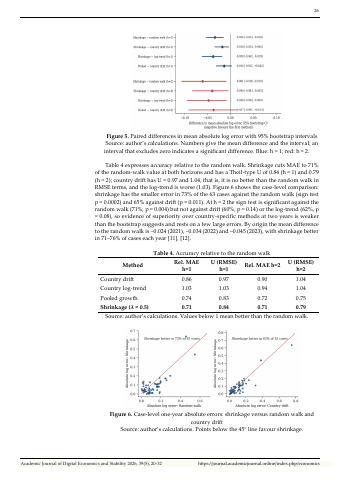
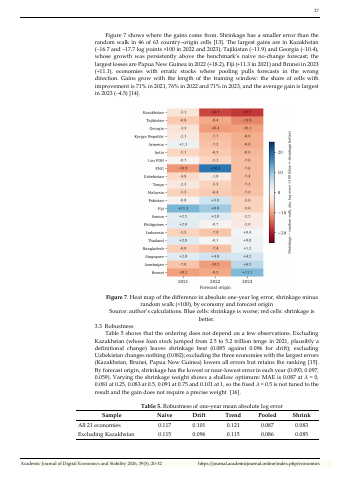
- Shrinkage forecasting out-performed the random walk baseline in 17 of 21 economies at the one-year forecast horizon.p.6
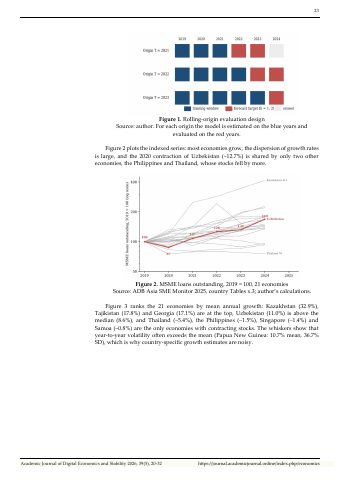
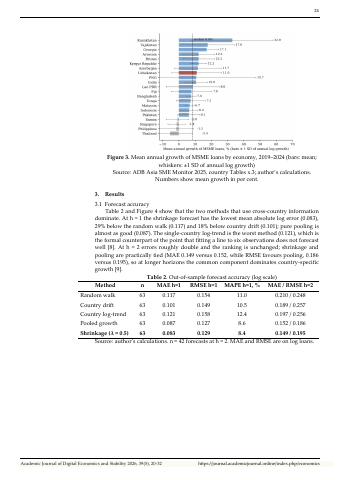
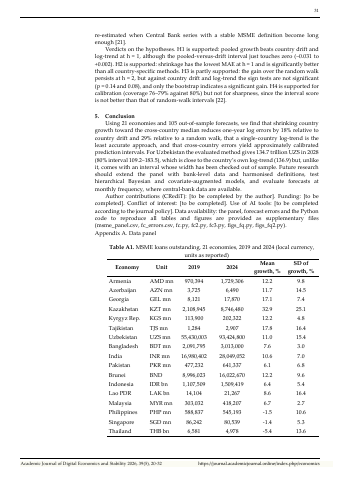
- Thailand recorded the strongest annual loan stock contraction among evaluated countries, averaging -5.4% per year.p.4
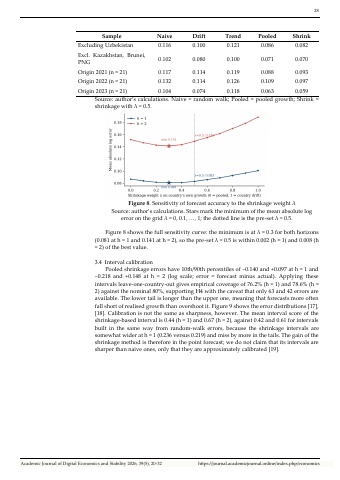
- Sensitivity analysis indicates that setting the shrinkage weight lambda to 0.3 yields the lowest mean absolute log error at both 1-year (0.081) and 2-year (0.141) horizons.p.9
- Uzbekistan's annual MSME loan growth fluctuated significantly between 2020 and 2024, ranging from -12.7% to +28.0%.p.10
Pages
 p.1
 p.2
 p.3
 p.4
 p.5
 p.6
 p.7
 p.8
 p.9
 p.10
 p.11
 p.12
 p.13
Topics and entities
Summary and figures generated from the document and checked automatically: every number shown appears on the cited page. Publishers can request removal.