Financial Investors and For-Profit Providers as New Players in Global Healthcare: The Politics and Practices of Health System Financialisation (Health Economics Policy and Law)
Summary
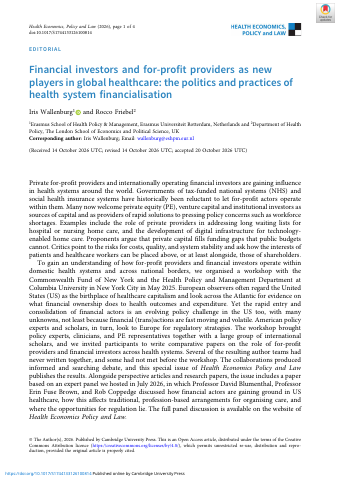
- An international workshop was organized in May 2025 to evaluate the impact of for-profit providers and financial investors in healthcare across national borders.p.1
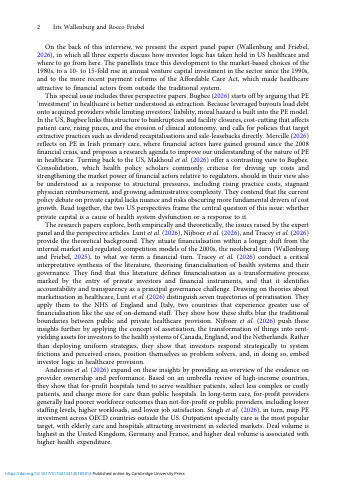
- An expert panel conducted in July 2026 examined how investor logic has increasingly entered the US healthcare system.p.1
- Annual venture capital investment in the healthcare sector has experienced a 10- to 15-fold rise since the 1990s.p.2
- In Irish primary care, financial actors have systematically expanded their involvement following the 2008 financial crisis.p.2
- Research by Lunt et al. categorizes 7 distinct trajectories of privatization that blur boundaries between public and private healthcare provision.p.2
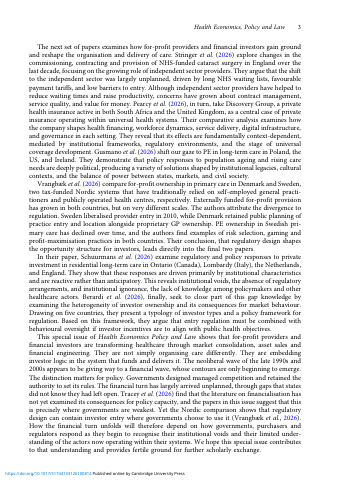
- Sweden liberalised its primary care provider entry in 2010, whereas Denmark maintained public planning alongside proprietary GP ownership.p.3
Key insights
- Governments are increasingly welcoming private equity, venture capital, and institutional investors to address public healthcare funding gaps and workforce shortages.p.1
- Market-based policies from the 1980s and Affordable Care Act payment reforms helped attract non-traditional financial actors into US healthcare.p.2
- Leveraged buyouts build moral hazard into healthcare private equity by loading debt onto acquired providers while limiting investor liability.p.2
- Provider market consolidation can act as a response to rising practice costs, stagnant reimbursement, and administrative complexity.p.2
- Investors utilize assetisation by transforming health system components into rent-yielding assets while offering solutions to system friction.p.2
- Contracting independent sector providers for cataract surgery reduced waiting times in England, but generated concerns over service quality and contract oversight.p.3
- Regulatory frameworks determine the opportunity structures for investors, as illustrated by divergent primary care outcomes in Denmark and Sweden.p.3
- Policy responses to private investment in residential long-term care are predominantly reactive, revealing institutional voids and lack of regulatory knowledge.p.3
Pages
 p.1
 p.2
 p.3
 p.4
Topics and entities
Summary and figures generated from the document and checked automatically: every number shown appears on the cited page. Publishers can request removal.