Financial inclusion, rural entrepreneurship and women’s empowerment: Insights from the SVEP experience in Kerala (Social Science & Humanities International)
Summary
- SVEP implementation blocks receive an average financial allocation of Rs. 5-6 crore per block, with around Rs. 2.5 crore earmarked as Community Enterprise Funds (CEF).p.2
- Through the Kudumbashree network, SVEP has successfully promoted more than 30,000 microenterprises in Kerala by 2025.p.2
- The study evaluated a sample of 364 rural women entrepreneurs across three districts: 96 in Wayanad, 139 in Thiruvananthapuram, and 129 in Kottayam.p.7
Key insights
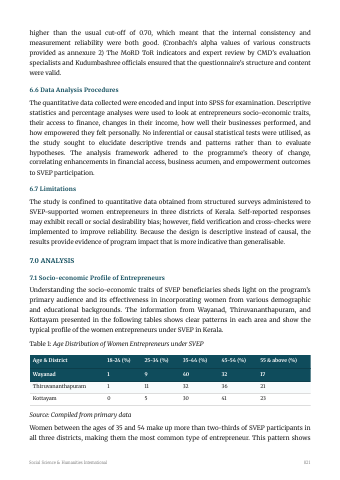
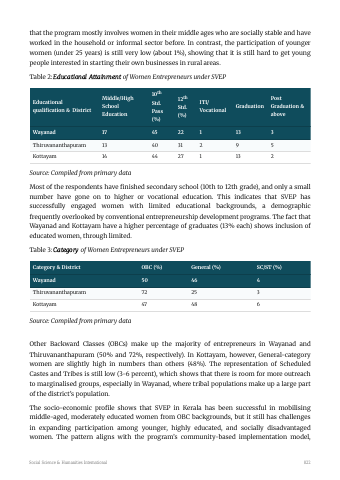
- Women entrepreneurs aged 35 to 54 represent over two-thirds of SVEP participants, while those under 25 account for only about 1%.p.8
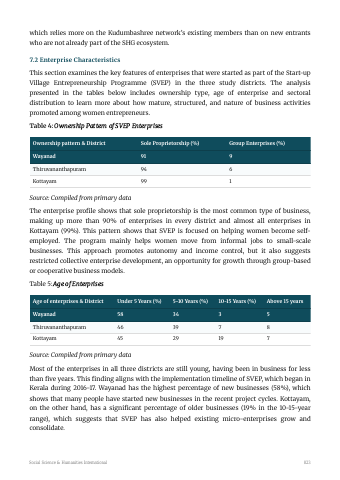
- Over 90% of SVEP-supported microenterprises operate as sole proprietorships across all surveyed districts.p.10
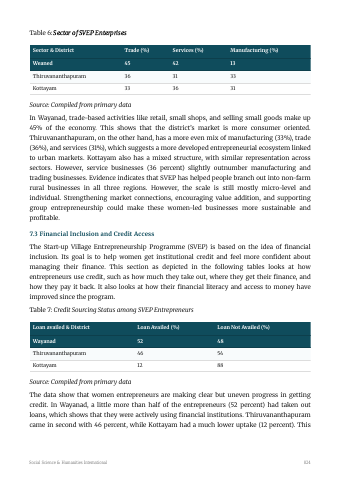
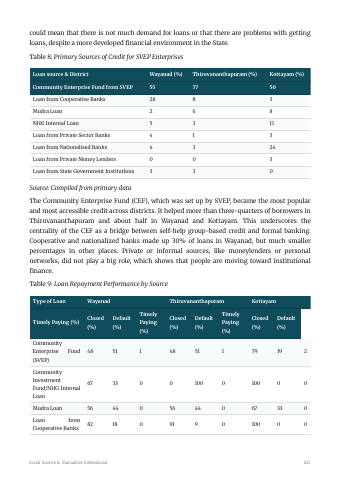
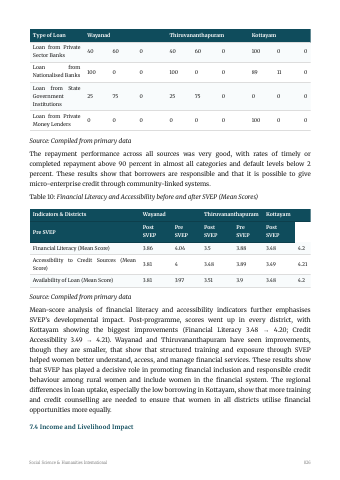
- Loan uptake rates varied sharply across regions, reaching 52% in Wayanad, 46% in Thiruvananthapuram, and 12% in Kottayam.p.11
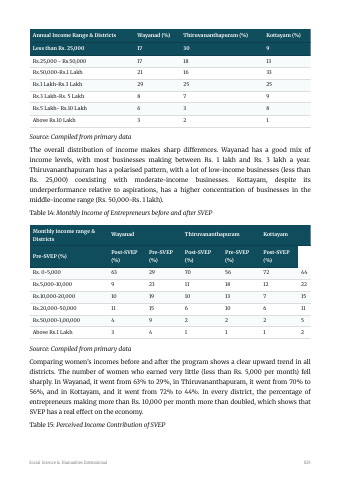
- In Wayanad, the proportion of women in the lowest monthly income bracket of Rs. 0-5,000 fell from 63% pre-SVEP to 29% post-SVEP.p.15
- Financial literacy mean scores improved in all districts post-programme, rising from 3.48 to 4.20 in Kottayam.p.13
Pages
 p.1
 p.2
 p.3
 p.4
 p.5
 p.6
 p.7
 p.8
 p.9
 p.10
 p.11
 p.12
 p.13
 p.14
 p.15
 p.16
 p.17
 p.18
 p.19
 p.20
 p.21
 p.22
 p.23
Topics and entities
Summary and figures generated from the document and checked automatically: every number shown appears on the cited page. Publishers can request removal.