DL-RL: Dual-Layer Graph Neural Networks with Curriculum Reinforcement Learning for Financial Fraud Detection (Academic research)
Summary
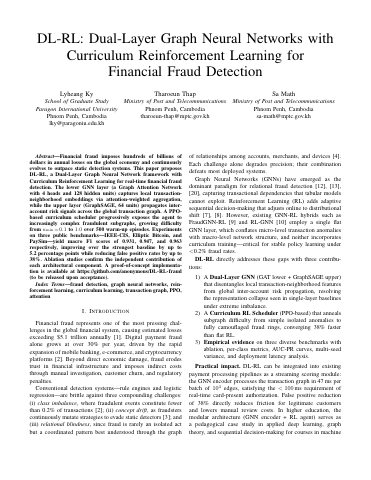
- Financial fraud imposes estimated annual global losses exceeding $5.1 trillion, while digital payment fraud grows at over 30% per year.p.1
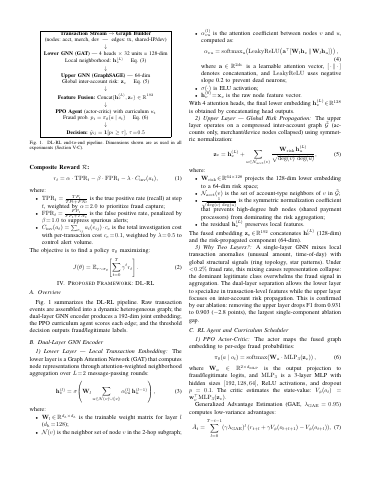
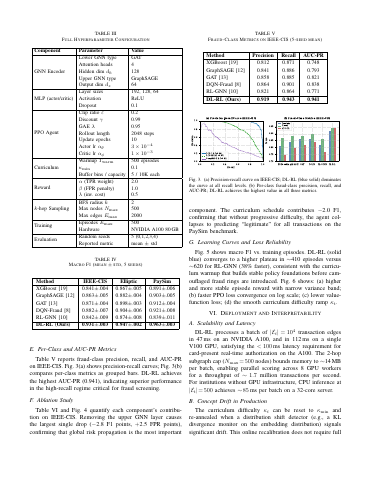
- DL-RL features a lower Graph Attention Network layer with 4 heads and 128 hidden units alongside an upper GraphSAGE layer with 64 units.p.1
- A PPO-based curriculum scheduler progressively anneals subgraph difficulty from κmin = 0.1 to 1.0 over 500 warm-up episodes.p.1
- The framework reduces false positive rates by up to 38% while improving over the strongest baseline by up to 5.2 percentage points.p.1
- The GNN encoder processes a batch of 104 transaction edges in 47 ms on an NVIDIA A100 GPU, satisfying latency requirements under 100 ms.p.5
Key insights
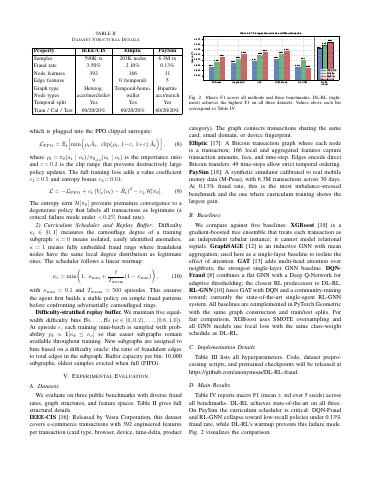
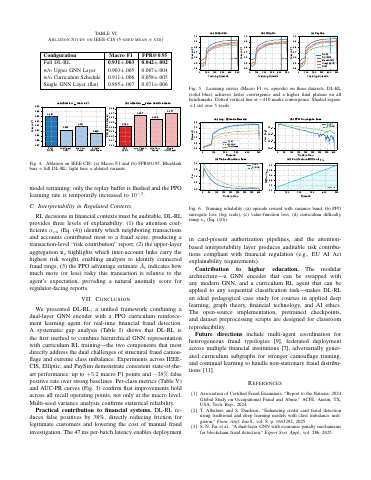
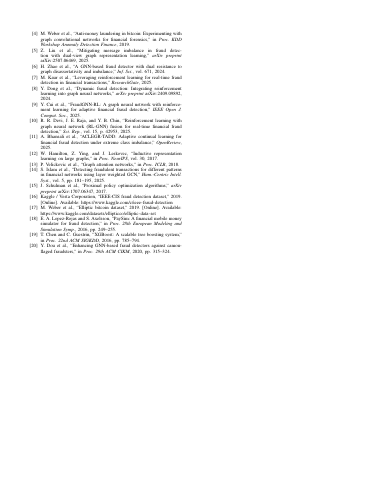
- DL-RL converges to a stable performance plateau in approximately 410 episodes, which is 38% faster than flat RL.p.5
- DL-RL achieves an AUC-PR score of 0.941 on IEEE-CIS, outperforming all single-layer GNN and RL baselines.p.5
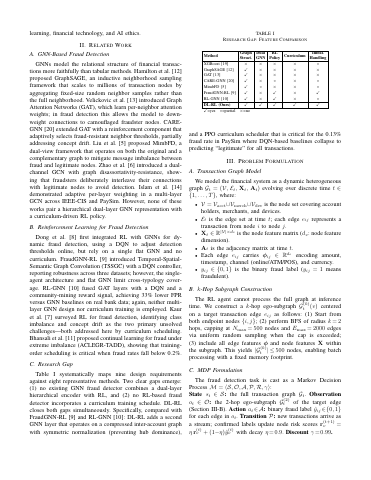
- Sub-graph sampling caps node count at Nmax = 500 nodes and edge count at Emax = 2000 edges per transaction batch.p.2
- Memory usage is bounded to approximately 14 MB per batch, enabling throughput of 1.7 million transactions per second across 8 GPU workers.p.5
Pages
 p.1
 p.2
 p.3
 p.4
 p.5
 p.6
 p.7
Topics and entities
Summary and figures generated from the document and checked automatically: every number shown appears on the cited page. Publishers can request removal.