Deep Transformer Architectures for Real-Time E-Payment Fraud Detection Under Class Imbalance (International Journal of Informatics and Communication Technology (IJ-ICT))
Summary
- Global losses from electronic payment fraud are estimated to reach around USD 48 billion globally by 2025.p.1
- Total global e-commerce sales are projected to reach over $7.5 trillion by 2025 and could exceed $9 trillion by 2027.p.1
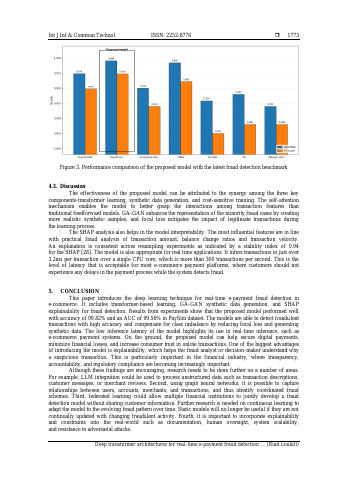
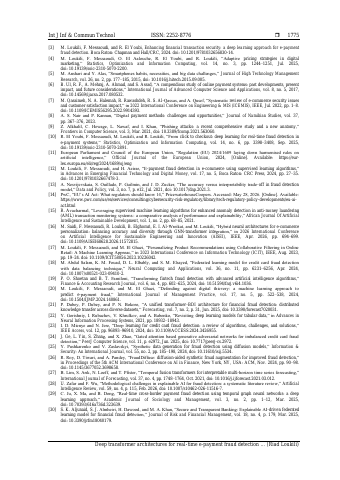
- The proposed deep transformer architecture achieves an accuracy of 99.82% and an AUC-ROC of 99.56% on the PaySim benchmark dataset.p.1
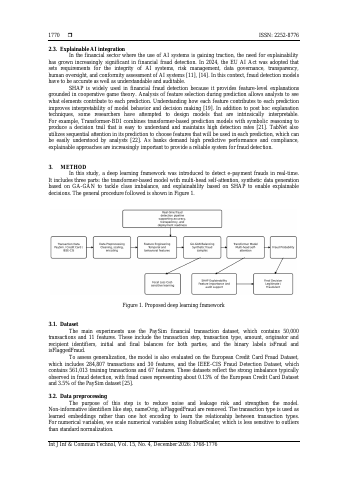
- The PaySim dataset includes 50,000 transactions and 11 features, where fraudulent transactions account for 3.5% of cases.p.3
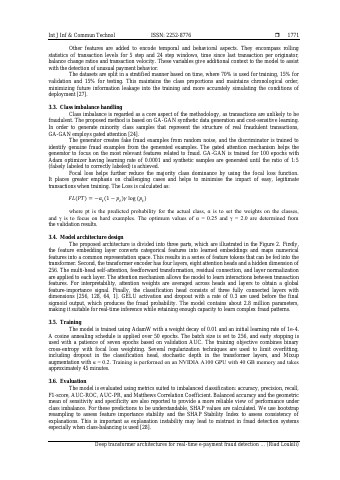
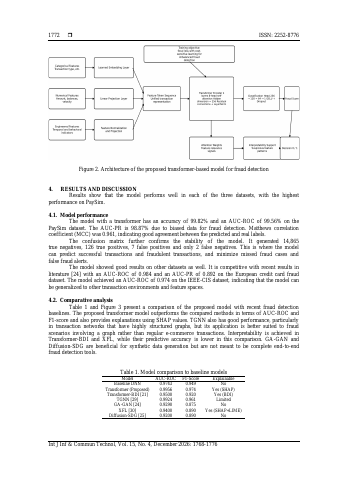
- The transformer model architecture comprises approximately 2.8 million parameters, configured with 4 layers and 8 attention heads.p.4
- Model inference requires just over 3.2ms per transaction on a single CPU core, enabling real-time processing of over 300 transactions per second.p.6
Key insights
- The proposed transformer model achieves an AUC-ROC of 0.984 on the European credit card dataset and 0.974 on the IEEE-CIS dataset.p.5
- PaySim evaluation results yield 14,865 true negatives, 126 true positives, 7 false positives, and 2 false negatives.p.5
- GA-GAN uses gated attention to generate synthetic fraud samples for 100 epochs until reaching a 1:5 sample ratio.p.4
- Focal loss parameters alpha equal to 0.25 and gamma equal to 2.0 were determined as optimal from validation experiments.p.4
- The European Union AI Act will be fully in force by August 2026, creating regulatory requirements for transparency and human oversight in financial AI decision-making.p.2
- Feature explanations generated using SHAP achieved a stability index of 0.94 across resampling experiments.p.6
Pages
 p.1
 p.2
 p.3
 p.4
 p.5
 p.6
 p.7
 p.8
 p.9
Topics and entities
Summary and figures generated from the document and checked automatically: every number shown appears on the cited page. Publishers can request removal.